What should you look for when choosing?
If you’re having coffee on your own, start by deciding what matters most to you: the packaging, the flavour, the nutritional information or the allergens. Then compare the portions and the label of the variety that suits you.
| What to consider |
What to check |
Who might it matter to? |
| Portion and storage |
Check the number of servings, whether the biscuits are individually wrapped and how to store an opened pack. Albert Heijn lists around nine servings in 150 g of Verkade Nobo Sprits Naturel and recommends resealing the pack after opening. |
If I’m having coffee on my own, I want to be able to take one biscuit without leaving the rest unprotected. Packaging and storage would be the first consideration for around 33% of consumers. |
| Plain or milk chocolate |
Check whether you want a chocolate coating. According to Verkade and Albert Heijn, the milk chocolate variety has a coating containing 15% milk chocolate; the plain variety has no coating. |
With my coffee, I mainly want to know whether I prefer the classic flavour or milk chocolate. For around 25% of consumers, flavour would come first. |
| Nutritional information |
Compare the nutritional information per serving and per 100 g, especially if the stated serving sizes differ. Verkade lists 4.0 g of sugars per plain biscuit and 4.9 g per milk chocolate biscuit. |
If I often have a biscuit with my coffee, I want to take the portion into account alongside what else I eat. For around 25% of consumers, nutritional information would be the main factor in their choice. |
| Allergens |
Read the current ingredients list and allergen warnings. Albert Heijn lists milk and wheat for both Verkade varieties; soya is also listed for the milk chocolate variety. |
If I need to avoid an allergen, checking the label takes priority over my flavour preference. For around 17% of consumers, this check would be the most important consideration. |
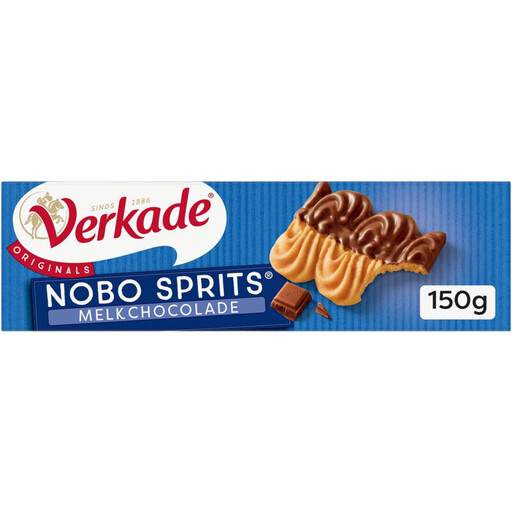
Milk chocolate spritz biscuits at Joybuy
If you prefer milk chocolate with your coffee, take a look at this 150 g pack from Verkade. If you’re having coffee on your own, check the serving size and storage information on the label before you tuck in.
 No image available
Verkade Nobo Spritzed Milk Chocolate, 150 g
For anyone who fancies a milk chocolate spritz biscuit with their coffee. The pack contains 150 g; if you want to have one at a time, check the serving size, allergens and storage instructions on the label.
View at Joybuy
Frequently asked questions
Is one Verkade Nobo Sprits Naturel a set serving?
Albert Heijn lists a serving of around 16.8 g for Verkade Nobo Sprits Naturel, with approximately nine servings per 150 g pack. This product serving size is useful when comparing nutritional information; it isn’t a recommended amount to eat.
Which allergens should I check for in these spritz biscuits?
For the Verkade Naturel variety reviewed, Albert Heijn lists milk, wheat and cereals containing gluten, with the possible presence of nuts and sesame. Verkade Melkchocolade also lists soya and lactose. Always check the current allergen information on the packaging before eating.
How should I store an opened pack of spritz biscuits?
For Verkade Nobo Sprits Naturel, Albert Heijn recommends storing the pack in a cool, dry place and resealing it after opening. This is especially useful if you’re enjoying the biscuits over several coffee breaks; check the storage instructions for any other variety.
Does allergen information also have to be provided for food sold online?
Yes. In the Netherlands, allergen information is part of the mandatory labelling for prepacked foods. The Netherlands Food and Consumer Product Safety Authority says it must appear on the label; Ondernemersplein says mandatory label information must also be available online. Check this information before buying, and check the label on the pack you receive before eating.
Is a spritz biscuit suitable as an everyday snack for an older person?
A spritz biscuit isn’t a general substitute for a snack chosen for its nutritional value. The Netherlands Nutrition Centre advises older people to limit products that are high in energy and low in nutrients, such as snacks. Whether, and how often, a biscuit fits depends on your overall diet and any personal dietary advice you’ve been given.


