
Careful cushion owner
Wants to check what their cushion and its care label allow before wet cleaning. This check comes before choosing a machine; BISSELL bases its cleaning advice on the upholstery code.


First, check whether your cushion’s care label allows wet cleaning: a spot cleaner won’t make a water-sensitive fabric suitable for cleaning with water. A compact model may be enough for a few small marks and limited storage space; if you regularly clean several cushions, compare tank capacity, attachments and reach too. These features alone don’t guarantee stain removal or a particular drying time.
Wants to check what their cushion and its care label allow before wet cleaning. This check comes before choosing a machine; BISSELL bases its cleaning advice on the upholstery code.
Needs a machine for spot-cleaning suitable upholstery and compares attachments, reach and the ability to extract used water. Rowenta, BISSELL and Kärcher describe models and accessories for upholstery.
Looks at tank capacity and ease of maintenance when cleaning several suitable cushions one after another. Rowenta lists different tank sizes for its Clean It models.
Start with the cushion’s care label, then decide whether you’ll mainly be treating small marks or cleaning several seat cushions one after another.
| What to consider | What to look for when buying | Who should give this more weight? |
|---|---|---|
| Fabric suitability | Read the cushion’s care instructions and the instructions for the machine and cleaning solution. BISSELL lists W and WS codes for its own water-based machines and formulas; this doesn’t mean every fabric or machine is suitable. | If I want to avoid damage, I’ll first check whether my seat cushion can be wet-cleaned. Around 33% of consumers put material suitability first. |
| Spot stains and reach | Check which upholstery and crevice tools come with the exact model, and whether the hose and power cord can reach the seat. | If there’s a mark on a seat or in a seam, I want to use the right attachment without putting the machine on the cushion. Around 27% of consumers put spot-treating pet stains first. |
| Residual moisture and drying time | Check how the machine extracts water, how the dirty-water tank is emptied and where the cushion can dry. The stated motor power won’t tell you how much moisture will remain in your fabric. | If I want to use the cushion again quickly, I’ll focus on water extraction and finding a suitable place for it to dry. Around 20% of consumers put residual moisture first. |
| Refilling, emptying and storage | Compare the clean- and dirty-water tank capacities of the exact model, its dimensions and the maintenance accessories included. Rowenta lists 1.5- and 0.85-litre tanks for the IN3020F0, and 2.3- and 1.5-litre tanks for the IN5020F0. | When cleaning several cushions, I want to stop less often; for occasional use, a machine that’s easy to store matters more. Around 20% of consumers prioritise ease of use and storage. |
Your cushion’s care instructions determine whether wet cleaning is suitable. A general product description doesn’t override them.
Before buying or using a machine, check the cushion’s care label and the cleaning solution’s instructions.
A figure on the packaging won’t predict how much moisture will remain in your upholstery after cleaning. The cushion may be out of use temporarily while it dries.
Check the manual for instructions on extracting water with the machine, and plan a place where the cushion can dry.
The SpotClean C5 and SpotClean ProHeat are product ranges for spot cleaning, including upholstery. Features vary by model.
According to Rowenta, the Clean It Compact IN3020F0 is designed for compact everyday use; the IN5020F0 has larger tanks and various attachments.
According to Kärcher, the SE 3 Compact Home N1 is a spray-extraction cleaner for items including upholstered furniture.
The 3000 Series XW3193/11R1 mentioned here is a refurbished model; the Dutch product information lists a nozzle for soft surfaces, including sofas.
These Joybuy products are designed for spot-cleaning upholstery with water; the selection also includes models with dual tanks. Before use, check that your seat cushion’s care label allows wet cleaning.
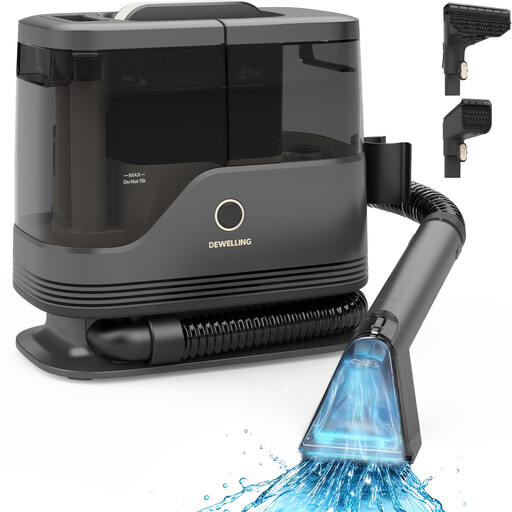 Image unavailable
The product name describes a portable upholstery cleaner with a self-cleaning function on the handle.
Stated power: 400 W. Stated suction pressure: 13 kPa.
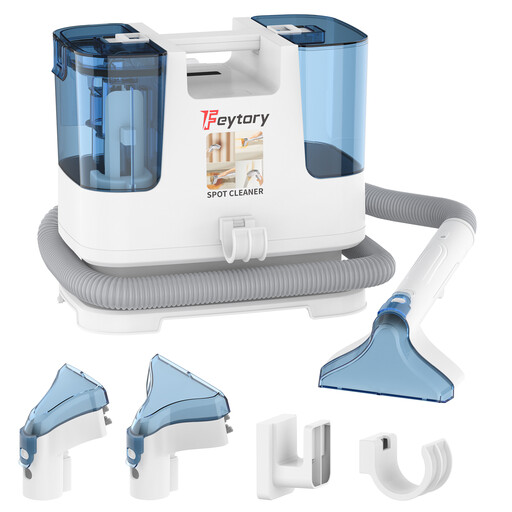 Image unavailable
The product name lists sofas, carpets and car interiors as suitable uses; check your cushion’s care label first.
Stated suction pressure: 15 kPa. The product name lists 0.6- and 1.5-litre water tanks.
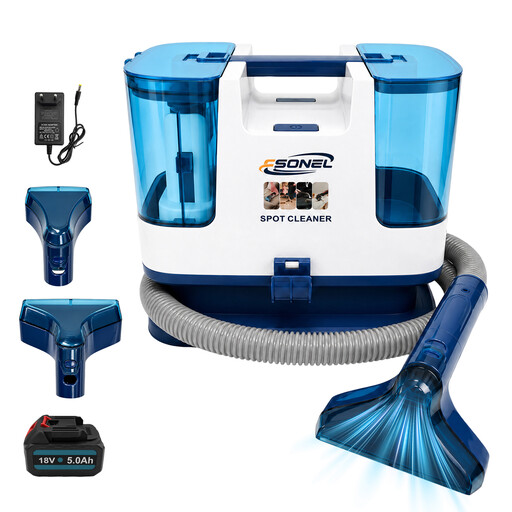 Image unavailable
The product name describes a handheld, cordless cleaner for wet-cleaning fabrics, including sofas and car seats.
Stated power: 400 W. Stated suction pressure: 17 kPa. The product name identifies this model as the version with 1 battery.
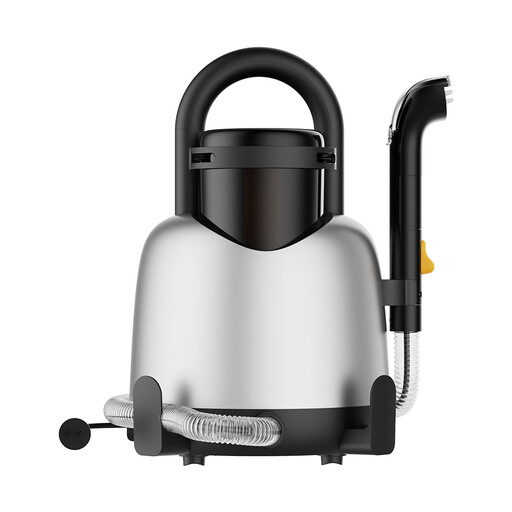 Image unavailable
The product name lists fabric and carpet as suitable uses and mentions a set with five attachments. Check that the cleaning mode you choose is suitable for your seat cushion’s care instructions.
Stated power: 1700 W. Stated suction pressure: 13 kPa. The product name lists steam and hot-water rinsing functions; check that the upholstery can withstand the treatment you choose.
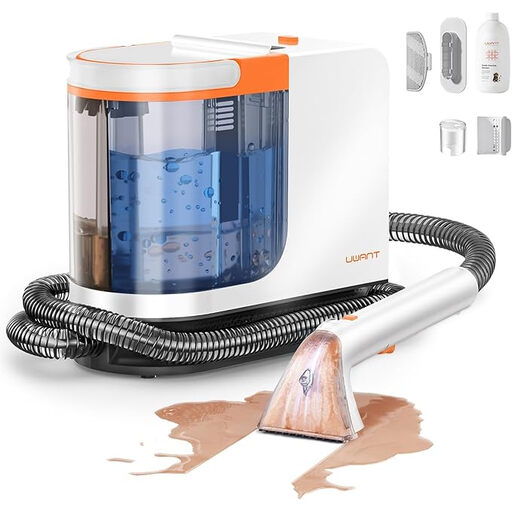 Image unavailable
The product name describes a portable cleaner for spot-cleaning items including sofas and upholstery, with a self-cleaning function.
Stated suction pressure: 18 kPa.
No. Check the cushion’s care instructions first. BISSELL lists W and WS codes as suitable for its own water-based machines and formulas; this brand-specific guidance doesn’t automatically apply to every fabric or machine.
First, remove any loose, dry dirt and pet hair. For the IN3020F0, Rowenta lists a pet hair remover to use before wet cleaning.
Empty and clean the machine according to the manual for the exact model. Kärcher lists a flushing function for the SE 3 Compact Home N1; Rowenta lists an auto-clean accessory for the IN3020F0. Follow the instructions for the tanks, hose and drying the machine before storing it too.
Not automatically. According to the Dutch government, there’s no fixed statutory guarantee period in the Netherlands, but you are entitled to a product that meets the terms of the contract. The retailer is your point of contact if a product is faulty; compare extra cover based on what it actually adds.
If the applicable EU rules require the machine to carry a CE mark, the manufacturer uses it to indicate that the product complies with those rules. According to the European Commission, CE marking isn’t a certificate of approval from a central EU authority, and it says nothing about stain removal on your cushion.