
Cautious footstool owner
You want to tackle dirt from your move without damaging unfamiliar or delicate upholstery with wet cleaning. Check the footstool’s care instructions first; Beliani Netherlands explains when water-based cleaning is suitable.


A spray-extraction cleaner is suitable only for a fabric footstool whose care instructions allow wet cleaning. If you’re unsure, ask the furniture manufacturer for advice. For a few stains, a compact model with a suitable upholstery tool may be enough. If you have several footstools or seams to clean, compare tank capacity, reach and attachments. Manufacturer specifications can help you choose, but they can’t predict how a particular fabric will react or dry.
You want to tackle dirt from your move without damaging unfamiliar or delicate upholstery with wet cleaning. Check the footstool’s care instructions first; Beliani Netherlands explains when water-based cleaning is suitable.
You occasionally treat a localised stain on a footstool that can be wet-cleaned, and want a machine that’s easy to grab and put away.
After your move, you want to clean several suitable seats and seams, so you’re looking at tank capacity, reach and the attachments included.
Suitable if: you want to treat a few stains on a footstool that can be wet-cleaned. A compact model with a suitable upholstery tool may be enough.
Keep in mind: compare the tank and storage space with your needs; a compact design says nothing about cleaning performance.
Suitable if: you want to clean several footstools, larger upholstered areas or seams one after another.
Keep in mind: a larger tank or more accessories don’t prove that a particular fabric will come up cleaner or dry faster.
Suitable if: the care instructions rule out water, or you’re not sure which cleaning method is allowed.
Keep in mind: a spot cleaner isn’t the right treatment for that footstool. Follow the recommended dry-cleaning method or ask the furniture manufacturer for advice.
| Concern | What to look for | Who is this important to? |
|---|---|---|
| Avoid damaging the upholstery | Read the care instructions for the exact footstool. If wet cleaning is allowed, first test colourfastness on an inconspicuous area. | If I don’t know whether my footstool can handle water after a move, I want to avoid damaging the fabric first and foremost. Around 36% of consumers prioritise checking whether the upholstery is suitable. |
| Localised stains and storage | Compare the dimensions, tank and upholstery tool actually included with the exact model. | For a few localised stains, I want a machine that’s easy to grab and put away. Around 29% of consumers prioritise cleaning small stains and compact storage. |
| Reaching several areas and seams | Check the clean- and dirty-water tanks, hose and cord reach, and which attachments are included in the box. | If I want to clean several footstools or hard-to-reach seams, reach and suitable attachments matter to me. Around 21% of consumers want to tackle several seats and seams. |
| Maintenance and running costs | Read the manual and check which cleaning solution and maintenance accessories are compatible with the full model number. | If I mainly want to know how much maintenance the machine needs and what supplies I’ll need later, I look beyond the first cleaning session. Around 14% of consumers prioritise maintenance and running costs. |
An upholstery tool doesn’t tell you which cleaning method the fabric on a particular footstool can handle. Using the wrong method could damage it.
Read the footstool’s care instructions first. If wet cleaning is allowed, test an inconspicuous area.
If you have several footstools or seams to clean, the dirty-water tank, tool and reach also affect how you can tackle the job.
Compare the full model and box contents with the scale of your task, not just the largest tank capacity.
After use, you’ll need to remove dirty water and residue as directed in the manual. Compatible cleaning solution or replacement parts may add to your costs later.
Before buying, check which solutions and parts are compatible with the full model number, and follow the maintenance instructions.
The SpotClean C5 3861N is a compact option for localised stains on suitable upholstery.
The Clean It Compact IN3010F0 is a compact option. According to Rowenta, the Clean It IN5011F0 has larger tanks and several brush widths for larger suitable areas.
The SE 3 Compact Home N1 is a spray-extraction option with separate tools for upholstery and crevices.
The 3000 Series XW3193/11R1 reviewed here is described as a refurbished version with a 3-in-1 tool for soft surfaces.
This Joybuy selection includes portable cleaners for upholstery and spot cleaning. Use one on a footstool only if its care instructions allow wet cleaning.
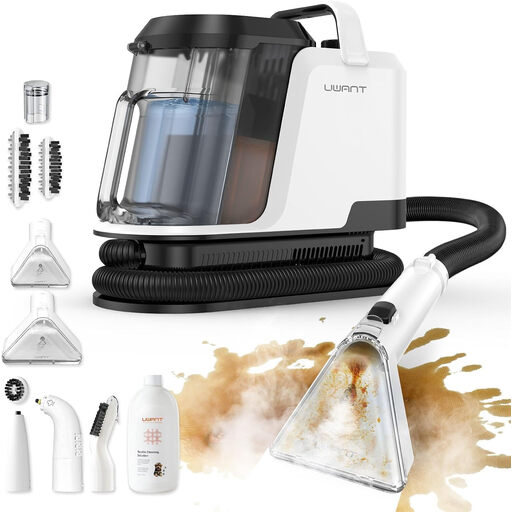 No image available
Consider this model only for a footstool whose care instructions allow wet cleaning.
The product name lists 18 kPa, 600 W and 3-in-1.
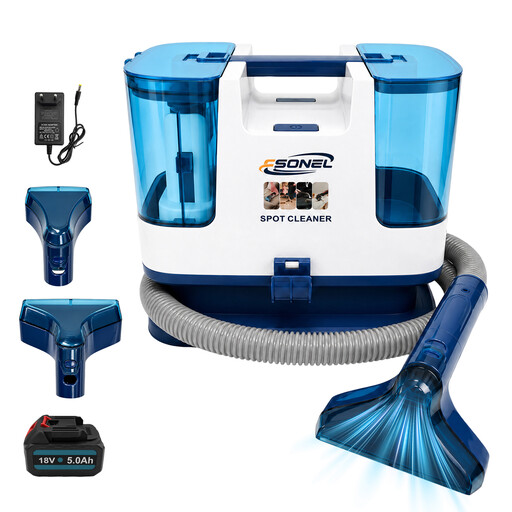 No image available
This portable model is an option for spot-cleaning sofa or footstool upholstery when wet cleaning is allowed.
The product name lists 400 W, 17 kPa and a single battery.
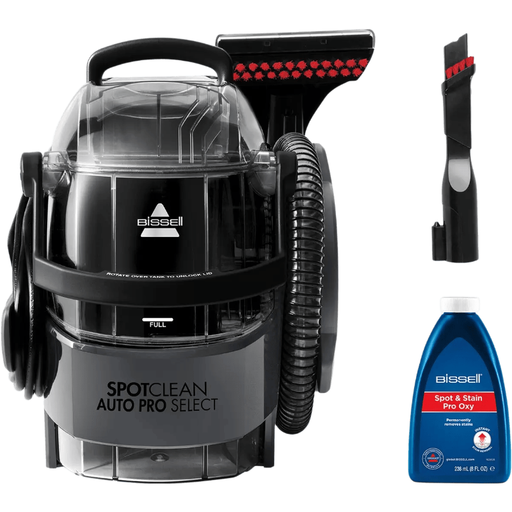 No image available
An option for spot-cleaning suitable upholstery; check that the care instructions allow wet cleaning before use.
The product description lists tools for upholstery and crevices.
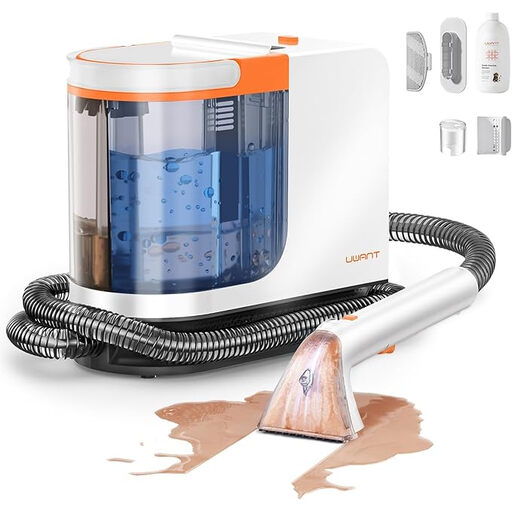 No image available
The product name mentions sofas and spot cleaning. Use it on a footstool only if wet cleaning is allowed by the furniture care instructions.
The product name lists 18 kPa, self-cleaning, and included accessories and cleaning solution.
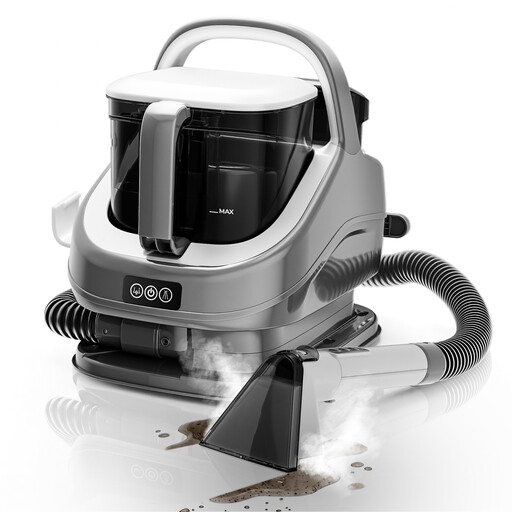 No image available
This cleaner is listed for sofas and upholstery. Always follow the care instructions for a footstool and use it only on suitable fabric.
The product name lists three settings, dual water tanks, 13 kPa and 1,300 W. This model isn’t suitable for non-water-resistant fabrics.
No. Follow the footstool’s care instructions. A W or WS code may mean water-based cleaning is suitable, provided you follow the rest of the furniture care instructions and test colourfastness on an inconspicuous area first. BISSELL advises against wet cleaning with an S or X code. If the label is missing, ask the furniture manufacturer for advice.
Before wet cleaning, remove loose dirt with a vacuum cleaner and, if wet cleaning is allowed, test a hidden area. Afterwards, empty and maintain the machine according to the manual for the version you’ve chosen; an included rinse accessory doesn’t replace those instructions.
You don’t need extra cover to have your statutory rights when buying as a consumer in the Netherlands. According to the Dutch government, there is no fixed statutory two-year guarantee period for every product. If a product is faulty, the seller must provide an appropriate solution.
The Netherlands Food and Consumer Product Safety Authority states that CE marking is mandatory for electrical consumer products. Electrical equipment within the applicable voltage range must also meet the relevant safety requirements. CE marking isn’t an independent test of stain removal, so check the details for the specific machine.
For online consumer purchases, you generally have a statutory cooling-off period of up to 14 days after delivery. The Netherlands Authority for Consumers and Markets lists some exceptions. Check the applicable returns terms and, before using the machine, make sure it and the cleaning method are suitable for your footstool.