
Cautious pouffe owner
You want to check whether the upholstery can handle water before you start, and avoid getting it too wet. Follow the care instructions for your exact pouffe.


Only buy a spray-extraction cleaner if your pouffe’s care instructions allow wet cleaning; otherwise, it isn’t the right choice for that pouffe. If stains keep coming back, a compact model with an upholstery nozzle could be a good fit, provided you have room to store it. For occasional use, you could also consider hiring a cleaner or washing a removable cover in line with its care instructions. Ashley’s upholstery care advice and IKEA’s instructions for a specific pouffe show why you should check the fabric, cover and frame separately.
You want to check whether the upholstery can handle water before you start, and avoid getting it too wet. Follow the care instructions for your exact pouffe.
You deal with small stains now and then, but also need to be able to store the cleaner, hose and nozzles in your rented home.
You want to tackle recurring stains on suitable upholstery, and are looking at reach, tanks and the cleaning needed after use.
First check what your pouffe can handle. Then compare storage space, how often you’ll use the cleaner and what needs doing after cleaning.
| What to consider | What to look for when buying | Who should prioritise this? |
|---|---|---|
| Suitability for wet cleaning | Read the care instructions for your specific pouffe and check the cover and frame separately. | I want to check that my specific fabric can handle water first; around 36% of consumers prioritise suitability for wet cleaning. |
| Storage space | Check how much room you’ll need for the cleaner itself, as well as the hose, cord and accessories. | I have a small cupboard, so I’m looking for a set-up I can store all together; around 29% of consumers prioritise storage space. |
| Buying or choosing an alternative | Think about how often you’ll clean, and whether the care instructions allow you to wash a removable cover. | If I only clean my pouffe occasionally, I want to weigh up whether hiring a cleaner or washing a suitable cover will do the job; around 21% of consumers prioritise this decision. |
| Reach and aftercare | Check the hose and cord length, the upholstery nozzle, and how to clean the tank and hose. | I want to reach the stain easily and clean the appliance afterwards; around 14% of consumers prioritise reach and aftercare. |
A general product description won’t tell you whether your pouffe’s fabric can be wet-cleaned. Using a treatment that isn’t suitable for the upholstery could cause damage.
Check the pouffe’s care instructions first. Don’t use wet cleaning if they say to avoid water.
According to VONROC, its 1000 W spot cleaner uses a separate spray bottle, and cleaning solution isn’t included. This is different from a model with an integrated spray function.
Check how the exact version works and what’s included in the box, rather than looking only at the power rating or product category.
A separate spray bottle and cleaning solution also take up space, and need to suit the way you’ll use the cleaner.
A cleaner will only be useful for a pouffe if the right attachment is available and included in the hire terms.
Before hiring, check that a suitable upholstery nozzle is available and what’s included in the hire.
The Dutch product page describes the SpotClean C5 as a compact cleaner for spot-cleaning suitable upholstery.
According to Rowenta, the Clean It Compact IN3020F0 is designed for everyday stains and homes with limited storage space.
Kärcher describes the SE 3 Compact Home N1 as a spray-extraction cleaner for upholstered furniture, among other uses.
VONROC describes its 1000W spot cleaner as suitable for smaller textile surfaces, with wet and dry vacuuming.
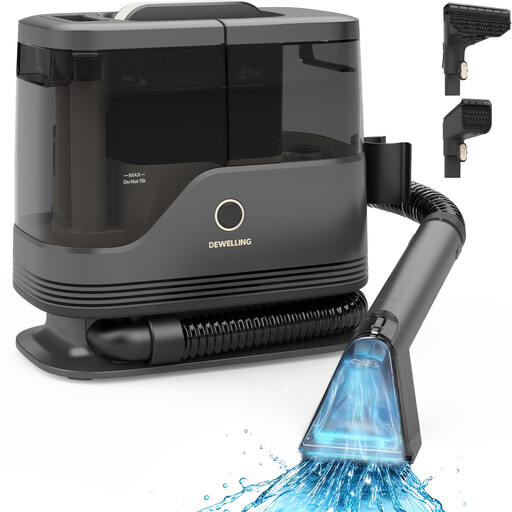
This selection features spray-extraction cleaners for spot-cleaning fabric upholstery. Only use them if your pouffe’s care instructions allow wet cleaning.
 No image available
For spot-cleaning fabric upholstery that, according to its care instructions, can be treated with water.
The product description lists spraying, dirty-water suction, two tanks, two nozzles and a self-cleaning function on the handle; it also specifies 13 kPa.
 No image available
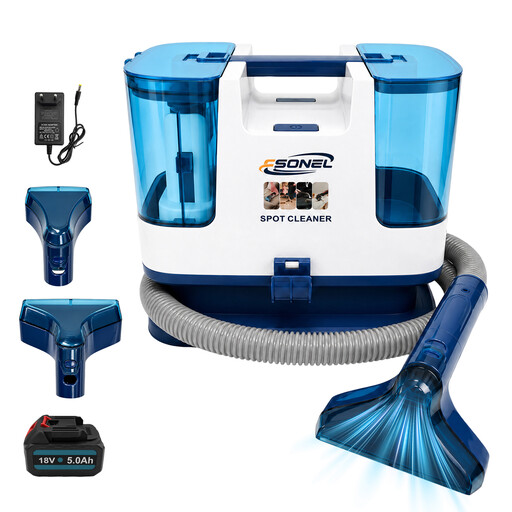
The product description lists spraying and dirty-water suction for fabrics suitable for wet cleaning, such as upholstery.
The product name specifies a handheld appliance with a lithium battery and the 1 Battery version; the description lists 400 W and 17 kPa.
 No image available
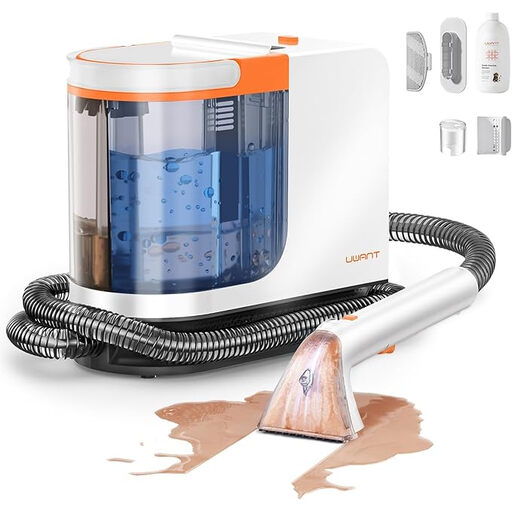
The product description lists use on sofas and other upholstered surfaces, with spraying, brushing and suction.
The product information specifies a 4.26 ft hose, a 9.84 ft cord and a self-cleaning function.
 No image available
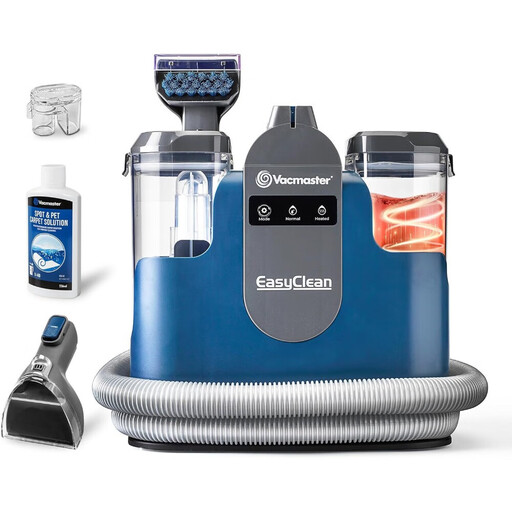
The product information lists spraying and suction for cleaning upholstery.
The product name specifies 500 W, two tanks with capacities of 1.6 l and 0.95 l, and a 1.8 m self-cleaning hose.
 No image available
The product description lists use on sofas and upholstery, with separate tanks for clean and dirty water.
The product name specifies 500 W, tanks with capacities of 1.6 l and 0.95 l, and a 1.8 m hose. The description lists dimensions of 34 × 22,5 × 36 cm and a weight of 3.4 kg.
No. Follow your pouffe’s care instructions. Ashley’s furniture care guidance makes clear that some upholstery can be treated with water, while other fabrics must be kept away from it. Test any permitted treatment on an inconspicuous area first.
Check the instructions for the cover and frame separately. For the IKEA STOCKHOLM 2025 pouffe, IKEA says the removable cover can be machine-washed separately at a maximum of 30 °C. For the frame, IKEA recommends vacuuming and wiping with a damp cloth. Don’t automatically apply these instructions to a different pouffe.
Follow the manual for the exact model and clean the parts specified. BISSELL lists a HydroRinse accessory for the SpotClean C5, while Rowenta lists an autoclean accessory for the IN3020F0. These are model-specific details from the manufacturers.
According to the Dutch Government, the seller must provide a solution if a product is faulty. There is no fixed statutory warranty period in the Netherlands; a manufacturer’s warranty is separate from the seller’s responsibilities.
According to the Dutch Government, consumers usually have 14 days to change their mind when buying at a distance, although there are exceptions. Before you buy, check who the seller is and which terms apply to your order.