
For weekly spot cleaning
You want to clean a suitable fabric footstool regularly and target specific areas, without a lot of storage or post-cleaning hassle. A compact design and a hose you can clean are useful differences to consider.


First, check whether your footstool’s care instructions allow wet cleaning; a spot cleaner won’t make a fabric that cannot tolerate moisture suitable for washing. A compact nozzle is handy for small, recurring marks, while a wider nozzle, longer hose reach or a rinsing attachment may be useful if you also want to tackle larger areas and seams. Compare the accessories and maintenance requirements for the exact model, not just its power.
You want to clean a suitable fabric footstool regularly and target specific areas, without a lot of storage or post-cleaning hassle. A compact design and a hose you can clean are useful differences to consider.
You want to check first which wet-cleaning methods your footstool can tolerate. The furniture’s care instructions determine whether a water-based spot cleaner is an option at all.
As well as tackling individual marks during your weekly clean, you want to treat a larger area or hard-to-reach seams on suitable upholstery. Nozzle width and hose reach may be worth considering.
First, check whether the upholstery can be wet-cleaned. Then choose a cleaner with the reach and aftercare requirements that suit your weekly routine.
Choose this if: you mainly tackle small marks on a footstool that is suitable for wet cleaning, and want to store the cleaner away compactly.
The trade-off: a small nozzle lets you target specific areas, but you’ll need more passes to clean the whole seat.
Choose this if: you want to clean several suitable surfaces or a larger area of the footstool in the same session.
The trade-off: the larger set-up may not be necessary for one small footstool. Check which nozzles are included with the exact model.
Choose this if: you want to clean seams or hard-to-reach edges as well as the seat, on suitable upholstery.
The trade-off: a crevice nozzle can be useful for seams, but it won’t make fabric that cannot be wet-cleaned suitable for this method.
Choose this if: your footstool’s care instructions rule out wet cleaning.
The trade-off: follow the recommended dry-cleaning method or ask the furniture manufacturer for advice.
| What to consider | What should you check? | Who is this important for? |
|---|---|---|
| Quickly tackling small marks | Check the size, access to the tanks, upholstery nozzle and hose length of the exact model. | If I want to tackle small marks quickly during my weekly clean, I look at how easy the cleaner is to set up. Around 31% of consumers who mainly want to clean small marks quickly make this a priority. |
| Protecting upholstery | Check your footstool’s care instructions and follow the permitted cleaning method. | I don’t want to use moisture that isn’t suitable for my furniture fabric, so the footstool’s care instructions should guide my choice. Around 31% of consumers who want to protect their upholstery put this first. |
| Reaching the seat and seams | Compare the nozzle width, whether a crevice nozzle is included, and the hose length of the model you’re considering. | If I want to clean both a larger area and the seams, I check whether the attachments are suitable. Around 15% of consumers who mainly want to reach the surface and seams consider this most important. |
| Weekly aftercare | Check whether the tanks are easy to access and whether a hose-rinsing or cleaning attachment is included with the exact model. | After every clean, I want to know how to care for and store the tanks and hose. Around 23% of consumers who mainly want simple aftercare give this the most attention. |
The permitted cleaning method depends on the fabric and your footstool’s care instructions, not just the cleaner’s product description.
Check the care label or furniture instructions, and test an approved method on an inconspicuous area first.
For a single footstool, the upholstery nozzle, access to seams and aftercare may matter more than a larger tank. The nozzles and rinsing attachments included vary by model.
Compare the contents of the box for the exact model with the parts of the footstool you want to clean.
A model name with an additional variant suffix may refer to a different version, with different accessories or features.
Check the full model name and the included accessories on the product details page before comparing versions.
SpotClean models are portable upholstery cleaners. The SpotClean C5 is worth considering if you want to target specific areas and clean the hose.
According to Rowenta, the Clean It Compact IN3020F0 has brushes in two widths for different upholstery-cleaning tasks.
The SE 3 Compact Home N1 is a spray-extraction cleaner with nozzles for upholstery and crevices.
The Dutch product page for the refurbished 3000 Series XW3193/11R1 describes a model for soft surfaces.
The Joybuy products below are portable spot cleaners whose product names list upholstery, sofas or fabric furniture among their uses. Only use spray-extraction cleaning if your footstool’s care instructions allow it.
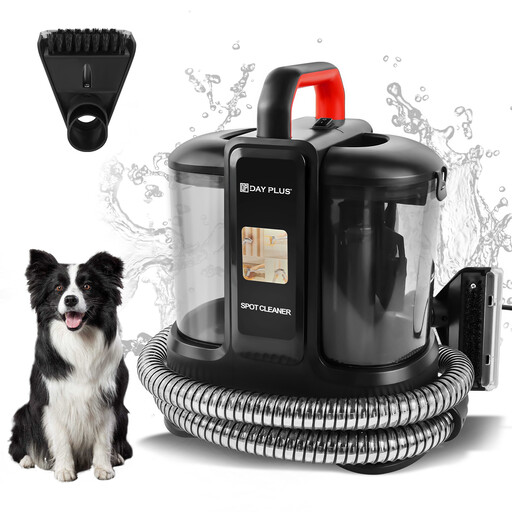 No image available
The product name lists upholstery and sofas among the uses for this portable cleaner.
Listed: 15 kPa, a 4.25 m cord, and 0.6 l and 1.2 l water tanks.
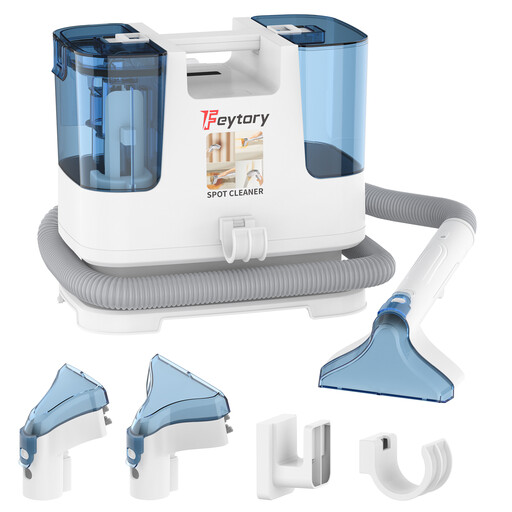 No image available
The product name lists sofas as one of its uses. Check whether this model suits your weekly cleaning task.
Listed: 15 kPa and 0.6 l and 1.5 l water tanks.
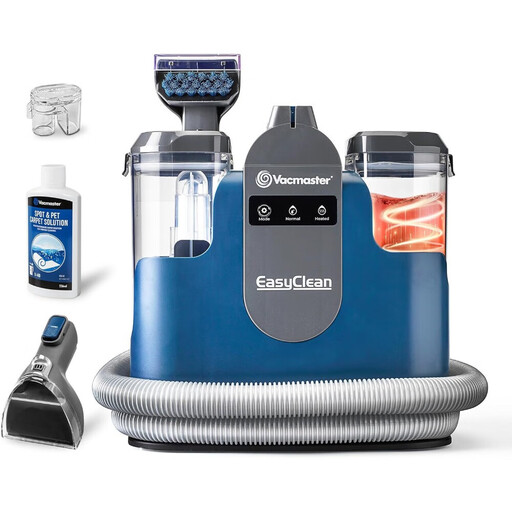 No image available
This model is described in the product name as suitable for carpets and upholstery. Check whether wet cleaning is permitted for your furniture fabric.
Listed: 500 W, 1.6 l and 0.95 l tanks, and a 1.8 m self-cleaning hose.
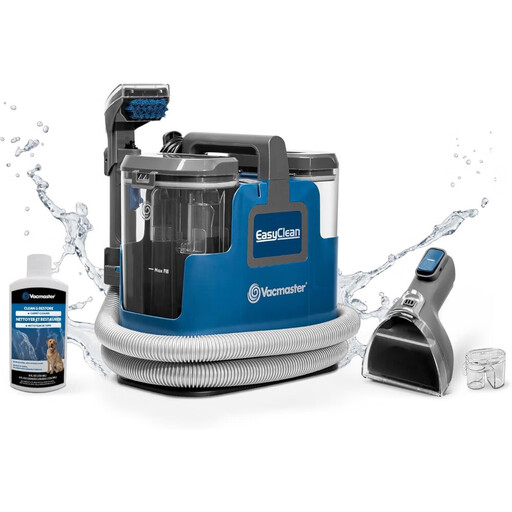 No image available
The product name lists carpets and upholstery as suitable uses for this compact model.
Listed: 500 W, 1.6 l and 0.95 l tanks, and a 1.8 m hose.
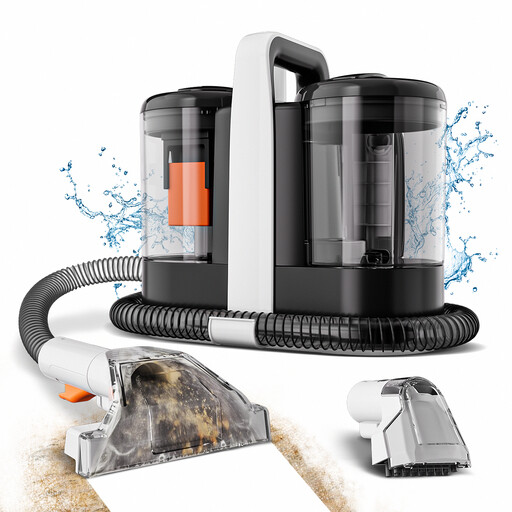 No image available
The product name mentions wet-cleaning fabric sofas. First, check whether your footstool is suitable for this method.
Listed: 600 W and 15 kPa.
No. It depends on your furniture’s care instructions. Beliani Netherlands’ furniture care guide distinguishes between W and WS, which may allow water-based cleaning, and S, X and D, for which wet cleaning is unsuitable. If in doubt, follow the specific instructions from the furniture manufacturer.
Follow your model’s instructions and check the tanks and hose. BISSELL says you can clean the C5’s hose after use with the included HydroRinse attachment; Kärcher describes an internal rinsing function for the SE 3 Compact Home N1.
No. The legal guarantee is separate from any manufacturer’s or seller’s guarantee. According to ACM ConsuWijzer, a product must meet what you could reasonably expect under normal use; if a product is faulty, the seller is responsible for providing an appropriate solution.
For a standard online consumer purchase, ACM ConsuWijzer says there is generally a statutory cooling-off period that ends 14 days after delivery; exceptions apply. Before buying, check which returns policy applies to your purchase.