
Someone with limited storage space
Wants to spot-clean upholstery that can be wet-cleaned without having to store a large machine in a cupboard or hallway. So they compare the machine's dimensions and nozzle.


First, check whether your chair upholstery can be wet-cleaned; a spot cleaner cannot make unsuitable fabric suitable for cleaning. For occasional stains, a compact machine with a suitable upholstery nozzle can be practical. If you have several chairs to clean, also consider the cable, hose and both tanks. Manufacturer specifications describe the equipment, but do not prove that it removes stains more effectively.
Wants to spot-clean upholstery that can be wet-cleaned without having to store a large machine in a cupboard or hallway. So they compare the machine's dimensions and nozzle.
Wants to clean several seats and edges in one go, and pays attention to the hose, cable and capacity of both the clean-water and dirty-water tanks.
Wants to avoid damaging the upholstery by checking the care instructions first and, if wet cleaning is allowed, testing colourfastness in an inconspicuous area. IKEA Netherlands recommends checking the product instructions for care advice for a specific sofa.
Start with the chair's care instructions; only then is it useful to compare dimensions, reach and tank capacity. BISSELL says that W and WS codes are suitable for water-based cleaning, while S and X codes are not. If the code is different or missing, follow the chair manufacturer's instructions.
| What to consider | What to look for | Who this matters most to |
|---|---|---|
| Upholstery suitability | Check the instructions for the specific chair; only wash a removable cover according to its own care label. | If I don't want to risk using a wet-cleaning method on fabric that isn't suitable, I'll check the chair or cover instructions first. Around 36% of consumers prioritise upholstery suitability. |
| Compact storage | Measure the available cupboard or shelf space and compare the machine's dimensions, as well as the space needed for the hose and accessories. | If I have limited cupboard space, I want to know whether the machine can actually be stored with its hose and attachments. Around 29% of consumers prioritise compact storage. |
| Reach when cleaning several chairs | Compare the cable and hose separately, as well as the capacity of both the clean-water and dirty-water tanks. | If I'm cleaning several chairs one after another, I want to avoid having to move the machine, refill it or empty it too often. Around 21% of consumers focus mainly on reach and capacity. |
| Machine maintenance | Check whether the tanks can be removed, how to clean the hose and which cleaning solution the manual recommends. | If I want to empty and clean the machine easily after use, I'll check in advance which parts are needed. Around 14% of consumers prioritise machine maintenance. |
The care instructions apply to the specific upholstery, not automatically to all fabric chairs. Using the wrong cleaning method can damage the upholstery.
Check the chair's instructions before use. If wet cleaning is allowed, test colourfastness in an inconspicuous area first.
The dirty-water tank may fill up sooner, and a long hose is no substitute for a nearby socket or suitable storage space.
Consider the cable, hose, nozzle, both tanks and the machine itself together, taking into account where you will use and store it.
A different version may have different specifications or accessories, even if its product name is very similar.
Before choosing a version, check the full model code, key specifications and box contents on the product details page.
BISSELL says the SpotClean C5 is designed for spot-cleaning suitable fabric upholstery.
The Clean It Compact IN3010 and Clean It IN5011 have different listed tank capacities and accessories; compare the full model code.
Kärcher describes the SE 2 Spot as a spray extraction cleaner with an upholstery nozzle.
Philips describes the 3000 Series as having a 3-in-1 nozzle, including for upholstery. The XW3193/11R1 version mentioned is refurbished.
These product picks are intended for spot-cleaning upholstery and other fabric surfaces mentioned; always check that wet cleaning is suitable for your specific chair.
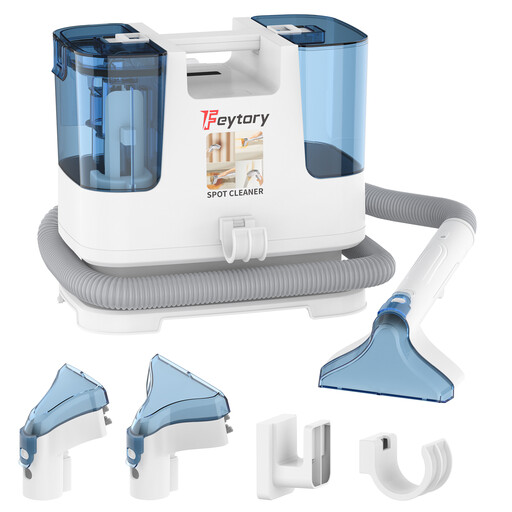 No image available
The product name lists sofas as a suitable surface; check the chair's care instructions before wet-cleaning.
The name specifies a handheld machine, 15 kPa and tanks holding 0,6 l and 1,5 l.
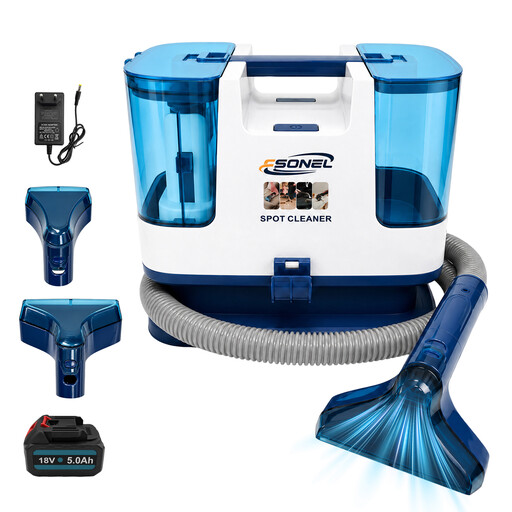 No image available
The product name lists sofas and wet-cleanable fabrics as suitable surfaces; first check whether your chair can be wet-cleaned.
This version specifies 400 W, 17 kPa and 1 battery.
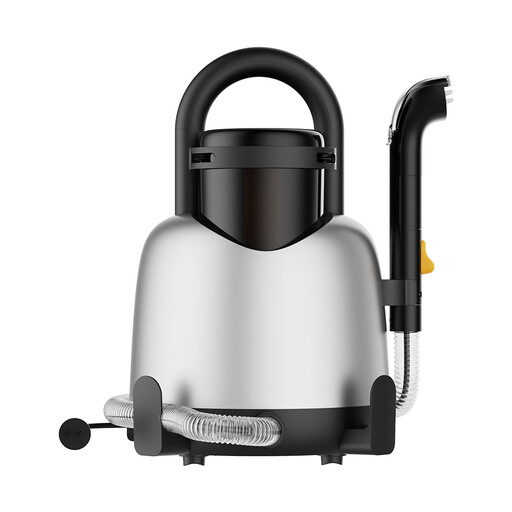 No image available
The product name lists upholstery and carpets; check the chair's instructions before using the cleaner for wet cleaning.
The name specifies a corded version with a self-cleaning function.
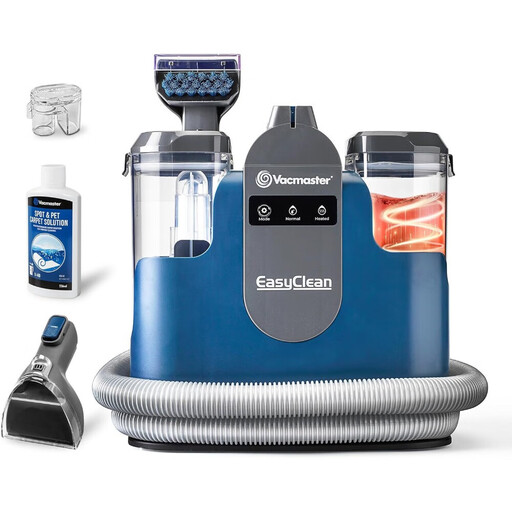 No image available
The product name lists carpets and upholstery; check whether wet cleaning is suitable for your specific chair.
The name specifies 500 W, 1,6 l and 0,95 l tanks, and a 1,8 m self-cleaning hose.
 No image available
The product name lists upholstery and sofas; first check that wet cleaning is allowed for your chair.
The name specifies 500 W, 1,6 l and 0,95 l tanks, and a 1,8 m hose.
No. Follow the instructions for the specific chair. BISSELL says that W and WS codes are suitable for water-based cleaning, but S and X codes are not. If wet cleaning is allowed, test colourfastness in an inconspicuous area first. Only wash a removable, machine-washable cover according to its own care label.
First, check the fabric instructions and remove loose dirt before wet-cleaning. Then follow the manual for the cleaning solution, filling, emptying and cleaning the machine after use. BISSELL instructs users to clean the SpotClean C5 hose after every use.
Check which cleaning solution and quantity are included with the machine, and which solution the manual recommends using afterwards. BISSELL says 236 ml of solution is included with the SpotClean C5, while Rowenta lists 250 ml with the IN3010. These are quantities included in the box, not running costs.
According to the Dutch government, the seller is your point of contact for a remedy under the statutory guarantee. The Netherlands does not have a fixed statutory guarantee period; what you can expect depends, among other things, on the product and the information provided. A manufacturer's guarantee is separate from this.