
Vandaag of morgen in huis

Kwaliteit gegarandeerd

Welkomstaanbiedingen ontgrendelen: GRATIS bezorging | Tot 80% korting | Gratis 30 dagen JoyPlus-proefperiode
Download de app
Sports socks may seem simple, but you’ll quickly notice when you’ve made the wrong choice. A cuff that is too tight can cause irritation, thin material may wear out faster and the wrong size can create friction inside your trainers. Anyone looking for sports socks will usually want a combination of comfort, breathability, a good fit and a reasonable price.
Whether you run, play basketball, go to the gym or are simply looking for white sports socks for everyday wear, look beyond colour and brand name. Below, we outline the key points to consider, along with some popular options for different uses.
“Cotton” sounds comfortable, but cotton sports socks are not automatically suitable for every intense workout. Cotton feels soft, but it can retain moisture. A cotton blend with polyester and elastane often offers a more practical balance of softness, stretch and durability.
Always check the full material composition. A high cotton content can feel pleasant for everyday wear, while a blend with more synthetic fibres may be better suited to running or longer workouts.
A multipack of sports socks may seem like good value, but a pack containing several pairs is only useful if the size is right. Check the EU shoe size rather than relying only on labels such as L or XL. Some models have a different sizing system from standard footwear.
Also check that the pack contains the quantity you want. A 3-pack, 6-pack and 9-pack differ not only in price, but also in how much washing you can rotate between.
A brand’s claim about antibacterial properties is not a guarantee of a particular user experience or hygienic effect in every situation. According to Li-Ning’s own research, the treatment used achieves stated percentages against Staphylococcus aureus, Escherichia coli and Candida albicans. These figures relate to the test results described by the brand, not to a medical effect.
Always wash sports socks according to the care label and allow them to dry thoroughly. Antibacterial claims do not replace normal care.
For basketball, tennis and intense workouts, mid-length sports socks are often practical. They provide more coverage around the ankle and calf than trainer or no-show socks. An elastic cuff should be firm enough to stay in place without digging in.
For everyday wear or low-top trainers, short trainer or sneaker socks make more sense. When comparing women’s and men’s sports socks, the shoe size is generally more important than the gender stated on the label. Unisex models can fit perfectly well, provided the size and stretch of the fabric suit your feet.
If you do a lot of jumping or running, or train on hard surfaces, look for a cushioned sole or extra material around the heel and forefoot. This can improve comfort inside your trainers. Also check whether the heel and toe are reinforced, as these areas tend to experience relatively high levels of wear from everyday washing and exercise.
Cushioning is not the same as a guarantee against injury. It mainly affects how the sock feels in combination with your trainers.
Breathable sports socks usually combine fibres that support air circulation and moisture management. According to the product descriptions of various models, polyester, polyamide and elastane are added to provide durability, stretch and a close fit respectively.
Care instructions vary by product. Some models can be washed at 40 °C, while others should be washed on a delicate cycle at a maximum of 30 °C. Avoid bleach and check whether the socks are suitable for tumble drying. Incorrect drying can damage the elasticity more quickly.
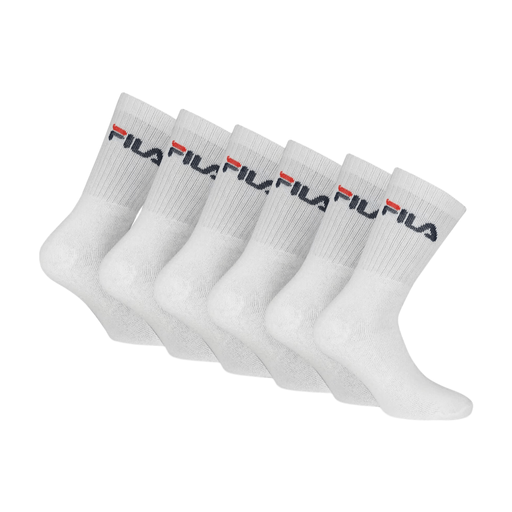
Why it suits this profile: A 6-pack of white sports socks is practical for anyone combining several workouts a week with everyday wear. The 39-42 size is clearly stated.
The pack contains six pairs, and the product description specifies a cotton, polyester and elastane blend. This means you do not have to rely solely on a general material name.
According to the product description: cushioned construction, breathable fabric and a supportive fit for training and everyday active wear.
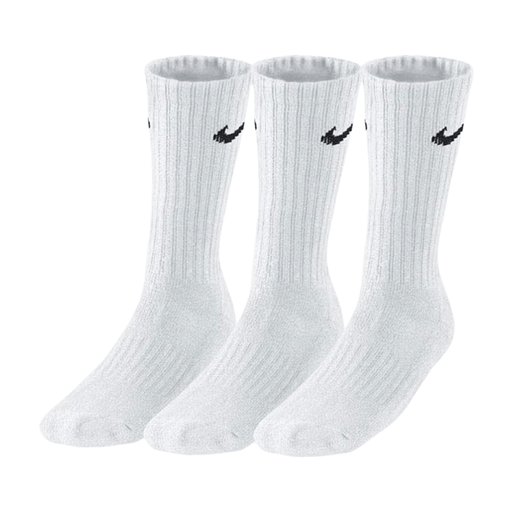
Why it suits this profile: This set is designed for training and running, making it suitable for users who place extra importance on cushioning and support inside their trainers.
The size guide states EU 43-46 for size L. The specifications also mention cushioning at the heel and forefoot, rather than making only a general comfort claim.
According to the product description: 75% cotton, a supportive arch band and a crew length. The set contains three pairs.
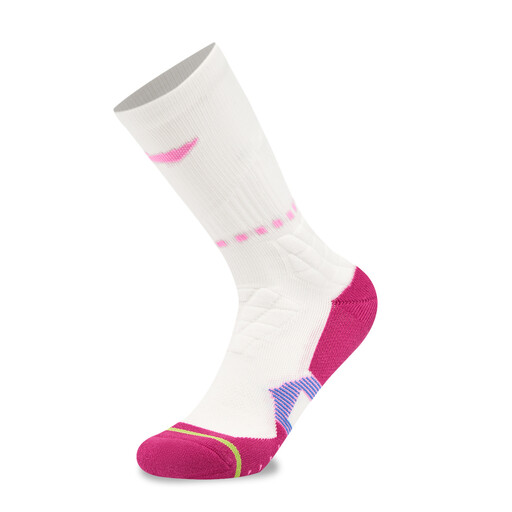
Why it suits this profile: The mid-length design and elastic cuff are well suited to basketball, training and other sports where the sock needs to stay in place.
The product information lists the composition, size range and care instructions. According to Li-Ning’s own research, specific antibacterial test results have also been reported; this is not a medical claim.
According to the product specifications: polyester and elastane blend, soft inner side, jacquard pattern and elastic cuff with a mid-length fit.
The terms women’s sports socks and men’s sports socks often mainly refer to size, colour and shape. When comparing products, check the actual EU size and foot length. If you are between sizes, you may want to consider a larger size with a stretchier model for a less restrictive feel, as indicated in the Li-Ning size chart.
For a neutral wardrobe, white sports socks are practical. FILA offers several white multipacks, including 6- and 9-packs in sizes 39-42 and 43-46. For low-top trainers, FILA trainer socks or Urban Classics no-show socks are more suitable than mid-length basketball socks. Do bear the activity in mind, though: a low-cut sock provides less coverage around the ankle.
Their lifespan depends on how often you train, the fit of your trainers, the wash programme and the material. Rotate several pairs, wash them according to the label and avoid high drying temperatures unless permitted. Replace a pair as soon as the heel or toe becomes thin, the cuff no longer fits snugly or the seams become noticeable.
A multipack is particularly useful if you exercise regularly. You can rotate pairs and avoid having to do extra washes between workouts. When comparing products, look at the price per pair, not just the total pack price.
We have put together a complete, up-to-date list of products that fully meet these strict selection criteria and the applicable European safety regulations.
Choose running socks with a close fit, breathable material blend and, if desired, extra cushioning at the heel and forefoot. Check that there are no loose seams in areas where your trainers place a lot of pressure.
They can be, but it depends on the composition. A cotton blend with polyester and elastane can feel softer while also offering greater stretch and durability. For long or intense sessions, it is sensible to check the moisture-management and ventilation specifications for the complete material.
For regular exercise, six to nine pairs are practical, especially if you have several workouts a week. If you exercise less often, you can start with a 3-pack. Choose the right size and length first; a larger pack cannot compensate for a poor fit.
