If you usually make one serving, a compact blender with a blending cup that doubles as a drinking cup is a sensible choice. If you prefer to pour your smoothie or make a larger quantity, compare a small jug blender instead. Measure the complete set and check the usable capacity and cleaning instructions for both the cup and the blade: wattage alone won’t tell you how smooth a spinach smoothie will be.
Which blender is right for you?
Smoothie maker with limited cupboard space
You mainly make spinach smoothies and want to store the motor base, cup and accessories together. A blending cup that doubles as a drinking cup can make a separate jug unnecessary. The Consumentenbond describes this type of use for smoothie blenders and blenders to go.
Fan of smooth green smoothies
You’re mainly interested in how well the blender mixes fruit and vegetables. Compare relevant blending results and check separately whether the blender is suitable for any frozen ingredients you plan to use. As the Consumentenbond explains, wattage alone doesn’t tell you everything.
Daily solo user
You want to make one serving and clean the parts quickly afterwards. Check the manual to see which parts of your model are dishwasher-safe; the Consumentenbond recommends following the cleaning instructions for each part.
What should you look for when choosing?
| What to consider |
What should you check? |
Who is this important for? |
| Space for the complete set |
Measure the motor base, cup or jug, lids and any extra cups together, then compare the measurements with your cupboard. |
If I have limited cupboard space, I want to know whether there’s room for all the separate parts too. Around 36% of consumers prioritise storing the complete set. |
| Blending fruit and vegetables |
Compare results for the specific model and check which ingredients were tested. Check the manual separately for information about frozen ingredients. |
What matters most to me is how the blender handles fruit and vegetables, and possibly frozen ingredients. Around 29% of consumers give top priority to ingredient suitability and blending results. |
| Cleaning |
Check whether each part is dishwasher-safe and how the blade should be cleaned and dried. |
For daily use, I want a cleaning routine I can stick to after every smoothie. Around 21% of consumers put cleaning at the top of their list. |
| Capacity and pouring |
Compare the usable capacity with your recipe and take the maximum fill line into account. Consider whether you’d rather pour your smoothie or drink it straight from a cup. |
If I make more than one small serving or like to pour my smoothie, I want enough capacity and a suitable shape. Around 14% of consumers choose capacity and pouring as their main consideration. |
Common buying mistakes
-
Looking only at the wattage
Wattage alone doesn’t show how well a blender makes smoothies. The Consumentenbond’s test information covers several aspects, including making smoothies. When comparing results, check which ingredients were used too.
Where possible, compare models using ingredients similar to those in your recipe.
-
Measuring only the motor base
An extra cup, lid or separate jug takes up space too. This is worth bearing in mind for models supplied with several cups or a separate jug.
Allow space for all the parts you plan to store after use.
An extra cup, lid or jug needs cupboard space too.
-
Assuming every part is dishwasher-safe
Cleaning instructions can vary between the cup, blade and motor base. For the nutribullet Pro 900 NB904CP, nutribullet says the cup can go on the top rack, while the blade should be cleaned separately with soap and water.
Before buying or using your blender, check the parts list and manual for the exact model.
With some models, this means cleaning and drying the blade by hand.
Brands to compare
Philips
Philips describes the Philips 3000 Series Mini HR2510/90 as a compact blender for smoothies and sauces that can be stored in a kitchen cupboard.
- Philips says that the removable parts are dishwasher-safe.
- The product description isn’t an independent test of how well it blends spinach.
nutribullet
The nutribullet Pro 900 NB904CP is a personal blender with a stated cup capacity of 700 ml and motor power of 900 W.
- nutribullet lists the dimensions as 376 × 140 × 140 mm and says the cup can go on the top rack of the dishwasher.
- nutribullet says the blade should be cleaned separately with soap and water; a higher wattage doesn’t prove that it will blend spinach more smoothly.
WMF
WMF offers both a KITCHENminis smoothie-to-go with blending and drinking cups, and a KITCHENminis model with a small glass jug.
- WMF lists two 600 ml cups for the smoothie-to-go and a usable capacity of 0.8 l for the jug version.
- The cups or jug and the other parts also need to be stored. Performance specifications don’t prove a particular result with spinach.
Severin
The Severin Smoothie Mix & Go SM 3735 is described as a blender with two removable drinking cups, each with a capacity of 0.6 l.
- Severin lists dishwasher-safe cups, a pulse function and dimensions of 36.4 × 13.3 × 13.3 cm.
- The product information doesn’t give a separately measured result for blending spinach.
Blenders at Joybuy
These models are designed for smoothies and range from compact cups to blenders with a jug. Compare their dimensions and capacity with your cupboard space and portion sizes; a compact model won’t necessarily suit every storage space.
 No image available
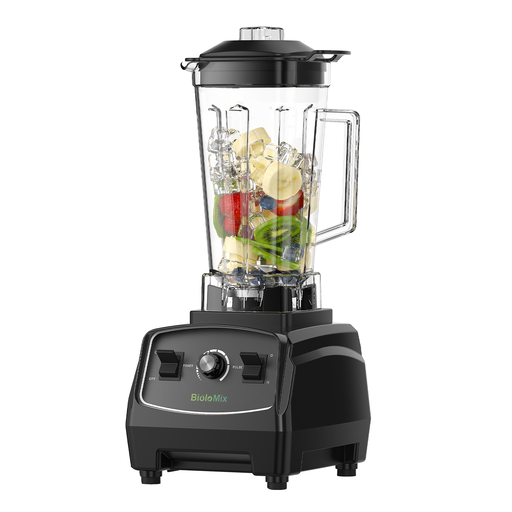
BioloMix 010 blender, 2 l, 2200 W
A blender with a generous jug for making several servings at once. Measure the jug and motor base together before putting it away.
The product name lists a capacity of 2 l, six stainless steel blades and an automatic cleaning function.
Joybuy
 No image available
ochama multifunction blender, 1.5 l, 600 W
A jug blender for smoothies. Compare the jug capacity and storage space needed with your usual portion sizes.
The product name lists a capacity of 1.5 l, three speeds and an ice-crushing function.
Joybuy
 No image available
Philips 3000 Series Mini HR2510/90
A compact jug blender for smoothies. Philips describes this model as suitable for storage in a kitchen cupboard; measure the complete set to make sure it will fit.
The product name lists a 0.6 l jug, 350 W and an ice-crushing function. Philips says the removable parts are dishwasher-safe.
Joybuy
 No image available
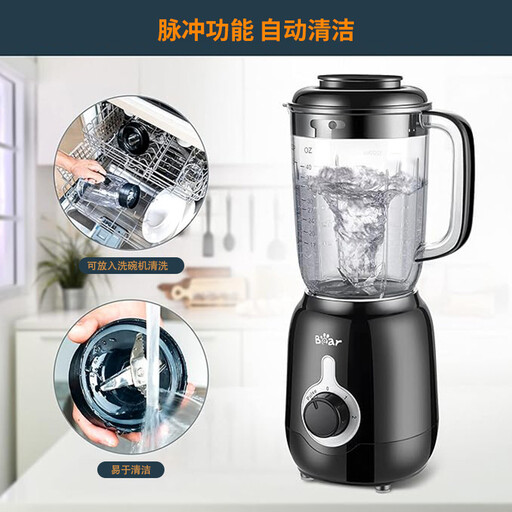
Bear LLJ-B12K1 tabletop blender, 1.2 l, 500 W
A jug blender for smoothies. Check that the capacity suits your portion sizes and that the jug will fit in your cupboard.
The product name lists two speeds, a pulse function and four stainless steel blades.
Joybuy
 No image available
Aigostar Marden BL-250, 500 ml, 250 W
The small capacity may suit a single smoothie; check whether 500 ml is enough for your recipe.
The product name lists a glass jug. The product description mentions a drinking lid with a spout, so you can use the blender cup as a drinking bottle.
Joybuy
Frequently asked questions
How do you choose between a drinking cup and a small jug?
If you usually make one serving to drink straight away or take with you, compare models with a blending cup that doubles as a drinking cup. If you prefer to pour your smoothie, consider a small jug. Either way, measure the complete set.
What can you check if the ingredients aren’t blending properly?
Follow the instructions in your model’s manual for ingredients and maximum fill levels. Also check that the jug or cup is fitted securely as instructed, and clean each part as directed.
Are you only entitled to a two-year blender guarantee in the Netherlands?
No, there’s no fixed statutory two-year guarantee period in the Netherlands. The Rijksoverheid explains that a product must remain in good working order for the length of time you can reasonably expect it to last. If there’s a problem, contact the retailer. Any manufacturer’s guarantee is separate from this.
What safety rules apply to electric blenders in the Netherlands?
Electrical appliances must meet the relevant European requirements. The Dutch Ondernemersplein explains that CE marking and an EU declaration of conformity are the manufacturer’s responsibility; a statement on a product page isn’t, by itself, an independent safety test.
Where can you take your old blender?
When you buy a new, similar appliance, the Rijksoverheid says you can return your old one to the retailer free of charge, including when you buy online. You can also take it to a municipal recycling centre or an appropriate collection point.


