Spiced biscuits aren’t a suitable everyday snack for babies and toddlers: the Dutch Nutrition Centre recommends choosing snacks mainly from its Wheel of Five food guide, and suggests having biscuits once a week rather than every day. If you’d like to offer spiced biscuits occasionally, keep it to a small treat and check the portion size and the latest ingredients and allergen information on the packaging.
Who is this choice for?
Parents looking for an everyday snack
If snacks are a regular part of your child’s routine, the first question is whether spiced biscuits are a suitable choice. The Dutch Nutrition Centre recommends snacks mainly from its Wheel of Five food guide for babies and toddlers, such as fruit, vegetables or a suitable wholegrain cracker.
Parents who want to offer spiced biscuits now and then
For an occasional treat, the size of the biscuit and how practical the packaging is both matter. A larger pack doesn’t in itself mean you should give your toddler more at a time.
Families who need to check allergens
If your child needs to avoid certain ingredients, the information on the packaging is essential. Even with a gluten-free variety, check the other ingredients and allergen warnings.
What should you look for when choosing?
First decide whether you’re looking for an everyday snack or an occasional treat. Then consider which pack size and ingredients are right for the occasion.
| What to consider |
What to check |
Who it matters to |
| Everyday snack |
Decide whether you’re looking for a regular snack or an occasional treat. For everyday snacks, also compare options from the Wheel of Five food guide. |
If I want to give my child a snack every day, I want to avoid making biscuits the regular choice. For around 50% of consumers, suitability for everyday use is the top priority. |
| Packaging and portions |
Check the pack weight and how many biscuits you want to give at a time; the stated serving size may not be right for every child. |
If I only offer spiced biscuits occasionally, I want a pack that makes it easy to save some for another occasion. Around 30% of consumers prioritise practical packaging. |
| Allergens |
Read the latest ingredients list and allergen warnings on the pack, even if the front mentions a dietary feature. |
If my child needs to avoid an ingredient, I want to know exactly what’s in the product. Avoiding allergens is the main concern for around 20% of consumers. |
Common mistakes
-
Treating a small biscuit as a regular toddler snack
The fact that a biscuit is small doesn’t make spiced biscuits an everyday snack. The Dutch Nutrition Centre suggests having biscuits once a week rather than every day.
For regular snack times, choose something from the Wheel of Five food guide instead, and save spiced biscuits for an occasional treat.
-
Assuming a large pack means a suitable portion
The number of biscuits in a pack doesn’t tell you how many to give your toddler at a time. And if you only offer them occasionally, you’ll have some left over.
Check the pack weight and serving information, and think about how you’ll divide the biscuits between separate occasions.
-
Assuming gluten-free means free from other allergens too
A gluten-free label only refers to gluten, not to all the ingredients or allergens that may matter for your child.
Check the full allergen information and warnings on the packaging of the variety you choose.
-
Relying on an old online ingredients list
Albert Heijn notes that product details, including ingredients and allergy information, can change. So a product page you looked at earlier isn’t a substitute for checking the label on the pack.
Before offering the biscuits, check the packaging you actually have at home.
Brands worth comparing
Albert Heijn
Albert Heijn sells AH Bakkers spiced biscuits in a 600 g pack, among other products. When choosing biscuits for a toddler, look beyond the pack size and check the latest nutritional information and ingredients too.
- The AH Bakkers spiced biscuits pack states a weight of 600 g.
- Albert Heijn says product information, including allergy information, can change, so check the label.
Jumbo
Jumbo sells both 600 g Bakkers Speculaas and a separate 125 g gluten-free spiced biscuit variety. These are different products, so choose a dietary option based on the ingredients that need to be avoided.
- The regular and gluten-free varieties are easy to tell apart by their product names and pack weights.
- A gluten-free product name doesn’t replace checking the label for other allergens.
Lotus Biscoff
Lotus Biscoff Speculoos is a 250 g branded product in Albert Heijn’s range. Speculoos isn’t necessarily the same product as the spiced biscuit varieties mentioned above.
- The product name and pack weight make it clear which variety you’re looking at.
- The brand name alone doesn’t tell you whether it’s suitable as an everyday snack for a toddler.
Spiced biscuits for an occasional treat
This Joybuy selection is for spiced biscuits you might offer as a planned treat, not as a replacement for an everyday snack.
 No image available
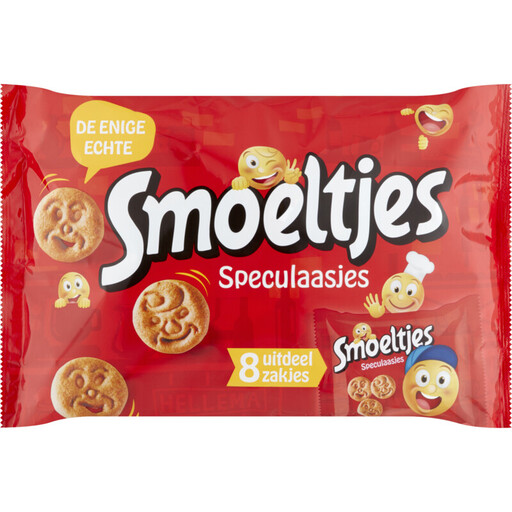
Hellema Smoeltjes Speculaas Cookies, 8 pieces, 200 g
For an occasional spiced biscuit treat, decide how many you want to give at a time. The product name states that the pack contains 8 biscuits and weighs 200 g in total. Before offering them, check the portion size and the latest ingredients and allergen information on the packaging.
View at Joybuy
Frequently asked questions
Are spiced biscuits suitable as an everyday snack for a toddler?
Not as a regular choice, according to the Dutch Nutrition Centre. It recommends snacks mainly from its Wheel of Five food guide for babies and toddlers, and suggests having biscuits once a week rather than every day.
How do I work out a portion of spiced biscuits for a toddler?
Don’t automatically assume a full biscuit or the serving size stated on the pack is right. Check the weight and nutritional information for the spiced biscuits you’ve chosen, and keep an occasional treat small.
Does choosing gluten-free spiced biscuits avoid other allergens too?
No. Gluten-free doesn’t mean a product is free from all other allergens. If your child needs to follow a restricted diet, read the full ingredients list and allergen warnings on the specific pack.
Where can I check the allergens in packaged spiced biscuits?
Check the label on the pack you buy. The Netherlands Food and Consumer Product Safety Authority states that allergens must be clearly and correctly listed on food labels. Product information can also change.


