
Student baking once
If you’re only making speculaas for the potluck and don’t necessarily want to buy a mixer, you can mix the dough by hand or use a hand mixer with dough hooks. Rutger bakt describes these options as well as using a stand mixer.


For a single potluck, mixing by hand or using a hand mixer with dough hooks may be enough; Rutger bakt also recommends a stand mixer with a flat beater. A stand mixer is worth considering if you use it regularly or want to make several batches, provided its attachments and stated capacity suit your recipe. Also compare the machine’s dimensions and check the CE marking and food-contact information for the model you choose.
If you’re only making speculaas for the potluck and don’t necessarily want to buy a mixer, you can mix the dough by hand or use a hand mixer with dough hooks. Rutger bakt describes these options as well as using a stand mixer.
If you mix dough regularly but have limited worktop or cupboard space, weigh up the dimensions and bowl capacity of the exact model. Consumentenbond recommends considering what you’ll use a stand mixer for, among other things.
If you want to make several batches for a group, compare the ingredients for each batch with the capacity stated by the manufacturer for the exact model. Bosch and KitchenAid, for example, publish different types of capacity information for their models.
When: If you’re making a small quantity just for this occasion.
Trade-off: You won’t need a stand mixer, but you’ll have to do the mixing yourself.
When: If you bake regularly and have limited space to set up or store a mixer.
Trade-off: A smaller body and bowl don’t necessarily mean the capacity will suit every batch in your recipe.
When: If you want to make several batches and the stated capacity for your dough and quantity of flour matches the recipe.
Trade-off: A larger capacity may mean fewer mixing sessions, but also compare how much space the machine takes up.
Start by asking yourself whether you’ll use the mixer again after the potluck. Then compare the attachment you need, the quantity you’ll mix at a time and the space you have available.
| What to consider | What should you check? | Which consumers is this important for? |
|---|---|---|
| Purchase and future use | Decide whether you’ll use the mixer again after this occasion; you can also mix the recipe by hand or use a hand mixer. | If I’m only baking for this potluck, I want to know whether I need my own stand mixer. Around 36% of consumers put the purchase and future use first. |
| Quantity per mixing session | Compare the ingredients in your recipe with the stated flour or dough limit for the exact model. | If I’m baking for a group, I want to know how much dough I can mix at a time. Around 29% of consumers prioritise making several batches for a potluck. |
| Attachment for biscuit dough | Check whether the model comes with the flat beater or mixing paddle that suits your chosen method. | If I’m making speculaas dough, I want to use the right mixing tool for the recipe. Around 21% of consumers prioritise finding a mixer that suits their mixing needs. |
| Space and cleaning | Compare the external dimensions and check the cleaning instructions for each part. | If I share a kitchen, I want to know whether the mixer will fit and how much washing up it involves. Around 14% of consumers prioritise space and cleaning. |
Manufacturers may state flour weight, dough weight and bowl volume. These measurements aren’t interchangeable and don’t, on their own, guarantee a particular quantity of speculaas dough.
Compare your recipe ingredients with the capacity stated for the exact model and, if necessary, make several batches.
Rutger bakt recommends using a flat beater with a stand mixer. Check which attachment comes with the model you choose rather than assuming that every attachment supplied does the same job.
Check the contents of the box and the instructions for your model number before you decide.
Tristar states that the parts of the MX-4817 are not dishwasher-safe, so cleaning instructions can vary by model and part.
Check the instructions for each part and clean it as directed.
The Dutch Government distinguishes between your statutory rights if a product is faulty and a manufacturer’s warranty, which offers additional cover.
Read the terms of any extended warranty and compare them with your rights as a customer of the seller.
Bosch describes the MUM Serie 2 as compact. For the MUMS2VM00, Bosch lists a 3.8-litre bowl, a whisk and a dough hook.
Kenwood says the Kenwood Go KZM35.000GY is designed for smaller kitchens; the kMix KMX750ARD is a model with a larger bowl.
Tristar lists a 5-litre bowl and a supplied beater for the MX-4817.
KitchenAid lists a beater and a 4.7-litre bowl for the Artisan 5KSM125.
These Joybuy products are stand mixers with stated mixing tools or bowl specifications that may help you compare models for biscuit dough. Check the CE marking and food-contact information for the specific item on offer. The NVWA sets out the applicable requirements for electrical products and food-contact materials; a product description alone doesn’t establish whether an individual item meets them.
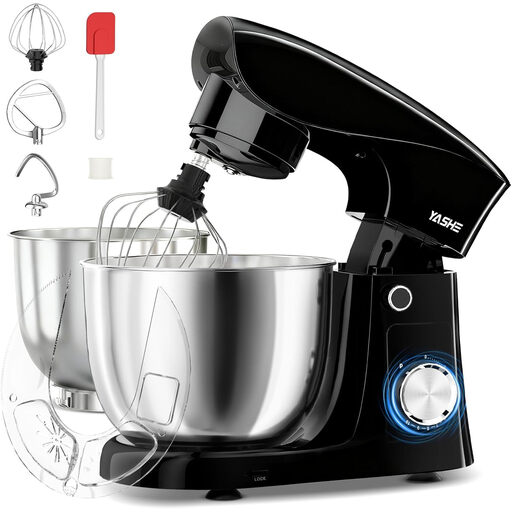 No image available
The listed mixing beater may be useful if you want to mix biscuit dough; check that it suits your chosen recipe method.
The product information lists two bowls of 4,5 and 5 litres, 10 speeds, a pulse function and a dough hook.
 No image available
The listed mixing beater is worth comparing with the tool you need for your speculaas recipe.
The product information lists a 5-litre bowl, 10 speeds, a pulse function, a tilt-head design and 400 W of power. It also lists a mixing beater, dough hook and whisk, as well as dimensions of 35,4 × 22,5 × 29,6 cm.
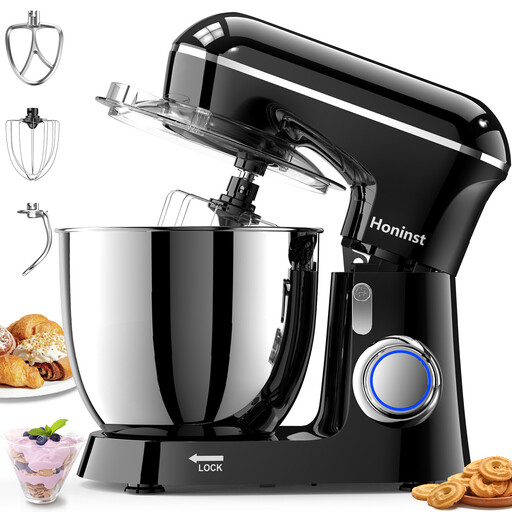 No image available
The product information lists a beater as well as a dough hook and whisk, so you can compare the mixing options supplied with your recipe.
Specifications include a 6,5 QT bowl, 10 speeds, a tilt-head design and non-slip feet.
 No image available
The supplied K-beater is worth comparing with the beater your recipe calls for.
The product information lists a 4-litre bowl, a dough capacity of up to 1,4 kg, six speeds and a pulse function. The external dimensions are 33,5 × 18 × 30 cm.
 No image available
The listed flat beater may be useful for mixing biscuit dough; check the instructions for your recipe and model.
The product information lists a recommended bowl capacity of 5 litres, eight speeds, a tilt-head design, and a flat beater as well as a dough hook and whisk. The accessories are described as dishwasher-safe.
Rutger bakt recommends a flat beater for a stand mixer; the recipe also suggests mixing by hand or using a hand mixer with dough hooks. Follow your machine’s instructions too.
Rutger bakt’s recipe makes 50–65 speculaas biscuits per batch and says to leave the dough to rest for at least one hour. First decide how many biscuits you want to make, then compare the ingredients for each mixing session with the capacity stated for your model; biscuit size affects the yield.
According to the Dutch Government, you’re entitled to a product that works properly and can contact the seller if there’s a fault; there’s no fixed statutory warranty period. A manufacturer’s warranty is additional cover, and wear and tear or damage caused by you doesn’t automatically entitle you to free repairs.
CE marking is compulsory for electrical products where the applicable rules require it; parts intended to come into contact with food must comply with food-contact material regulations. The NVWA explains these requirements, but a general product description doesn’t prove that an individual item complies with them.
Ask about any relevant food allergies and check the ingredients in your recipe. Rutger bakt’s recipe contains flour and butter; other ingredients you choose may also contain allergens. Allergen labelling rules don’t automatically mean you have to provide labels for a private potluck.