
Opera listener with limited space for speakers
Wants a stereo pair for recordings but can only position the speakers close to or on the wall.


Choose wall-mounted speakers if you have two suitable places to install them. An active stereo pair may suit you better if you don’t want a separate amplifier, while passive models require a compatible amplifier. With either set-up, the distance from the wall and the room’s acoustics can affect the bass and stereo image. Check the instructions for the exact model and judge the sound from your listening position: specifications alone can’t predict how opera will sound in your room.
Wants a stereo pair for recordings but can only position the speakers close to or on the wall.
Wants to play recordings through an existing source and is looking for compatible connections. Passive speakers also need a suitable amplifier.
Has a fixed listening position and wants to take the wall’s effect into account when choosing where to place the speakers and whether to adjust the bass.
Start by checking the available positions for the left and right speakers. Then make sure the connections, amplification and any adjustments suit your source and listening room.
| What to consider | What should you check? | Who is this important for? |
|---|---|---|
| Positioning and bass | Check the instructions for the exact model, the space available, the port and any bass controls. Assess the set-up from your listening position. | If the speakers need to be close to the wall, I want to know how the bass sounds from my usual listening position. Around 36% of consumers prioritise positioning and bass near the wall. |
| Two stereo channels | Check that the left and right speakers can be positioned appropriately and whether the offer includes one speaker or a pair. | For opera, I want to be able to position two separate speakers around my listening position. Around 29% of consumers prioritise a practical stereo arrangement. |
| Connecting to your source | Note the output on your CD player, streamer or other source and compare it with the inputs and any accessories required. | I want to connect my existing source without discovering too late that I need a particular connection or adapter. Around 21% of consumers prioritise source compatibility. |
| Complete set-up | Check the number of speakers, whether an amplifier is needed, and whether you need any cables, mounting equipment or adapters. | If I need additional equipment, I want to know in advance what’s needed to play through the left and right speakers. Around 14% of consumers prioritise knowing what’s required for a complete set-up. |
The position of the port alone doesn’t tell you how the bass will sound in your room. KEF also notes that a speaker with a rear port isn’t automatically unsuitable for placement near a wall.
Follow the positioning instructions for the exact model and assess the sound from your usual listening position.
KEF lists the Q4 Meta individually, and Genelec supplies one G Two per pack; Sonos describes two Era 100 speakers as a stereo pair.
Check how many speakers are included in the offer and whether you need two for the left and right channels.
A passive speaker needs suitable amplification. For a wired source connected to a Sonos Era 100, Sonos specifies an adapter, sold separately.
Before buying, work out how your recording source will connect to both speakers, including any amplifier and adapter you may need.
DALI lists the OBERON ON-WALL as discontinued. That doesn’t necessarily mean a specific offer is still available.
Check the exact model name and version in the offer.
These brands offer a range of documented set-ups. Suitability depends, among other things, on where you’ll position the speakers, your source and the amplification required.
The passive Q4 Meta is one option for a left-and-right wall-mounted set-up.
DALI describes the OPTICON LCR MK2 as a wall speaker that can also be used for stereo.
The active R1280DBs offers a stereo option with built-in amplification and several connection options.
The active G Two is an option if you want to be able to adjust the bass after positioning the speaker.
According to Sonos, two Era 100 speakers can be used together as a stereo pair.
The passive Debut 3.0 DF53 is a floorstanding alternative if you have space for floor speakers. The Dutch importer also refers to this version as F5.3 (DF53).
This Joybuy selection includes active speakers with mounting kits, a passive bookshelf pair and active computer speakers. Check that the connections and set-up for each model suit your source and available space.
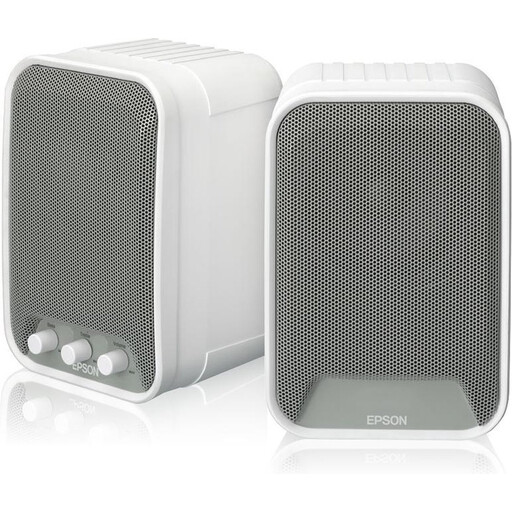 No image available
These active stereo speakers may suit you if you’re looking for a set-up with mounting kits.
The product information lists 2.0 channels, built-in amplification, mounting kits, screws and cables. For the audiovisual set-up described, it specifies a connection to the ELPCB01.
 No image available
This passive bookshelf pair may suit you if you’re looking for two separate speakers for the left and right channels and have a suitable amplifier.
The product name specifies one pair of passive speakers measuring 6.5 inch.
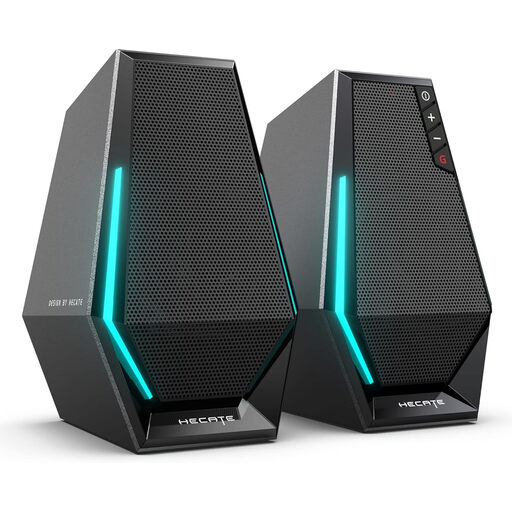 No image available
These 2.0 stereo speakers may suit you if your source is compatible with one of the listed connections.
The product information lists USB, 3.5mm AUX and Bluetooth 5.3.
No, a front-facing port isn’t a general requirement. KEF notes that a speaker with a rear port isn’t automatically unsuitable for positioning near a wall. Follow the instructions for the exact model and assess the bass from your listening position.
Try to position the left and right speakers as similarly as possible in relation to your listening position. Genelec points out that similar reflections from both speakers help create an accurate stereo image. Also follow the positioning instructions for your chosen model.
Only if your CD player’s output is compatible with the connection required. Sonos specifies a Line-In Adapter or Combo Adapter, sold separately, for a wired line-in connection. Check which cable you’ll need too.
According to the Dutch Government, when you buy from a business in the Netherlands at a distance, you’ll often have 14 days to change your mind, although there are exceptions. The Dutch Government also states that there is no fixed statutory warranty period; if something is faulty, the seller must provide a solution.