
Teacher in a noisy open-plan office
You do most of the talking and want learners to follow what you say while colleagues nearby are chatting. DGMR describes noise disturbance as a potential problem when making video calls in the office.


A speakerphone is most suitable if you teach hands-free or learners need to speak from the same table. Compare the microphone set-up, full-duplex capability and how it connects to your computer. Noise cancellation does not guarantee that colleagues’ voices will disappear: test it with real background noise, and consider a headset or quieter room for one-to-one lessons.
You do most of the talking and want learners to follow what you say while colleagues nearby are chatting. DGMR describes noise disturbance as a potential problem when making video calls in the office.
You need to hear and respond to questions and interruptions. That makes simultaneous speech an important feature to compare when choosing a speakerphone.
You use different computers or teaching rooms and want to know in advance which connection you need and how to set up the speakerphone.
When: if you teach hands-free and want to hear learners through the speaker.
Trade-off: colleagues can hear the speaker, and the microphone may pick up voices in the room.
When: if learners are in the same room and ask questions during the lesson.
Trade-off: the microphone may pick up more voices in the room; a stated range doesn’t tell you how well it filters out colleagues.
When: if you’re presenting on your own and clear speech or privacy matters more than sound for the whole room.
Trade-off: learners in the room won’t automatically be able to listen through a speakerphone; finding a quieter spot takes planning.
| What to consider | What should you check? | Who is this most important for? |
|---|---|---|
| Clear speech with background chatter | Make a test recording where you teach while colleagues are talking. If needed, compare the result with a headset or a quieter room. | If I teach in an open-plan office, I want to know whether learners can follow what I’m saying over the conversations around me. Around 38% of consumers prioritise clear speech with background chatter. |
| Answering questions | Check that the exact model supports full-duplex, and test an interruption during a trial call. | If learners often ask questions, I want to respond without simultaneous speech being cut off. Around 23% of consumers give interaction and answering questions top priority. |
| Connecting to the computer you teach from | Check whether USB-A or USB-C is compatible and which connection method works with your computer and video-conferencing app. | If I teach using different computers, I want to use the speakerphone without connection problems. Around 23% of consumers prioritise a reliable computer connection. |
| Moving between workspaces | Compare the stated talk time with the length of your lessons, and check which cables or adapters are included with the model. | If I move between classrooms or workspaces, I want to know whether I can easily take the speakerphone with me and connect it. Around 16% of consumers give portability top priority. |
Noise cancellation doesn’t guarantee that learners will hear you clearly in a noisy room. AnkerWork recommends choosing a relatively quiet environment if background noise remains a problem.
Test it with real background chatter, and compare a headset or another room for one-to-one lessons.
For the Jabra Speak2 55, Jabra recommends using USB to connect to a computer. The manual says standard Bluetooth to a computer is not certified to deliver the same audio quality.
Check which connections and accessories are included with the exact model, and test your chosen connection before the lesson.
The Joybuy listing for the Speak2 55 mentions Bluetooth 5.2 and 4,700 mAh, while Jabra lists Bluetooth 5.1 and two 900 mAh batteries for this model. Check that the product variant matches the manufacturer’s specifications.
Before relying on specific details, ask for confirmation of the full model name and specifications of the version on offer.
The Speak2 range is worth considering when comparing microphone set-up, full-duplex capability and computer connectivity. The features listed below apply to the Speak2 55.
The Sync series offers an option to compare for a fixed or changing workspace; the specifications listed apply to the Sync 20.
The Expand 40 is worth comparing if other people will also be speaking at the table.
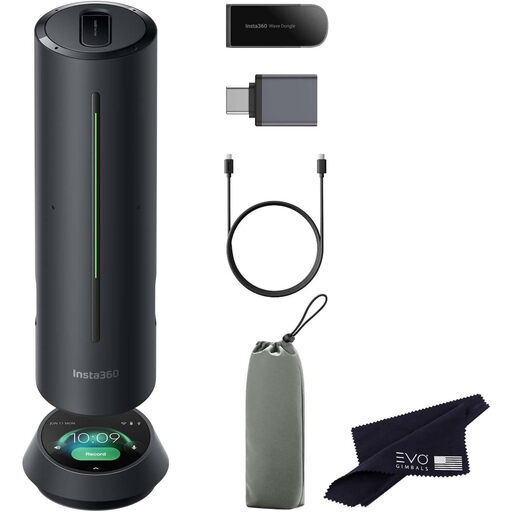
The PowerConf S500 is an option to compare for computer use via USB-C or the included dongle, and mobile use via Bluetooth.
The CP700 is a compact option for personal use or a small group, with USB and Bluetooth connectivity according to Yealink.
These Joybuy products are speakerphones for teaching online from a computer, with options for both one-to-one lessons and interactive sessions. Check the connection for each model and test the microphone in your own workspace.
 No image available
An option for teaching hands-free and placing the speakerphone some distance away; product claims are not an independent test with colleagues talking in the background.
The product description lists eight microphones, a stated pickup range of 16.4 feet, AI noise cancellation, microphone direction patterns, Bluetooth and a built-in battery offering 12 hours of use.
 No image available
A portable option for teaching online from a computer; check which connection method suits your teaching set-up.
The product description mentions USB or Bluetooth and a stated battery life of up to 15 hours. According to the description, the stated wireless range of up to 30 m requires the optional Jabra Link 370 adapter.
 No image available
An option to compare if learners ask questions during the lesson; check the connection and test simultaneous speech before use.
The product description lists four beamforming microphones and full-duplex. Check the exact model and specifications, as the Joybuy listing and Jabra’s model information differ in a few respects.
Yes. Select the speakerphone as both the microphone and speaker on your computer and in your video-conferencing app, then make a test call before the lesson. Microsoft Teams also lets you adjust background noise suppression; even so, test how your voice sounds in your workspace.
No, it depends on the model and connection method. For the Jabra Speak2 55, Jabra recommends using USB to connect to a computer; according to the manual, standard Bluetooth to a computer is not certified to deliver the same audio quality.
First, check that you’ve selected the right device and try USB if your model has that connection. AnkerWork recommends choosing a relatively quiet environment if background noise remains a problem; for a one-to-one lesson, you could also compare a headset or another room.
For a standard online purchase as a consumer, you generally have up to 14 days from delivery to change your mind, with some exceptions; ACM ConsuWijzer explains these rules. You’re also entitled to a legal guarantee if a product doesn’t do what you could reasonably expect when used normally. Different terms may apply to business purchases.
Radio equipment sold on the European market must meet the applicable European requirements. The Dutch Radiocommunications Agency states that the required CE mark must be displayed on the equipment; for a specific product, check that the model matches its accompanying documentation.