Choose based on the distance between the speakerphone and the participants, the number of speakers and the connection supported by your meeting computer. Features such as noise and echo cancellation, and full-duplex audio, may be useful. However, manufacturer specifications are no guarantee that everyone will be heard clearly in your office; if there’s a lot of noise, a quieter room is still an important consideration.
Who should consider this?
Leading a discussion in a noisy room
You want remote participants to be able to follow the book discussion despite background noise. So consider both the meeting space and the device’s audio features. Arboportaal discusses noise as a factor in communication and concentration.
Organising a group discussion around a table
You want to know whether a quiet-spoken participant or someone sitting further away will still be heard. Compare your table layout with the microphone range specified by the manufacturer; Jabra and HP publish range figures for specific models.
Organising meetings with different devices
You use different laptops or mobile devices and want to check in advance which USB or Bluetooth connection the version you’re considering supports. Jabra and HP list connection options for each model and version.
What should you look for?
Start with the distance across the table and your computer’s connections. Then compare the features and portability that suit the room where you’ll be holding the book discussion.
| What to consider |
What should you check? |
Who is this important for? |
| Clear audio with background noise |
Check whether the exact model lists noise and echo cancellation. Also assess the room and, if possible, try out your intended setup. |
If your book discussion is taking place in an office with distracting background noise, you’ll want remote participants to be able to follow the conversation. Around 36% of consumers prioritise clear audio in noisy conditions. |
| Picking up everyone around the table |
Measure the distance to the furthest speaker and compare it with the stated range for the exact version. Look for support for people speaking at the same time if participants often add to each other’s points. |
If participants are spread around the table, you’ll want even the furthest away or quietest person to be able to contribute. Around 29% of consumers give top priority to coverage for everyone around the table. |
| Connecting to your meeting computer |
Check for USB-A and USB-C, and whether Bluetooth is intended for use with a computer or only with mobile devices. Also check whether the version you’ve chosen includes any adapter you need. |
If you want to connect the speakerphone to a specific laptop or different devices, the right connection is essential. Around 21% of consumers prioritise device compatibility. |
| Taking it to another room |
Check the stated talk time, charging options and whether the connection will work in the alternative meeting space. |
If your current room is too noisy and you want to continue the discussion elsewhere, portability matters. Around 14% of consumers give portability top priority. |
Common buying mistakes
-
Confusing noise cancellation with a quiet meeting room
A feature that reduces background noise is no guarantee that participants will hear each other clearly in every room. The room and the speakers’ positions still matter.
First, consider where the group can sit and where each speaker will be positioned. If the office is very noisy, check whether a quieter room is available too.
You may still need to move the book discussion to a more suitable room.
-
Ordering a different version of the model from the one you need
Connections and included adapters can vary between versions. HP distinguishes the Sync 40 from the Sync 40+ in terms of the PC Bluetooth adapter; Yealink lists separate SP92 packages with and without a dongle.
Before buying, check the full model name, the connection you need and what’s included in the package on offer.
If the package you choose doesn’t include an adapter you need, you may have to source one separately.
-
Treating the stated microphone range as a real-world test
A manufacturer’s range in metres doesn’t, by itself, tell you how clearly a quiet-spoken participant will be heard over the noise and echo in your office.
Compare the stated range with your actual table layout and, if possible, test it with the furthest speaker in the room you plan to use.
Brands to compare
Jabra
According to Jabra, the Speak2 55 is an option for a compact group setup, with USB-A or USB-C for a computer and Bluetooth for a smartphone or tablet.
- For the Speak2 55, Jabra lists four microphones, full-duplex audio, noise and echo cancellation, and a microphone range of up to 2.3 metres.
- These are manufacturer specifications; they don’t guarantee clear audio in a particular noisy room.
Poly
HP positions the Poly Sync 40 for flexible workspaces and small meeting rooms.
- HP states that the Sync 40 has a microphone range of up to 2.5 metres.
- HP distinguishes between the Sync 40’s wired PC connection and the PC Bluetooth adapter included with the Sync 40+. Compare the versions separately.
EPOS
The EXPAND 40 is an option for group conversations where USB-C or Bluetooth is preferred.
- EPOS lists three beamforming microphones, features to reduce background noise and echo, and support for people speaking at the same time.
- These are manufacturer claims, not an independent comparison with other speakerphones.
Yealink
The SP92 is a portable option with a range of connection options.
- Yealink lists full-duplex audio, echo and noise cancellation, and a stated range of up to 4 metres.
- Yealink offers an SP92 package without a dongle and one with a dongle; check which version is on offer.
AnkerWork
AnkerWork describes the PowerConf S3 as a portable speakerphone for small meeting setups.
- AnkerWork lists six microphones, Bluetooth, USB-C and up to 24 hours of talk time.
- The manufacturer’s page is for a UK-market version; it doesn’t confirm the availability or specifications of the Dutch version.
Speakerphones on Joybuy
These Joybuy products are related to speakerphones for group discussions and book discussions in a noisy office.
 No image available
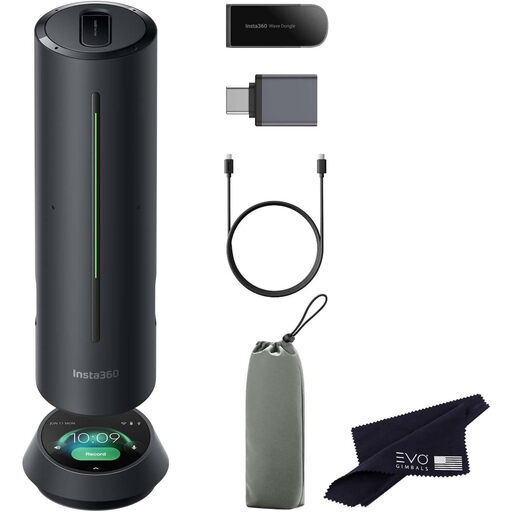
Insta360 Wave AI Conference Speakerphone, Bluetooth, Black
An option to compare if you’re looking for a speakerphone for a group conversation in a noisy room.
The product name lists Bluetooth.
Joybuy
 No image available
Jabra SPEAK 510 MS, USB-A, Black
An option to compare if you’re looking for a speakerphone for meetings in different locations.
The product name lists USB-A and Bluetooth.
Joybuy
 No image available
Jabra Speak2 55 MS Teams, Dark Grey
An option to compare if participants often add to each other’s points during group conversations.
The product name lists the MS Teams version and the Dark Grey colour.
Joybuy
Frequently asked questions
Where should you place the speakerphone during the book discussion?
Position the speakerphone so that the distances to the speakers are within the stated microphone range for the version you’ve chosen, paying particular attention to the furthest seat. A manufacturer’s stated range is no guarantee of clear audio when there’s background noise.
Will Bluetooth automatically connect wirelessly to my laptop?
No. Check the exact version and connection options. Jabra lists Bluetooth for smartphones or tablets with the Speak2 55; HP describes the Poly Sync 40 as having a wired PC connection and lists an included PC Bluetooth adapter for the Sync 40+.
Can you record the book discussion without further consideration?
Using a speakerphone isn’t the same as recording a conversation. If an organisation processes personal data when making a recording, the Dutch Data Protection Authority says there must be an appropriate legal basis under the GDPR. Consent is one possible legal basis, but it isn’t automatically the only option or the right one in every situation; whether it’s permitted depends on the purpose and circumstances.
Which returns and warranty rules should you know about?
According to the Netherlands Authority for Consumers and Markets, online consumer purchases usually come with a 14-day cooling-off period after delivery, subject to exceptions. If a product is faulty, the seller is responsible for the statutory warranty. Don’t assume that consumer rules apply in the same way if your office makes the purchase for business use.


