
Mentor or mentee at a single noisy desk
Wants the other person to hear their voice clearly, but also needs to consider whether an open speaker will be clear and appropriate in a busy workplace.


A speakerphone can work for a non-confidential mentoring session, but it won’t make a conversation private in an open-plan office or block out the noise around you. For confidential topics, or if you’re struggling to hear your mentor, find a suitable private room first. Only then compare speakerphones, checking the exact model, connection options and coverage for everyone taking part. NEN says a closed room is necessary for confidential conversations.
Wants the other person to hear their voice clearly, but also needs to consider whether an open speaker will be clear and appropriate in a busy workplace.
You may be discussing personal work-related matters. Find a private place to talk first: NEN says a closed room is necessary for confidential conversations.
Consider how far apart people are sitting, where each speaker is positioned, how you’ll take turns and which connections the exact product version supports.
First, decide whether an open speaker is suitable for the session’s privacy needs and background noise. Then compare the microphone processing, coverage for everyone taking part and the connections supported by the version you want to use.
Choose this when: the session is confidential, colleagues might overhear, or office noise makes it difficult to hear your mentor.
Bear in mind: you’ll need a suitable room; a headset is for one person and isn’t a shared speakerphone.
Choose this when: you’re the only person taking part in a non-confidential conversation and want to connect to your computer via USB.
Bear in mind: check that the exact version is compatible with your computer’s ports and meeting app. A stated range isn’t a real-world test in a noisy office.
Choose this when: you want to move your setup around or take turns speaking with one other person.
Bear in mind: a stated microphone range and noise processing don’t guarantee that voices from talking colleagues will be filtered out.
Choose this when: several people need to speak to the mentor from different seats.
Bear in mind: match the speakerphone’s position and stated pickup area to the seating plan. Yamaha describes the YVC-330’s SoundCap mode as picking up voices within a 1 m radius.
| What to consider | What to look for when buying | Which consumers |
|---|---|---|
| Clear outgoing speech | Compare the microphone processing on the exact model and try it in your usual busy workplace. | When I speak at a noisy desk, I want my mentor to hear me clearly without assuming that noise processing will remove every background voice. This is a priority for around 36% of consumers. |
| Privacy and being able to hear clearly | Before choosing a product, decide whether people nearby can hear the conversation and whether a quiet, private room is available. | When I’m discussing personal matters or struggling to hear my mentor, a private space matters more than a microphone specification. This is a priority for around 29% of consumers. |
| Conversations with several speakers | Check for full-duplex audio and the stated microphone range of the exact version. Also consider the furthest seat from the device. | When several people are taking part around a table, I want everyone to be able to speak from their own seat and interrupt one another. This is a priority for around 21% of consumers. |
| Connection and product version | Check your computer port, meeting app and full model name, as well as which cable or dongle is included. | When I want to use a speakerphone with my computer, I want to know in advance whether the connection and version will work with my setup. This is a priority for around 14% of consumers. |
Microphone processing can affect the sound being picked up, but it won’t stop colleagues hearing the speaker or block out the noise around you.
First, consider the room and how confidential the conversation is. Compare speakerphones only after that.
A stated distance applies to a specific model and doesn’t tell you how clearly voices will come through among talking colleagues or from every seat.
Try the intended seating positions in your actual setup and compare them with the stated range.
A model range may include versions with different connections or a PC dongle. For example, EPOS lists EXPAND 30-series versions both with and without a USB Bluetooth dongle for PC.
Check the full model name, meeting app and what’s included in the box.
If your setup needs a PC dongle, check whether it’s included with the version you’ve chosen or needs to be sourced separately.
The Speak2 55 is designed to be moved between a desk and a small table. Compare the Teams and UC versions separately.
The Sync 10 is a compact USB setup; the Sync 20 series is a different version, which HP also describes as supporting Bluetooth for smartphone use.
The portable EXPAND 30 series is designed for personal use or a small group.
Yamaha describes the YVC-330 as suitable, among other things, for an open-plan workplace with a defined local speaking area.
The PowerConf S500 is described as an option for a shared meeting setup.
This selection includes speakerphones for desk use and a personal headset as an alternative if you don’t want to use a shared speaker.
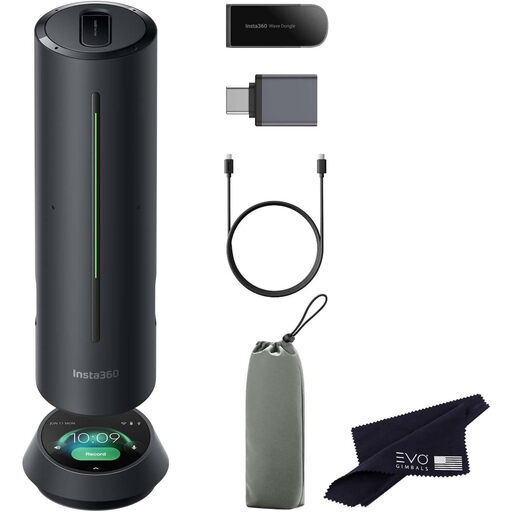 No image available
A speakerphone for a desk or small table. Check that Bluetooth is compatible with the device you use for meetings.
The product information mentions storage for audio files. Before a confidential conversation, check the recording settings and how files are managed.
 No image available
A speakerphone for a personal conference call. Check whether Bluetooth or USB-A suits the connection you want to use.
The product name lists Bluetooth and USB-A (USB 2.0). Check which cables or accessories are included with the version you’ve chosen.
 No image available
A portable speakerphone for a desk or small table. Check that the Teams version is compatible with your meeting app.
The product name identifies this as the MS Teams version. Its stated use case doesn’t guarantee clear speech among talking colleagues.
 No image available
This is a mono headset, not a table speakerphone. Consider it only if you’re looking for a personal listening and speaking solution.
The product name lists USB-A and a mono version. Check that it connects to your computer and works with your meeting app.
No. Microphone noise reduction won’t stop people nearby from hearing the speaker. NEN says a closed room is necessary for confidential conversations.
Select the microphone and speaker you plan to use in your meeting app, then try a conversation and an interruption from your usual seat. If you’re in a group, test from the furthest seat too. The stated microphone range doesn’t prove that voices will be clear above office noise.
Not necessarily. Jabra lists USB-A/USB-C for connecting the Speak2 55 to a computer, and Bluetooth for a smartphone or tablet. Check that your computer and meeting app are supported for the exact version, including any dongle you may need.
Check whether your setup needs a dongle, whether it’s included with the version you’ve chosen and which warranty terms apply to that specific offer. HP lists a two-year standard warranty for the Sync 20 series; this doesn’t determine the terms for other models or sellers.
CE marking is only required for products covered by harmonised EU rules that require it. For radio equipment, such as Bluetooth products, the European Commission’s Radio Equipment Directive provides the regulatory framework. According to the Dutch Data Protection Authority, recording employee conversations is subject to certain conditions and information requirements. This doesn’t mean that every mentoring session must be recorded, or that recordings are always permitted without conditions.