If a colleague is joining remotely, choose a speakerphone based on the distance to the furthest speaker and a connection that suits your meeting laptop. Then test it in your actual table layout. If everyone is in the room, you don’t need a speakerphone for the meeting. Bright light from a window calls for a separate adjustment to the screen position or window covering, not an audio device.
Who is this for?
Team with a remote colleague
You’re discussing a concept together and want your remote colleague to hear voices from different places around the table. Measure the distance to the furthest seat, and consider microphone placement and people speaking at the same time.
User of a shared laptop
You’re starting the meeting on a laptop used by several colleagues and want to select the right microphone and speaker quickly. Check the ports and audio settings on both the laptop and the meeting app.
Team that moves between workspaces
You move the meeting or sometimes call in using a phone. Compare the connection options for each model, and check how it pairs and charges.
What should you consider when choosing?
USB speakerphone connected to the meeting laptop
Choose this if: a colleague is joining remotely and the laptop has a suitable USB port.
Bear in mind: a cable limits where you can place it; check the port, cable and distance to the furthest speaker.
Portable Bluetooth speakerphone
Choose this if: you move between workspaces or sometimes join meetings using a phone or tablet.
Bear in mind: pairing and charging; Bluetooth support for a phone doesn’t confirm that the same connection is suitable for a meeting laptop.
Expandable table set-up
Choose this if: participants are so far apart that placing a single device is difficult.
Bear in mind: a two-device set-up needs extra configuration; the stated coverage doesn’t guarantee clear speech in your room.
No speakerphone
Choose this if: everyone is in the room and no one needs to listen or speak remotely.
Bear in mind: if someone does join remotely later, they’ll need to hear everyone at the table and be heard themselves.
| What to consider |
What should you look for? |
Who is this important for? |
| Voices from every seat |
Measure the distance to the furthest seat. Jabra recommends placing the Speak2 55 centrally, 0.5–2.3 m from each participant; test the set-up at your table. |
When I’m discussing a concept with someone remotely, I want comments from the furthest seat to come through too; around 36% of consumers prioritise clear speech from every seat. |
| Connection and audio settings |
Check the USB port and the cable or dongle included. Select the device as both the microphone and speaker on the laptop and in the meeting app. |
With a shared laptop, I want to select the right input and output quickly; around 29% of consumers prioritise a reliable connection. |
| Two-way conversation |
Check whether the exact model specifies full-duplex audio, and test whether a remote participant can respond while others are speaking. Jabra and EPOS describe this feature for the models mentioned. |
When comments may overlap during a text review, I want the conversation to flow naturally both ways; around 21% of consumers prioritise this. |
| Moving it and seeing the controls |
Check Bluetooth support for the device you intend to use and how to tell when the speakerphone is muted. Test the controls in the room’s lighting; a speakerphone won’t fix screen glare. |
When I move between workspaces, I want to use the speakerphone easily and see its controls; around 14% of consumers prioritise portability and visible controls. |
Common buying mistakes
-
Treating a stated microphone range as a guarantee of clear speech
The manufacturer’s placement guidance doesn’t test the acoustics, table layout or speakers in your room.
Measure the distance to the furthest seat and test the actual set-up with a remote participant.
-
Assuming Bluetooth for a phone is the recommended laptop connection
Jabra recommends a USB connection to a computer for the Speak2 55; according to Jabra, a standard Bluetooth connection to a computer doesn’t have the same certification status.
Check which connections are supported for the exact model and device, and which cable or dongle comes with that version.
-
Buying a speakerphone to fix glare on the concept
A speakerphone handles audio, but it won’t make the screen easier to read next to a bright window.
Check how readable the screen is at the time of the meeting, and adjust its position or the window covering if needed.
Brands to consider
Jabra
The Speak2 55 is designed for portable meetings around a table, with USB connectivity to a computer and Bluetooth connectivity to a phone or tablet.
- For the Speak2 55, Jabra specifies four beamforming microphones, full-duplex audio and placement 0.5–2.3 m from participants.
- Jabra recommends USB for computer use; according to Jabra, a standard Bluetooth connection to a computer doesn’t have the same certification status.
HP Poly
The Poly Sync range includes USB and Bluetooth speakerphones, and may suit organisations that already use this meeting equipment.
- HP describes the Sync range as USB and Bluetooth speakerphones.
- Compare the USB connector, any dongle and the platform version for each Sync model; features of the range don’t necessarily apply to every model.
AnkerWork
The PowerConf S500 is designed for table meetings, with connections via USB-C or a dongle for a PC and Bluetooth for a phone.
- The manual describes three connection options and a mute button.
- Check which accessories come with the version on offer, and whether the device is selected as both the microphone and speaker.
EPOS
The EXPAND 40 is an option for meetings where USB-C or Bluetooth and the ability to speak at the same time are important.
- EPOS lists three beamforming microphones and duplex support for this model.
- Descriptions of noise cancellation and call quality are claims made by EPOS, not the result of an independent audio test.
EMEET
The OfficeCore M0 Plus is designed for table meetings, with USB-C or Bluetooth and the option to pair a second device.
- EMEET specifies four microphones and describes pairing two devices.
- The stated coverage and group size are manufacturer specifications; check the configuration needed for your table.
Speakerphones at Joybuy
Joybuy speakerphone options for a concept review; check that each model’s connection and placement suit your meeting set-up.
 No image available
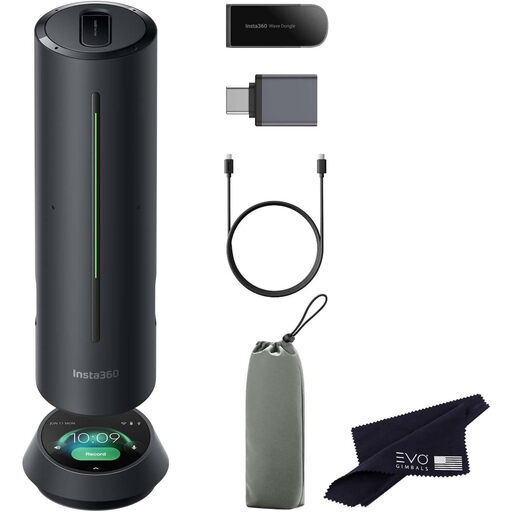
Insta360 Wave AI Conference Speakerphone, Black
The product title mentions Bluetooth, which may be useful if you want to move the set-up.
Check that the connection and microphone placement suit the furthest seat and your meeting app.
View at Joybuy
 No image available
Jabra SPEAK 510 MS, USB-A, Black
The title mentions USB-A and Bluetooth; check which connection suits the shared laptop and meeting app.
Select the speakerphone as both the microphone and speaker before the meeting starts.
View at Joybuy
 No image available
Jabra Speak2 55 MS Teams, Dark Grey
For the Speak2 55, Jabra recommends USB for computer use; check that the connection suits this MS Teams version and your laptop.
For the Speak2 55, Jabra specifies full-duplex audio and four beamforming microphones. Test the placement with the actual seating positions around your table.
View at Joybuy
Frequently asked questions
Where should you place the speakerphone when discussing a concept?
Start by placing it in the centre of the table, then compare the distance to each speaker with the guidance for the exact model. For the Speak2 55, Jabra recommends a distance of at least 0.5 m and no more than 2.3 m from each participant; then test it from the actual seats.
Why can the remote colleague still hear the laptop microphone?
Select the speakerphone as both the recording and playback device in the operating system and the meeting app. The Jabra and AnkerWork manuals describe using the speakerphone for the audio connection.
What should you do if bright light from the window makes the concept hard to read?
Change the screen’s position or angle in relation to the window, or use a suitable window covering. Arboportaal recommends this for reducing reflections and glare in the workplace; a speakerphone won’t change what’s on the screen.
Can you record a work meeting using a speakerphone without asking?
Having a speakerphone doesn’t in itself give you permission to record conversations. According to the Dutch Data Protection Authority, you need a valid legal basis to collect and use personal data, and employees must know when their conversation is being recorded. Whether a particular recording is permitted depends on its purpose, your role and the circumstances.


