
Gamer with a small desk
You want to find a PC that fits first, then choose between a mini PC and a compact tower. Make sure you allow room for cables and airflow too; HP recommends leaving enough ventilation space around desktop PCs.


If space is limited, start by considering the simulation you want to play, your screen and where the PC will go. A gaming mini PC takes up little room, a compact desktop offers a different balance between size and components, and a larger tower is worth considering if expandability matters more to you than a compact design. SpaceEngine and Universe Sandbox have different system requirements; those requirements alone cannot predict how a particular PC will perform with your settings.
You want to find a PC that fits first, then choose between a mini PC and a compact tower. Make sure you allow room for cables and airflow too; HP recommends leaving enough ventilation space around desktop PCs.
You want to match the graphics settings to the requirements of your simulation, the GPU and its video memory, rather than choosing based only on the size of the case. Cosmographic Software and Giant Army publish different system requirements for SpaceEngine and Universe Sandbox.
You’re weighing up a compact design against replaceable components, and checking the upgrade options for the exact configuration. MSI and Lenovo describe different desktop ranges and configurations, so check the components in the specific model you’re considering.
| What to consider | What should you check? | Who is this important to? |
|---|---|---|
| Space and placement | Measure the available width, depth and height. Also check the feet, cable direction and the clearance needed around the vents of the exact model. | If space is tight, I want to know whether the whole setup will fit and whether the air vents will remain unobstructed. Around 28% of consumers say placement is their main concern. |
| GPU and simulation requirements | Cosmographic Software lists at least 5 GB of VRAM for its recommended SpaceEngine configuration; Giant Army recommends 8 GB of video memory for Universe Sandbox. Check the requirements for your version and settings; these are not performance guarantees. | When I want to run a specific space simulation, I check the requirements for that exact game and the full GPU specification. Around 22% of consumers prioritise whether a PC is suitable for their own simulation. |
| Cooling and airflow | Check where the PC draws in and expels air, and whether the vents will remain clear and accessible in your setup. HP recommends adequate ventilation and regularly cleaning the vents. | If my PC is going in a corner or alcove, I want to keep the vents clear and be able to clean them. Around 17% of consumers put cooling at the top of their list. |
| Future upgrades | For the exact configuration, check which memory and storage slots are free and which components can be replaced. Don’t assume you can upgrade it based on the product range alone. | If I want to upgrade components later, I check in advance which changes are possible with the configuration I’ve chosen. Around 17% of consumers prioritise expandability. |
| Included components and seller | For each configuration, check which components and operating system are included, who the seller is, and the terms for any additional warranty and returns. | If I want to know exactly what I’ll receive and who to contact if there’s a fault, I check the offer and the seller. Around 16% of consumers say this is their main buying concern. |
Cables, feet and clearance around the vents can all affect where the PC will actually fit.
Measure the complete setup and follow the placement instructions for your chosen model.
Requirements can vary between simulations. RAM and video memory are also different specifications, and meeting a minimum or recommended requirement does not guarantee a particular level of gaming performance.
Check the full GPU specification and the requirements for the simulation and version you want to use.
According to the Dutch government, the Netherlands does not have a fixed statutory warranty period. A manufacturer’s warranty is in addition to your statutory rights.
Keep your proof of purchase and contact the seller if something goes wrong.
The ROG NUC (2025) is an example of a gaming mini PC for anyone who values a small case.
The OMEN 16L TG03-0630nd is an example of a compact, fully equipped gaming desktop.
The MPG Trident AS 14th range is a slim gaming desktop, offering an alternative to a mini PC or conventional tower.
The Legion Tower 5 Gen 10 is a larger tower option for anyone who doesn’t need the smallest possible case.
This Joybuy selection includes compact gaming desktops and mini PCs for anyone short on space. The models have different graphics specifications, so check your simulation’s requirements before choosing.
 No image available
A complete gaming PC to consider if the GPU specification listed is suitable for your simulation’s requirements; specifications alone can’t predict performance.
GeForce RTX 5060 Ti with 8 GB of video memory, 16 GB DDR4 RAM and a 480 GB NVMe SSD.
Windows 11 Home is pre-installed but not activated.
Giant Army recommends 8 GB of video memory for Universe Sandbox; this does not guarantee a particular gaming experience.
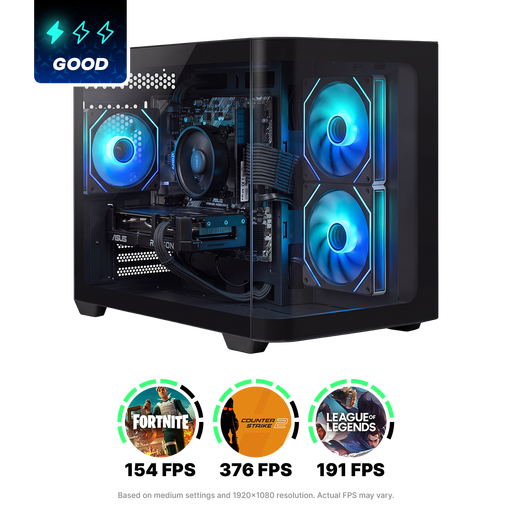 No image available
The case is described as a compact SHARK WAVE MINI; check the external dimensions and the airflow clearance in your setup.
Radeon RX 9060 with 8 GB of video memory, 16 GB DDR4 RAM and a 500 GB NVMe SSD.
Windows 11 Home.
Giant Army recommends 8 GB of video memory for Universe Sandbox; that doesn’t prove how this PC will perform with your settings.
 No image available
A mini PC to consider if its small form factor suits your workspace. Check the graphics and other system requirements for the full configuration against those of your chosen simulation.
16 GB LPDDR5 memory and a 512 GB M.2 NVMe SSD.
Windows 11 Home is pre-installed and activated.
 No image available
A compact mini PC for anyone short on space; check whether the integrated Radeon 680M meets the requirements of your simulation and the settings you want to use.
16 GB RAM, a 512 GB SSD and two M.2 slots.
 No image available
The mini PC form factor may suit a small workspace. Compare the Radeon 760M and the rest of the configuration with your simulation’s requirements; the product name alone is no guarantee of performance.
24 GB LPDDR5 memory and a 512 GB PCIe 4.0 SSD.
No, you can’t tell from a single specification. Giant Army recommends 8 GB of video memory for Universe Sandbox; Cosmographic Software lists at least 5 GB for the recommended configuration in the SpaceEngine quick-start guide. Check the requirements for your software, version and settings; these figures don’t promise a particular frame rate.
First check the placement instructions for your chosen model and keep the air vents clear. HP recommends adequate ventilation around desktop PCs and regularly cleaning the vents, so don’t measure the case alone.
No. According to the Dutch government, the Netherlands does not have a fixed statutory warranty period; what you can expect from a product depends, among other things, on the product and the circumstances. If there’s a fault, contact the seller. A manufacturer’s warranty is in addition to your statutory rights.
Not for every purchase. According to the Dutch government, many eligible distance purchases come with a 14-day cooling-off period, but not every transaction is covered by these rules, such as an online purchase from a private individual. Check who the seller is and the information provided about the purchase.
Check who the seller is, what warranty and returns terms apply, and whether import charges may apply. The Dutch government also notes that electronic products placed on the market in the EU must meet applicable requirements and CE marking rules; a Dutch-language sales page alone doesn’t prove that these requirements have been met.