
Vandaag of morgen in huis

Kwaliteit gegarandeerd

Welkomstaanbiedingen ontgrendelen: GRATIS bezorging | Tot 80% korting | Gratis 30 dagen JoyPlus-proefperiode
Download de app
A shoe rack may seem like a simple purchase, until you find that the shelves are too narrow, boots do not fit or the whole unit wobbles once it is full. For a family, the required capacity can quickly increase. A shoe rack for 30 pairs of shoes takes up little floor space, but it does require a suitable height and a stable surface.
If you focus only on the price or appearance, you could end up spending money unnecessarily. Pay particular attention to these three common pitfalls:
Do not just measure the width of the space, but also the depth, height and clear walking space. In a narrow hallway, a deep rack could obstruct doors or a walkway. Also check for skirting boards, radiators and sockets.
A hallway shoe rack is often tall and relatively narrow. A low model is more likely to fit under a coat rack or inside a wardrobe. For a living room, a shoe cabinet may be more practical, as closed doors keep shoes out of sight.
Pay attention to the order of the dimensions. Product listings may show width, depth and height in different orders. Always check the product specifications before ordering.
A rack with multiple levels makes good use of vertical space. The 5five Shoe Rack measuring 87 x 30 x 155 cm, for example, has 16 shelves and is designed for indoor use. The model is made from polypropylene and steel and requires self-assembly.
Another 5five model is listed as suitable for 30 pairs of shoes and measures 65.5 x 24.5 x 138 cm. The product information states that it has a metal construction and a freestanding design that is not intended for sitting on. For wide men’s shoes or boots, it is advisable to check the available height and depth of each shelf.
Steel and metal are suitable if you are looking for an open shoe rack with a light, airy appearance. Check that the connections are firmly secured and that the rack is standing on a level floor. With a tall rack, securing it to the wall can improve stability, particularly in a household with children.
Plastic is often lightweight and easy to clean. A combination of polypropylene and steel can be a practical choice for everyday use, provided that the shelves are suitable for the weight of your shoes.
For a tidier appearance, a closed shoe cabinet is worth considering. Models with adjustable shelves offer greater flexibility for trainers, ankle boots and taller shoes. However, do pay attention to ventilation and the available internal dimensions.
The right choice depends on the space available and how you use it. Someone who mainly wants to tidy away everyday shoes quickly will have different requirements from a family with lots of pairs of shoes or someone looking for a hallway unit with a seat.
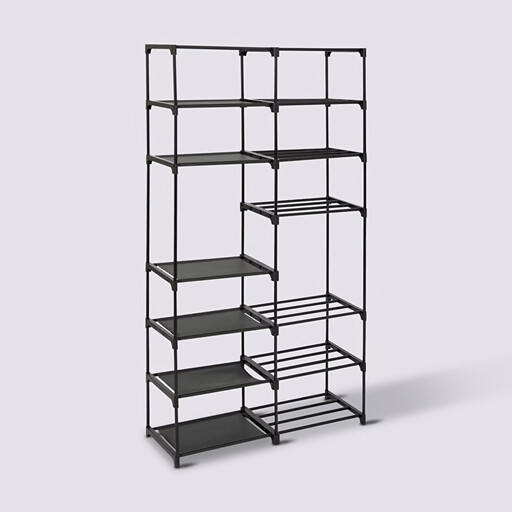
Why it suits this profile: This tall model offers plenty of storage levels without taking up much floor space. It is suitable for households looking for open shoe storage in the hallway, bedroom or wardrobe.
The dimensions and the total of 16 shelves are clearly stated. This means you can check in advance whether the height and capacity are suitable for your space.
87 x 30 x 155 cm; 16 shelves; polypropylene and steel; weight of 2.59 kg; suitable for indoor use.
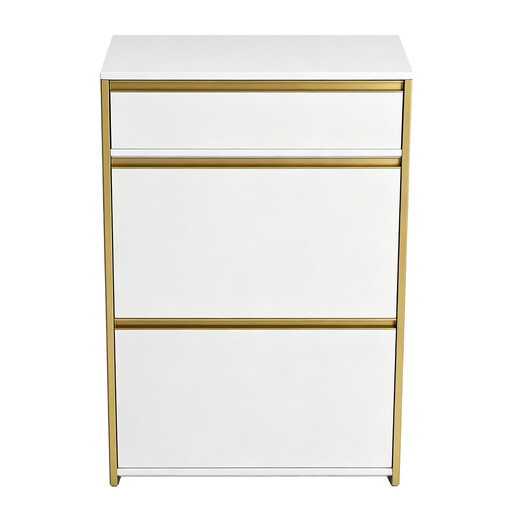
Why it suits this profile: This closed unit is ideal for anyone who wants to keep shoes out of sight while also gaining extra storage space for small items. It measures 60 x 24 x 104.5 cm.
According to the product information, the internal shelves are adjustable and removable. This allows you to adapt the layout instead of being restricted to a single shelf height.
Two doors; four adjustable shelves; drawer and top surface; according to the product information, space for up to 12 pairs; wall-fixing included as a stabilising feature.
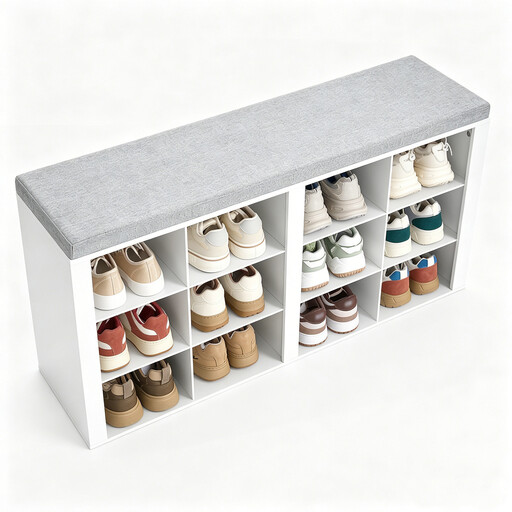
Why it suits this profile: A shoe rack with a bench is useful in a hallway where family members want to sit down to put on their shoes. This model has 12 compartments and adjustable shelves.
The adjustable shelves accommodate different types of footwear. The product information also states that the unit has a load capacity of 150 kg.
104.5 x 49.5 x 30.5 cm; 12 compartments; adjustable shelves; removable seat cushion covers; materials: chipboard, sponge, cotton and linen.
We have put together a complete, up-to-date list of products that fully meet these strict selection criteria and the applicable European safety regulations.
Not every home has space for a freestanding rack. A hanging shoe organiser on the door makes use of vertical space and is suitable for lightweight shoes or accessories. Check beforehand that the door still closes properly and that the hooks can support the weight.
For a wardrobe, stackable shoe boxes keep everything organised. Transparent boxes make the contents visible and can be expanded one pair at a time. However, they take longer to access and put away than an open rack.
A stackable metal model can be practical if you want to change the layout later. The JOYFURNOS 3-Tier Metal Shoe Rack measures 30 x 92 x 55 cm, is stackable according to the product information and holds approximately 16 to 20 pairs. The stated maximum static load is 10 kg per level and 30 kg in total. Do not use the rack as a step stool.
That depends on the width, depth and spacing between the shelves. A rack that can hold a large number of pairs on paper offers less usable space when you have high-top trainers, boots or wide shoes. Count your current collection and leave some spare room for everyday use.
Place the rack on a level surface, distribute heavier shoes across the lower levels and tighten all the connections securely. With tall models, securing the rack to the wall is recommended if children or pets can reach it. Always follow the assembly instructions and check the connections regularly.
A shoe cabinet keeps shoes out of sight and can make the hallway look less cluttered. An open shoe rack makes it easier to access and put away shoes and generally provides better ventilation. Choose a cabinet with adjustable shelves if you want to store different types of footwear. With a closed model, also check the ventilation and internal dimensions.
