
Guests who are there for the cake
You’re looking for a little bread to go with coffee and cake, not necessarily a loaf for everyday lunches. For example, PLUS sells a white sourdough baguette that you can bake at home.


If you’re mainly looking to serve a small piece of bread alongside cake, a white sourdough baguette is one option. If you’d also like bread for everyday meals, look at wholemeal or brown multigrain sourdough and compare the ingredients and fibre content. For each product, check the allergens, whether it contains iodised salt, and whether it’s ready to eat or needs baking.
You’re looking for a little bread to go with coffee and cake, not necessarily a loaf for everyday lunches. For example, PLUS sells a white sourdough baguette that you can bake at home.
You’d like to serve the same bread with everyday meals too, so you’re looking at the type of grain and the fibre content. According to the Netherlands Nutrition Centre, wholemeal bread is high in dietary fibre, vitamins and minerals.
You want to be able to keep bread for a planned coffee break or use it in portions. If so, check the product format and storage instructions, as these can vary for fresh, part-baked and frozen bread.
First decide whether the bread is just for serving with coffee and cake or whether you also want it for other meals. Then check how it needs to be prepared and read the information on the packaging.
| What to consider | What should you check? | Who is this relevant to? |
|---|---|---|
| Bread to serve with cake | Check whether the bread is white, brown or wholemeal; the word sourdough doesn’t tell you which type of grain has been used. | If cake is the main event, I’d serve no more than a small piece of bread alongside it. For around 31% of consumers, the style of bread would be the first thing to consider. |
| Using it for other meals | Check the ingredients and compare the fibre per 100 g across products with the same preparation status. | I’d also use the bread for breakfast or lunch, so I’d look at the type of grain and the nutritional information. Everyday use would be the priority for around 31% of consumers. |
| Preparation and storage | Check whether the bread is ready to eat or needs baking, and read the storage and preparation instructions. | For a planned coffee break, I’d want to know when the bread will be ready and what to do with any leftovers; around 23% of consumers would see this as the most important factor. |
| Ingredients and allergens | Read the allergen information and check the salt per 100 g or whether it contains bakers’ salt or iodised salt, if this matters to you. | If I need to avoid a particular ingredient, the information on the packaging matters more than the style of bread. Checking the label would be the main consideration for around 15% of consumers. |
Sourdough describes how the bread is made, not necessarily the type of grain used. This means white and wholemeal sourdough breads can have different nutritional values.
If you want wholemeal bread, look for that description specifically and check the ingredients list.
According to the Netherlands Nutrition Centre, bakers’ salt is iodised, but bakers aren’t required to use it.
If this matters for your purchase, check the ingredients list for bakers’ salt or iodised salt.
Jumbo says that its sourdough breads baked in store aren’t available to order online. This could matter if you want to plan ahead for a visit.
Check the ordering or in-store information for the bread you want to buy.
If you only get through part of the loaf during your coffee break, you’ll need to store the rest properly.
Choose a size that suits the occasion, or freeze portions of bread according to the storage instructions. For part-baked or frozen products, follow the instructions on the packaging.
Bread left for too long can dry out or go off.
Albert Heijn lists several AH Liefde & Passie OerDesem varieties, including breads made with rye, pumpkin or spelt and buckwheat.
Jumbo describes a range of breads baked in store, including wholemeal pumpkin and white spelt sourdough.
Lidl lists a rustic wholemeal wheat sourdough bread in its fresh-from-the-oven range.
PLUS lists both a white baguette made with sourdough and a small brown multigrain sourdough loaf.
Dirk includes sourdough among the other types of bread in its bread category.
Through Bakkersgoud, ALDI lists rustic bread options at stores with an in-store bakery.
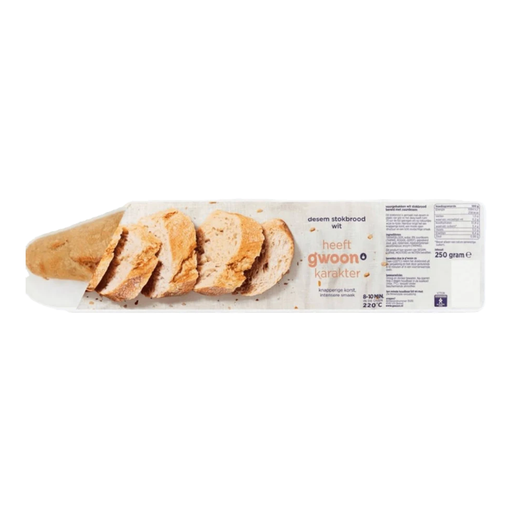
This white baguette could be served alongside coffee and cake. If you’re specifically looking for sourdough, check the current product packaging for a mention of sourdough.
 No image available
A 250 g white baguette for anyone who’d also like to serve bread alongside cake. Check the packaging to see whether it contains sourdough, which allergens are listed and whether it needs baking.
No, the word sourdough doesn’t automatically mean that the bread is wholemeal. If the type of grain matters to you, check the product name and ingredients list.
No, according to the Netherlands Nutrition Centre, bakers aren’t required to use bakers’ salt. Check the ingredients list for bakers’ salt or iodised salt, or ask your baker.
The Netherlands Nutrition Centre says that opened wholemeal sourdough bread keeps for 2 to 4 days in a kitchen cupboard and 1 to 3 months in the freezer. If you want to freeze it in portions, it’s best to do so soon after buying it, and to follow the instructions on the packaging too.
Yes, as long as you have the time and equipment to bake it before serving. PLUS says its white sourdough baguette takes 8 to 10 minutes in an oven at 220 °C or 4 minutes in a preheated air fryer at 200 °C. For other breads, follow the instructions on the packaging.