Who is a soup maker suitable for?

Lunch prepper with limited cupboard space

You want to take soup with you, but also be able to put the appliance away in a small cupboard after use. So compare its external dimensions with your cupboard, not just the jug capacity. For example, DOMO publishes the external dimensions of the DO726BL.

Meal prepper making several lunches

You want to make several portions at once and tailor the batch to what you can safely store or freeze. The Netherlands Nutrition Centre advises keeping cooked food in the fridge for no more than two days.

Cook looking to avoid an extra appliance

You already have a saucepan and hand blender, and are weighing up automatic heating and blending against the extra storage space and cleaning involved. A recipe from the Netherlands Nutrition Centre describes making soup in a saucepan and then blending it with a hand blender.

What should you consider when choosing?

Compact electric soup maker

Suitable if: you usually make smaller batches for lunch and have space to store an extra appliance. DOMO lists a 1 l jug and programmes for smooth and chunky soup for the DO1004BL.

Trade-off: the jug capacity limits how much you can make at a time; also check the external dimensions of the exact model.

Soup maker for larger batches

Suitable if: you want to make several lunches at once and have enough measured cupboard space. Princess lists a capacity of 1.3 l for the 212040.

Trade-off: a larger capacity doesn’t prove the appliance will fit in your cupboard; DOMO lists the DO726BL as 46 cm high.

Your existing saucepan and hand blender

Suitable if: you already have a saucepan and hand blender and don’t want to store another appliance. The Netherlands Nutrition Centre describes cooking soup in a saucepan and then blending it with a hand blender.

Trade-off: cooking and blending remain separate manual steps.

What to consider What should you check? Who is this important for?
Storage space Measure the available width, depth and height, then compare them with the external dimensions of the exact model. The jug capacity doesn’t tell you whether the whole appliance will fit in your cupboard. If my cupboard has limited space, I want to know in advance whether the appliance will fit. Around 36% of consumers make storage space their top priority.
Portions per batch Compare the stated jug capacity with the number of portions you want to make for lunch, and check the fill markings in the manual. If I want to make several portions for lunch at once, I look at how much I can make per batch. Around 29% of consumers prioritise batch size.
Ease of cleaning Read the cleaning instructions and check which parts can be removed. DOMO states that the blades on the DO726BL cannot be removed. If I use it regularly, I want to know how to clean the jug, lid and blades. Around 21% of consumers make ease of cleaning their top priority.
Preparation method Check which programmes are available for smooth or chunky soup on each model, and consider whether you’d rather cook and blend the soup yourself. If I want to choose the texture of my soup or decide how it’s prepared, I compare the programmes with my existing saucepan and hand blender. Around 14% of consumers prioritise the preparation method.

Common buying mistakes

  • Confusing jug capacity with external dimensions

    A capacity of 1.2 l doesn’t tell you how much cupboard height the appliance needs. According to DOMO, the DO726BL is 46 cm high.

    Measure the space where you plan to store it and compare it with the external dimensions of the exact model you want to buy.

  • Assuming a soup maker is a way to store soup

    Making soup in one appliance doesn’t remove the need to cool it quickly and keep it chilled during storage or transport.

    Plan for sealed portions, refrigeration and, if needed, a cool bag before making soup for lunches later on.

  • Mixing up model versions and product condition

    Philips describes the HR2204/80R1 as refurbished; this version isn’t necessarily the same as another model variant.

    Compare the full model code and check the product condition and terms of the offer.

Brands to compare

Compare the versions listed separately: jug capacity, programmes, dimensions and product condition may vary.

DOMO

DOMO lists a 1 l jug for the DO1004BL and a 1.2 l jug for the DO726BL.

  • According to DOMO, the DO1004BL has programmes for smooth and chunky soup.
  • DOMO lists the DO726BL as 46 cm high and says its blades cannot be removed; measure your cupboard and check the cleaning instructions for this model.

Princess

Princess describes the 212040 as a soup maker with a jug capacity of 1.3 l.

  • Princess also lists a separate blending programme.
  • Jug capacity alone doesn’t tell you whether the appliance will fit in your cupboard; check the external dimensions of the exact model.

Philips

Philips describes the Viva SoupMaker HR2204/80R1 as a refurbished version with a 1.2 l jug and six automatic programmes.

  • Philips lists programmes for thin and thick soup, among other options.
  • Check the full model number, HR2204/80R1, and the product condition; don’t assume details for another variant apply.

Joybuy product selection

This selection is for anyone looking for an appliance to make soup for lunches. Check the capacity and external dimensions of the exact model before ordering.
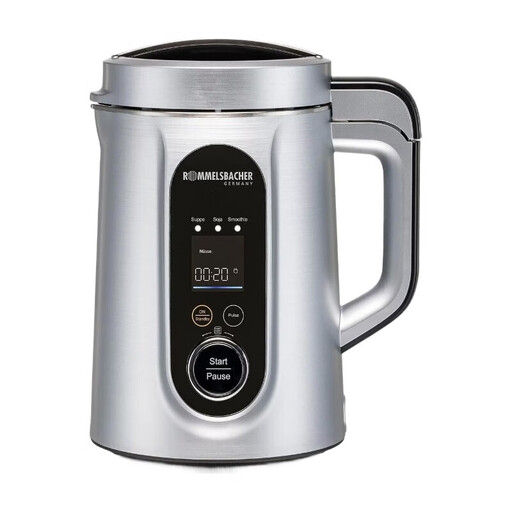
Rommelsbacher Soup & Vegetable Drink Maker SVD 1400

Rommelsbacher Soup & Vegetable Drink Maker SVD 1400

The product name mentions soup and vegetable drinks, making this a potential option if you’re looking for an appliance to prepare soup. Before buying, compare its capacity and external dimensions with the portions you need for lunch and the cupboard space available.

Joybuy

Frequently asked questions

How long can I keep lunch soup I’ve made in advance?

The Netherlands Nutrition Centre advises keeping cooked food in the fridge for no more than two days, ideally at 4 °C. Let the soup cool and put it in the fridge or freezer in a sealed container within two hours; freeze any portions you won’t eat in time.

How should I take chilled soup with me for lunch?

Keep cooled soup sealed and chilled, and use a cool bag when transporting it, as the Netherlands Nutrition Centre advises for cooked food. Before eating, heat a prepared meal thoroughly until it’s steaming hot.

Can I put the whole soup maker in the dishwasher?

Don’t assume you can: check the cleaning instructions for the exact model and its individual parts. A cleaning programme doesn’t necessarily mean you can skip cleaning it by hand.

What should I check if my appliance develops a fault after buying it in the Netherlands?

Check who the seller is and which terms apply to the offer. According to the Dutch Government, if a product develops a fault within the first year after purchase, the seller must show that the consumer caused it. If they can’t, the stated terms give you the right to a free repair or replacement and, in certain specified cases, a refund. An additional warranty doesn’t replace these rights.

Which safety marking is relevant for an electric soup maker?

The Dutch Government states that electronic appliances sold in the EU must have a CE marking. Check the product information and marking for the exact model; a CE marking isn’t a practical test of its cooking performance.
