Who is a soup maker suitable for?

Cook with limited worktop space

You want one appliance for cooking and blending, but need to make sure its footprint and height, and the space needed to store it, will work in your kitchen. DOMO lists the Soup Genius DO726BL as 46 cm high, so measure the clearance beneath your wall cupboards too.

Cook who makes small portions

You don’t want to make a large batch of soup every time, so you need to check both the jug capacity and the minimum fill level. The stated capacity alone doesn’t tell you how small a batch you can make.

Cook who likes smooth soup

You want to cook and blend carrots in the appliance, with a suitable setting for smooth or chunky soup. DOMO lists smooth and chunky soup settings for the Soup Genius DO726BL.

What should you look for when buying?

What to consider What should you check? Who is this important for?
Kitchen space Measure the width, depth and height of the space where you’ll use and store the appliance. DOMO lists the Soup Genius DO726BL as measuring 17.60 × 19.00 × 46.00 cm. If I have limited worktop space, I also want to know whether the appliance will fit beneath a cupboard. Around 36% of consumers put available space first.
Portion size Check the MIN and MAX markings or the manual for the exact model you’ve chosen; the jug capacity isn’t the minimum fill level. If I want to make a small batch, it needs to fall within the permitted fill levels. Around 29% of consumers prioritise their preferred batch size.
Preferred soup texture Check that the appliance both heats and blends, and that its programmes suit smooth or chunky soup. DOMO lists both soup settings for the DO726BL. If I want smooth carrot soup or a chunkier texture, the available settings are key. Around 21% of consumers prioritise their preferred soup texture.
Cleaning Check the cleaning instructions and whether the blades can be removed. DOMO states that the blades on the DO726BL cannot be removed. If I want to keep cleaning to a minimum after cooking, I’ll check how to clean the jug and blades. Around 14% of consumers give cleaning and maintenance top priority.

Common buying pitfalls

  • Comparing only the capacity in litres

    The stated capacity and the minimum fill level answer different questions. The jug capacity alone doesn’t tell you whether a small amount will fall within the fill limits.

    Compare the amount you want to make with the MIN and MAX markings or the manual for the exact model.

    If your batch is outside those limits, you may need to make several batches or have soup left over.

  • Assuming a narrow footprint means it’s easy to store

    According to the manufacturer, the DOMO Soup Genius DO726BL is 46 cm high. So, while an appliance may take up little width, it might not fit beneath a low cupboard.

    Measure the available height where you plan to use and store the appliance.

  • Confusing a standard blender with a soup maker

    The Dutch Consumers’ Association notes that a suitable blender can blend soup, but only some blenders can heat it too.

    Check separately whether the jug is suitable for hot soup and whether the appliance heats the ingredients itself.

    If the blender doesn’t heat, you’ll also need a separate pan.

Brands to compare

Philips

The Dutch Philips website describes the Viva SoupMaker HR2204/80R1 as a refurbished model with a 1.2-litre jug and programmes for, among other things, thin and thick soup.

  • Philips lists six programmes.
  • The model described is refurbished; the product specifications don’t tell you whether it’s currently in stock or available new.

Princess

Princess describes the 212040 as a 1.3-litre soup maker that heats and blends ingredients.

  • The manufacturer also lists uses such as making compote.
  • For your recipe, check the minimum fill level and how much storage height the appliance needs.

DOMO

DOMO describes the Soup Genius DO726BL as a 1.2-litre heated blender jug with eight programmes.

  • Its stated footprint is 17.60 × 19.00 cm.
  • According to the manufacturer, the appliance is 46 cm high and has non-removable blades. Bear this in mind when storing and cleaning it.

Morphy Richards

The British manufacturer describes the Compact 501021 as a 1-litre soup maker with programmes for smooth and chunky soup.

  • Its stated dimensions are 21.3 × 15.7 × 22.7 cm.
  • This British product information doesn’t confirm the model, plug or availability for the Dutch market.

Soup makers at Joybuy

This product selection is for anyone who wants to make soup with an appliance that heats and blends.
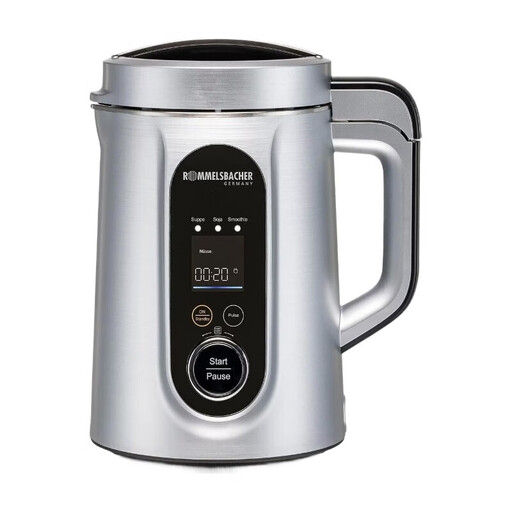
Rommelsbacher Soup & Vegetable Drink Maker SVD 1400

Rommelsbacher Soup & Vegetable Drink Maker SVD 1400

An option if you want one appliance to heat and blend your soup. Bear in mind the warning that the inner pot gets hot; unplug the appliance before cleaning.

Joybuy

Frequently asked questions

Can I put raw carrots straight into a soup maker?

For the Princess 212040, the manufacturer describes a programme that heats and blends raw vegetables. Morphy Richards advises cutting carrots and other root vegetables into even pieces of about 1–2 cm for its soup makers. For another model, follow its own manual.

Can I make less than a full jug of soup?

First, check the minimum fill level for your model. Morphy Richards advises that the total contents of its soup makers should stay between the MIN and MAX markings; the stated jug capacity doesn’t confirm that a small portion is suitable.

How should I store leftover soup?

The Netherlands Nutrition Centre advises putting leftovers in the fridge or freezer within two hours of cooking. Keep leftovers in the fridge for no more than two days.

Does Dutch law automatically limit me to a two-year legal guarantee?

No. According to the Dutch government, there is no fixed statutory guarantee period in the Netherlands; the expected lifespan depends on the circumstances. If a product is faulty, contact the retailer. Any manufacturer’s guarantee is separate.

Is CE marking required for an electric soup maker sold in the Netherlands?

Yes. The Netherlands Food and Consumer Product Safety Authority states that CE marking is compulsory for electrical products placed on the Dutch market. This general requirement doesn’t confirm that a specific appliance on sale carries the marking or that all its product information is accurate.
