
Host serving plenty of bowls
You want to know whether one batch will make enough soup, so you compare the amount you need with the jug capacity and maximum fill line. DOMO and Princess list models with a capacity of 2 litres.


Choose a jug based on the number of guests, your preferred portion size and the maximum fill line. A smaller jug may suit small starters or cooking several batches, while models with a capacity of 2 to 2.2 litres offer more stated capacity per batch. DOMO and Princess list 2-litre models, while DOMO also lists a 2.2-litre model; the manufacturer’s stated capacity doesn’t guarantee a particular number of bowls. For a smooth result, choose a suitable smooth-soup programme, and plan cooking ahead separately from safe storage.
You want to know whether one batch will make enough soup, so you compare the amount you need with the jug capacity and maximum fill line. DOMO and Princess list models with a capacity of 2 litres.
You want a smooth carrot and coriander soup, so you look for a smooth-soup programme and the option to blend again after the cooking cycle. Good Food’s recipe uses the smooth-soup setting and adds the coriander later.
You want to make the soup in advance or keep clean-up to a minimum after dinner. Think about how you’ll store it, and check which cleaning options the exact model offers. The Nutrition Centre provides advice on storing leftovers.
First, decide what matters most to you: the amount per batch, the texture you want, serving time or cleaning.
| What to consider | What to check before buying | Who is this for? |
|---|---|---|
| Amount per batch | Multiply the amount you want in each bowl by the number of guests. Allow for the ingredients and the maximum fill line. | I want to make enough soup for all my guests in one batch, so I’ll match the quantity to my portions. Around 36% of consumers prioritise cooking one batch. |
| Smooth results | Check whether the exact model has a smooth-soup programme and how to blend again safely once the cycle has finished. | I want smooth soup and to choose when to blend in the coriander. Around 29% of consumers prioritise a smooth texture. |
| Preparing and serving | Check the model’s programme time and plan chopping, any extra batches and serving separately. If you make the soup ahead, follow the advice for storing leftovers. | I want to coordinate preparation and serving, perhaps by cooking earlier. Around 21% of consumers prioritise preparation and serving time. |
| Cleaning and reuse | Check the cleaning instructions and which programmes you’ll actually use later. Don’t assume the jug is dishwasher-safe unless this is confirmed. | I want to look after the soup maker easily after dinner and use it again later. Around 14% of consumers prioritise maintenance and reuse. |
Vegetables and other ingredients take up space too. Good Food’s recipe advises against filling the soup maker above the maximum line.
Work out how much you need for your guests, follow the model’s fill line and plan an extra batch if necessary.
An extra batch takes more preparation time and needs to fit into your serving schedule.
Consumentenbond distinguishes between blenders that can purée soup and models that can heat it too.
Check whether the jug is suitable for hot soup and whether the appliance heats it itself; otherwise, allow for a separate cooking step.
You may need a separate cooking step or other suitable equipment.
A keep-warm function is designed for serving, and doesn’t tell you how to store soup safely if you made it hours earlier.
If you make soup ahead, follow the Nutrition Centre’s advice on storing it. A stated keep-warm time isn’t a substitute for this advice.
DOMO lists soup makers with a range of stated capacities. Capacity may be a factor if you want to limit the number of batches you need to cook.
The Princess 214002 Family XL is a dedicated soup maker with a stated capacity of 2 litres.
According to Philips, the HR2204/80R1 has a 1.2-litre jug and may suit smaller starters or planned batches.
According to Moulinex, the Easy Soup LM841B10 is a soup maker with a stated capacity of 1.2 litres.
According to Rommelsbacher, the SVD 1400 Vera is designed for soup and other uses, including plant-based drinks and porridge.
This product selection focuses on soup makers, and also includes a model designed for plant-based drinks and porridge.
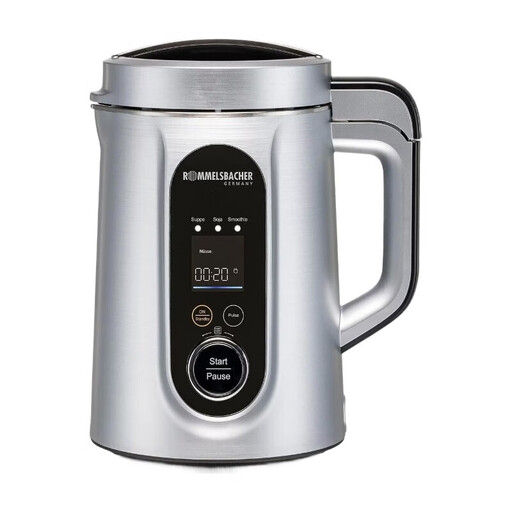 No image available
Suited to anyone who wants to make plant-based drinks or porridge as well as soup; Rommelsbacher lists these uses for this model.
Maximum fill: 1.3 litres according to Rommelsbacher.
The product description lists nine automatic programmes and a pulse function.
First, work out how much you want to serve as a starter, then multiply it by the number of guests. Compare the result with the model’s maximum fill line, allow for the ingredients and plan an extra batch if needed. Good Food’s recipe warns against filling the soup maker above the maximum line.
In Good Food’s recipe, the other ingredients go through the smooth-soup programme first; the coriander is added afterwards and blended in. Check the manual to find out how to blend again safely with your model.
Yes, as long as you store it safely. The Nutrition Centre advises cooling leftovers within two hours, covering them and storing them in the fridge at 4 °C, then eating them within two days. When reheating chilled leftovers, make sure they’re piping hot all the way through.
Check the cleaning instructions and which parts are supplied with the exact model or available separately. DOMO lists a cleaning function for the DO705BL and replacement parts for that model.
According to the Dutch Government, the seller must provide a solution if a product is faulty. There’s no fixed statutory guarantee period in the Netherlands; a manufacturer’s guarantee is in addition to your statutory rights.