
Chunky soup fan
You want to see the lentils and vegetables in your lunch soup, so you’re looking for a dedicated chunky soup setting rather than just a blending function. DOMO, Russell Hobbs and Philips list options for chunky, filled or thick soup.


For chunky lentil soup, a soup maker with a dedicated programme for chunky or filled soup is a sensible choice. Also compare its hot soup capacity with the number of portions you need. DOMO lists a 2-litre capacity for the DO705BL, while Russell Hobbs lists 1.4 litres of soup capacity for the 21480-56. These are the manufacturers’ stated figures, not a guarantee of a particular number of portions of thick soup. When using dried lentils, follow the cooking instructions and check that they’re tender; with a soup pan, you can adjust the cooking and texture as you go.
You want to see the lentils and vegetables in your lunch soup, so you’re looking for a dedicated chunky soup setting rather than just a blending function. DOMO, Russell Hobbs and Philips list options for chunky, filled or thick soup.
You want to know whether your chosen method will cook the lentils through, and be able to adjust the cooking time and texture if needed. The Netherlands Nutrition Centre distinguishes between dried and pre-cooked pulses.
You want to make enough for several people or have leftovers, so you compare the hot soup capacity rather than just the jug’s total capacity. DOMO and Russell Hobbs each state a specific soup capacity for the models mentioned here.
First decide whether you mainly want to keep some texture, check how dried lentils are cooking or make several portions at once. Then consider how easy it is to clean.
For this weekend lunch, your buying priorities might look something like this:
| What to consider | What to look for | Who is this most important for? |
|---|---|---|
| Visible pieces | Look for a dedicated chunky or filled soup setting, and check whether the model also has a separate blending function. | If I want to see pieces of lentil and vegetables in my soup, I’m looking for a programme that isn’t designed solely to purée everything smooth. Around 36% of consumers prioritise keeping a chunky texture. |
| Cooking the lentils through | Follow the instructions for the type of lentils you’re using, and check the appliance and packaging instructions. The Netherlands Nutrition Centre advises cooking dried pulses until tender. | When using dried lentils, I want to be able to check that they’re properly cooked rather than relying on the automatic cycle alone. Around 29% of consumers give cooking the lentils through their highest priority. |
| Amount of soup | Compare the stated hot soup capacity and bear the fill line in mind; don’t count the capacity for cold preparations as soup capacity. | If I’m making soup for several people or to have leftovers, I want to know how much I can make in one go. Around 21% of consumers mainly choose based on the amount made per batch. |
| Cleaning | Check the cleaning instructions for the exact model. DOMO lists a cleaning function and removable blades for the DO705BL; this doesn’t mean that all parts are dishwasher-safe. | After making a thick soup, I want to know how much cleaning the appliance requires and whether parts can be removed according to the manual. Around 14% of consumers consider easy cleaning the most important factor. |
Capacity can vary depending on the preparation. Russell Hobbs lists 1.75 litres for cold preparations and 1.4 litres for soup for model 21480-56.
Compare the stated hot soup capacity and check the fill limits for the exact model.
The cooking time required depends on the lentils and the instructions on the packaging; a soup programme doesn’t provide a universal cooking time.
Check the packaging and make sure the lentils are cooked through. According to the Netherlands Nutrition Centre, pre-cooked lentils from a tin, jar or pouch only need heating through.
The Philips product page for HR2204/80R1 specifically refers to a refurbished item; its specification and condition don’t automatically apply to another variant.
Before buying, check the full model code and the condition of the product on offer.
According to DOMO, the DO705BL has a 2-litre capacity and a dedicated Chunky setting, making it a good fit if you want to make soup with recognisable pieces.
The 21480-56, described on the Russell Hobbs website for the Netherlands, combines a heated blender with a programme for chunky soup.
For the HR2204/80R1, Philips lists programmes for thick and thin soup, among others, and a jug capacity of 1.2 litres.
This selection includes a soup maker for anyone who wants to prepare soup in one appliance. Check separately whether the appliance on offer is suitable for the chunky lentil soup you want to make.
 No image available
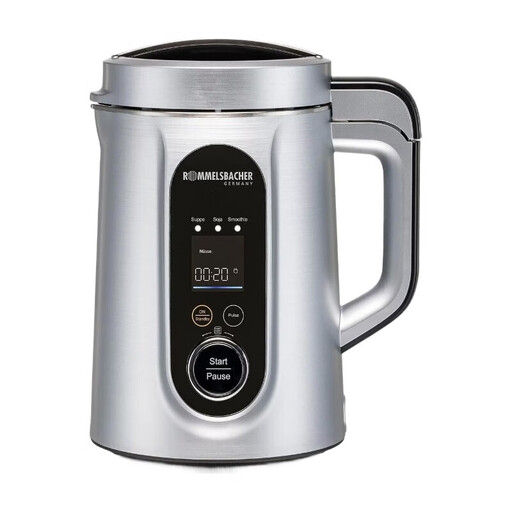
Suitable if you want to prepare soup in one appliance; the product information lists integrated heating and a mixing system.
The stated capacity is 1.3 litres; the product information lists nine automatic programmes, a pulse function and a stainless steel inner pot.
Before buying, check that the item on offer carries the CE marking. The Dutch Food and Consumer Product Safety Authority (NVWA) states that electrical appliances must carry the CE marking. When using the appliance, follow the maximum fill line, as the jug and its contents get hot.
Don’t assume that one cycle will always be enough: the lentils need to be cooked through according to the instructions for the type you’re using and the appliance. The Netherlands Nutrition Centre advises cooking dried pulses until tender; lentils from a tin, jar or pouch only need heating through.
Cool leftovers quickly, store them covered in the fridge or freezer, and don’t leave them out of the fridge for more than two hours. The Netherlands Nutrition Centre’s Storage Guide recommends keeping thickened vegetable soup in the fridge for two days; check which advice applies to your recipe.
No. According to the Dutch government, there is no fixed statutory guarantee period in the Netherlands. If a product is faulty, the seller must put things right; a manufacturer’s guarantee is in addition to your statutory rights.
The NVWA states that electrical appliances, including kitchen equipment, must carry the CE marking. Check the marking on the actual item being offered.