
Vandaag of morgen in huis

Kwaliteit gegarandeerd

Welkomstaanbiedingen ontgrendelen: GRATIS bezorging | Tot 80% korting | Gratis 30 dagen JoyPlus-proefperiode
Download de app
A solar outdoor light seems simple: place it outside, let the solar panel charge and enjoy light in the evening without cables. In practice, performance varies significantly depending on the model and installation location. A light that looks bright in a product photo may burn for less time in a shady British garden. Terms such as “waterproof”, “extra bright” and “energy-efficient” are also not always used to mean the same thing.
With this buying guide, you can compare solar outdoor lighting using verifiable specifications. This makes it easier to find the right solar wall light, solar garden light, solar security light or solar pathway light for your patio, balcony, exterior wall, driveway or entrance.
A solar security light with a high lumen output may be suitable for a driveway or garage, but it also uses the stored energy more quickly when operating at full brightness. Check whether the light has several modes. An outdoor light with a motion sensor, for example, may only shine brightly for a short time when movement is detected, while a softer background light stays on for longer.
As well as lumens, consider the light distribution. Three adjustable light heads can illuminate a larger area than one fixed light source with the same total light output.
The IP rating indicates how well a housing is protected against dust and water. An IP44 outdoor light is resistant to splashing water and is suitable for many sheltered walls, balconies and entrances. An IP65 outdoor light offers a higher level of protection against dust and water jets according to its classification.
Neither rating means that you should submerge the light. Do not place a solar light in a dip where water collects, and always follow the installation instructions. Also check that the seals, sensor and solar panel remain free from dirt.
A powerful battery cannot compensate for an unsuitable location. Trees, a tall fence, a canopy or the north-facing side of a wall can limit charging. According to the product information for various models, direct sunlight is needed for optimum charging performance.
When positioning the light, look for:
Lumens indicate how much visible light a lamp produces according to its product specification. For decorative solar garden lights along a border, a low light output is often sufficient. The UME pathway lights, for example, specify 10 lumens per light and a warm colour temperature of 3000K. This is suitable for marking out a path without strongly illuminating a large area.
An entrance or driveway is more likely to require a higher light output. The Philips Fyns specifies 1000 lumens and 3000K. The Philips Zyren models specify 4000 lumens and are intended to provide broader illumination with a motion sensor.
A low colour temperature, such as 2700K, generally appears warmer. At around 3000K, the light remains warm white, while 5000K has a cooler, brighter daylight character. Choose warm light for patios and gardens; cooler light can be practical around a garage or side entrance.
Do not simply choose the highest number: consider the actual installation location.
A solar light with a motion sensor mainly uses the battery when someone enters the detection area. Look at the detection distance, viewing angle and adjustable modes. A sensor with a wide range is not automatically convenient in a small front garden: passers-by on the pavement may trigger the light unnecessarily.
Also check:
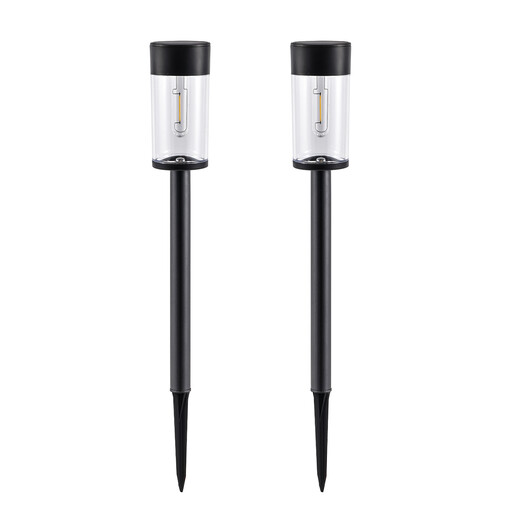
Why it suits this profile: This set is designed for paths, borders, lawns and driveways. The ground stakes make installation without cabling simple.
The product specification states 10 lumens per light and IP65. This makes it clear that these are accent and orientation lights, not broad-beam security lights.
Two lights per set, 3000K warm white light, automatic dusk activation and a stated lighting duration of 8–12 hours under the specified charging conditions.
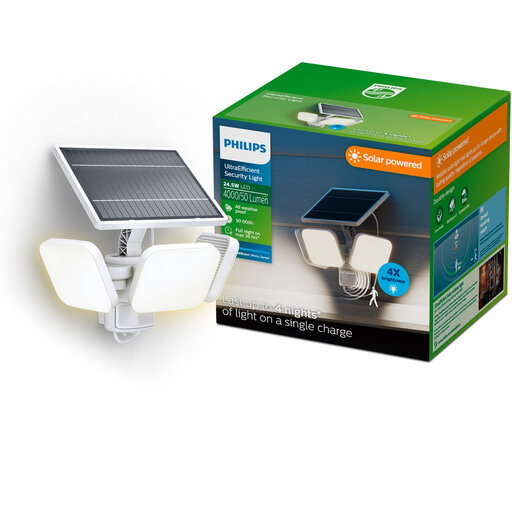
Why it suits this profile: This adjustable wall light is designed to provide broad illumination for areas such as driveways, garages or large sections of garden.
The specifications state 4000 lumens, IP65 and a PIR detection range of 8 metres for direct approach and 16 metres from the side. This allows you to adjust the range more accurately to suit the location.
Adjustable light head, two lighting modes, dusk sensor and a capacity of up to four nights per full charge, as stated in the product information.

Why it suits this profile: This solar wall light combines 1000 lumens with a motion sensor and is designed for entrances, exterior walls and passageways where additional light is needed temporarily.
The product information clearly states an IP44 rating, two lighting modes and automatic operation. It is therefore best installed in a location where exposure to splashing water is appropriate for this classification.
1000 lumens, 3000K warm white light, integrated motion sensor and installation without mains cabling.
We have put together a complete, up-to-date list of products that fully meet these strict selection criteria and the applicable European safety regulations.
First position a solar outdoor light temporarily in the desired location and, after a sunny day, check whether the panel receives enough light. Set an integrated switch to “on” when using the light for the first time, if instructed to do so in the manual. Mount wall lights on a stable surface and use the supplied fixings.
For a longer useful lifespan:
Yes, but charging performance may be lower because of shorter days, cloudy weather and the lower position of the sun. Position the panel as unobstructed as possible and clean it regularly. Using the motion sensor mode can help you use the stored energy more selectively.
This depends on the battery, LED module, housing, operating duration and weather conditions. Product information may state an expected lifespan for the light source, but this is not the same as a guarantee for the complete light. Also check the statutory guarantee and any additional manufacturer’s warranty.
During normal use, a solar outdoor light does not run on mains electricity. The battery is charged by the solar panel during the day. The lighting duration then depends on sunlight, battery capacity, temperature, lighting mode and how often the motion sensor is activated.
