
Vandaag of morgen in huis

Kwaliteit gegarandeerd

Welkomstaanbiedingen ontgrendelen: GRATIS bezorging | Tot 80% korting | Gratis 30 dagen JoyPlus-proefperiode
Download de app
Solar garden lights seem simple: place them outdoors, let the solar panel charge during the day and enjoy the light in the evening. Yet some purchases can be disappointing. One light may give off very little light in winter, a string may not work well in the shade, or a ground spike may prove too fragile for hard clay soil.
With this guide, you can compare solar garden lighting based on verifiable features. This helps you make a more informed choice for a path, border, patio, balcony or decorative corner.
Brands often state a lighting time after a full charge. In the Netherlands, cloud cover, short days, shade and dirt on the solar panel can reduce its output. So a light that can operate for several hours according to the product information will not necessarily achieve that every night.
Pay attention to:
In practice, IP65 means that a product offers protection against dust and water jets according to the stated classification. It does not mean that you can leave every light submerged in water for long periods. Cable connections, the battery compartment and the solar panel also deserve attention.
For exposed outdoor areas, waterproof garden lighting with a suitable IP rating is a logical choice. Also check the safety warnings and position the light according to the instructions.
A small ambient light is designed to create atmosphere, not to brightly illuminate an entire garden path. Look at the number of lumens, the colour temperature and the light distribution. Warm white light around 2700–3000K generally creates a softer appearance. Cool white light around 6500K looks clearer and more functional.
Solar garden lights use a solar panel and a rechargeable battery. The product description sometimes states a charging time of, for example, 4–6 or 6–8 hours of sunlight. Position the panel away from trees, walls and overhanging plants. A panel facing the shaded side of the garden will produce less power, even if the light itself is positioned well.
A longer stated lighting time is particularly relevant for:
For decoration, a few soft LEDs are often sufficient. For a walkway, several fixed light points are more practical. Check whether the brightness is stated per light or for the complete set. For example, the UME set is listed as having 10 lumens per light and a colour temperature of 3000K.
LED solar lights require little maintenance, but a dusty cover or dirty panel reduces the light output. Wipe both regularly with a soft cloth.
A metal housing, ABS plastic or stainless steel each has a different appearance and application. Pay particular attention to:
Compact models are more practical for a balcony or windowsill than tall spike lights. For a wide driveway, a set of solar path lights is often more practical than a single decorative lantern.
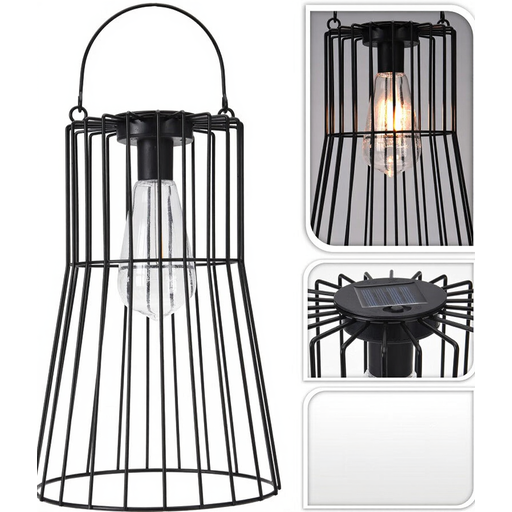
Why it suits this profile: This lantern can be used on a patio, balcony or windowsill, or as a freestanding light. The handle makes it easy to hang or move.
The product information lists a built-in photovoltaic cell, an automatic sensor and a 3V LED. However, check that the chosen location receives enough daylight.
Black metal housing, a height of approximately 29.5 cm and, according to the product description, up to 6 hours of illumination after a full day’s charging.
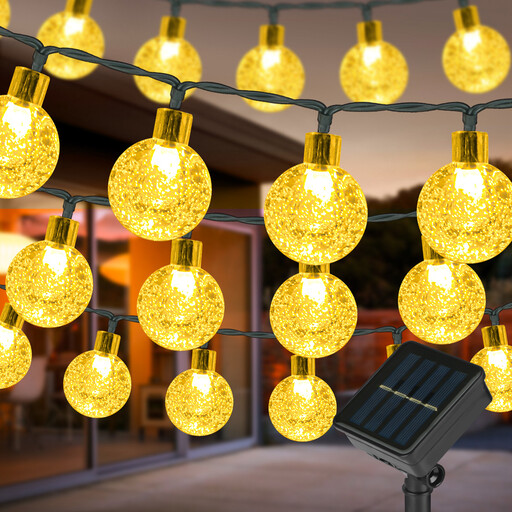
Why it suits this profile: This solar string light is designed to create ambient lighting in a garden, balcony, patio or at an event. Its 7-metre length offers several arrangement options.
The product information lists IP65, automatic operation and a solar panel that can be positioned separately in a sunny location. IP65 remains a classification, not permission to submerge the product.
50 warm-white LED bulbs, 8 lighting modes and, according to the product information, 8–14 hours of illumination depending on the weather.
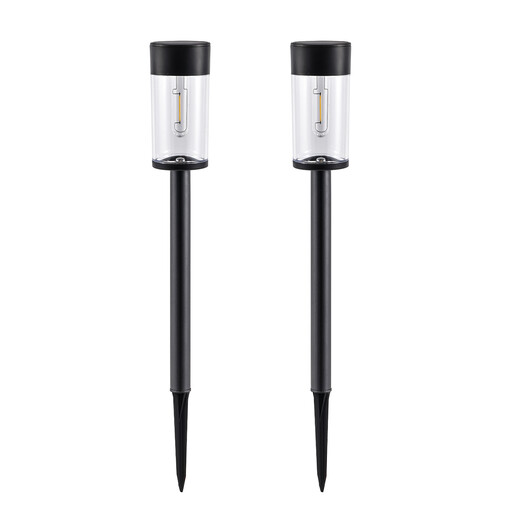
Why it suits this profile: This set is designed for paths, borders, driveways and lawn edges. Two separate light points help mark a route more evenly.
The product description lists IP65, an automatic on/off function and installation using ground spikes. Insert the spikes firmly and check the soil beforehand.
3000K warm white light, two lights per pack and, according to the product information, 8–12 hours of illumination after 6–8 hours of sunlight.
We have put together a complete, up-to-date list of products that fully meet these strict selection criteria and the applicable European safety regulations.
Yes, but their performance may be lower. Shorter days, cloud cover and the low position of the sun limit charging capacity. Position the solar panel as openly as possible and clean it regularly. During prolonged periods of poor weather, expect less light or a shorter lighting time.
This depends on the material, battery, exposure to the weather and maintenance. According to some product descriptions, the LED itself has a long nominal lifespan, but the battery is a separate component that may provide less capacity over time. Check whether it can be replaced and follow the maintenance instructions.
Solar-powered outdoor lighting does not use electricity from a socket during normal use. This means you will not have regular electricity costs for charging. However, remember to factor in the purchase price, any battery replacements and recycling in accordance with local regulations.
