
Vandaag of morgen in huis

Kwaliteit gegarandeerd

Welkomstaanbiedingen ontgrendelen: GRATIS bezorging | Tot 80% korting | Gratis 30 dagen JoyPlus-proefperiode
Download de app
An outdoor solar wall light may seem simple: put it up, let it charge during the day and enjoy automatic light in the evening. Yet many purchases fail to live up to expectations. A light may look powerful in the product photo, but provide little light in practice, struggle to charge on a shady wall or be less suitable for rainy weather than the term “waterproof” suggests.
As a Joybuy Product Recommendation Officer, I filter the most important product specifications from the marketing copy. This helps you compare products more effectively and choose a solar wall light for your entrance, patio, balcony, garden or driveway.
Wattage does not directly indicate how much light a lamp produces. Pay particular attention to the number of lumens (lm). A compact lamp producing 180 or 200 lumens is suitable for atmospheric lighting or as an orientation light by a door. For a driveway or security purposes, a higher light output is generally more useful.
Also consider the operating mode. A solar light with a motion sensor can shine brightly for a short time and then dim. This saves energy, but its operation differs from a light that stays at full brightness throughout the evening.
An IP44 outdoor light is protected against solid objects larger than 1 millimetre and splashing water from different directions. This makes IP44 suitable for many sheltered walls, balconies and patios, but not for immersion or direct jets of water.
For an exposed wall or a location subject to heavy rain, IP65 may be a more practical choice. Also check whether the manufacturer specifies that the solar panel must not be submerged. An IP rating applies to the conditions tested, not automatically to every type of weather.
A black wall light often works well with a modern façade, but positioning determines whether the battery receives enough charge. A north-facing wall, an overhang, trees or a balcony above can reduce performance. Therefore, check:
An outdoor light without wiring is easy to install, but it still requires a suitable mounting location.
For atmospheric lighting, warm white tones around 2700 to 3000 K are pleasant. Cooler white light of around 4000 K or higher creates a more practical and striking effect. For an entrance, consider the combination of colour temperature and lumens:
According to each brand’s product description, operating time, light output and sensor performance may depend on the selected mode, the amount of sunlight and the battery status. Treat stated operating times as product specifications under certain conditions, rather than a guarantee for every winter evening.
A solar light with a motion sensor only switches to a brighter setting when movement is detected. This is useful by a front door, garage or driveway, as the light does not need to operate continuously at maximum brightness. Pay attention to the detection range and viewing angle. The Brilliant Magua, for example, is described as having a detection angle of 120 degrees. For the Philips Zyren, the product description states a PIR range of 8 metres when approached directly and 16 metres when approached from the side.
A dusk sensor is another useful feature. It allows a light to switch on automatically when it gets dark. Check whether the light also has a permanent-on setting or several lighting modes.
An integrated lithium battery is practical, but should not be opened or replaced yourself in accordance with the safety instructions. Keep the solar panel free from dust, leaves and bird droppings. In winter, the available sunlight is less intense, which can reduce operating time.
A separate solar panel with a cable gives you greater freedom when installing the light. According to the product details, the Aigostar Bluetooth Mesh wall light has a solar panel with a 5-metre cable and a 3-metre light cable. This can be useful when the wall itself receives little sunlight, but the panel can be positioned elsewhere in a sunnier spot.
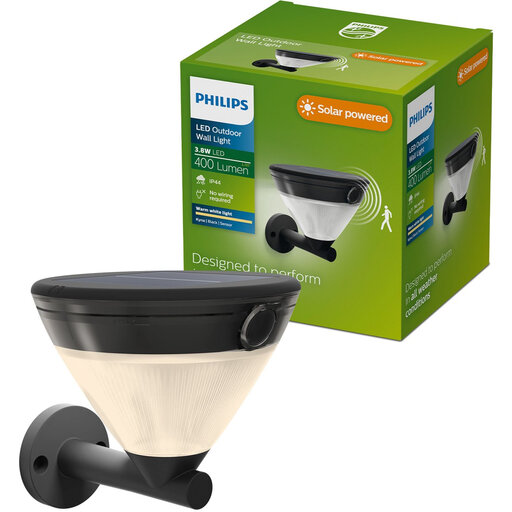
Why it suits this profile: A compact choice for a balcony, front door or sheltered patio. According to the product details, the light provides 400 lumens, warm white light at 2700 K and two modes.
The IP44 rating makes it clear that this light offers protection against splashing water, rather than being suitable for immersion.
400 lumens, integrated LED, motion sensor and no mains connection required.
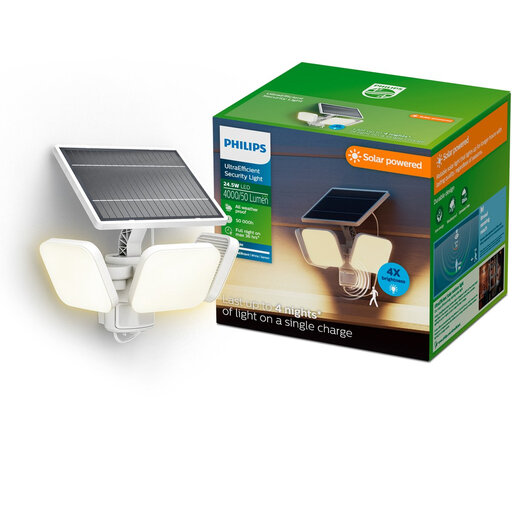
Why it suits this profile: For anyone looking for a powerful light with a wide detection range and an adjustable light head for a façade or driveway.
The product details specify IP65 and 4000 lumens, so you do not have to rely solely on a general term such as “weather-resistant”.
PIR sensor, adjustable head, 3000 K and, according to the product description, up to four nights of illumination after a full charge.

Why it suits this profile: Designed for a larger garden, garage, patio or driveway where broad illumination and multiple lighting levels are desirable.
The stated IP65 rating and three lighting levels provide more specific information than simply promising “powerful lighting”.
302 LEDs, a stated light output of 3000 lumens, three adjustable heads and a motion detection angle of 180 degrees.
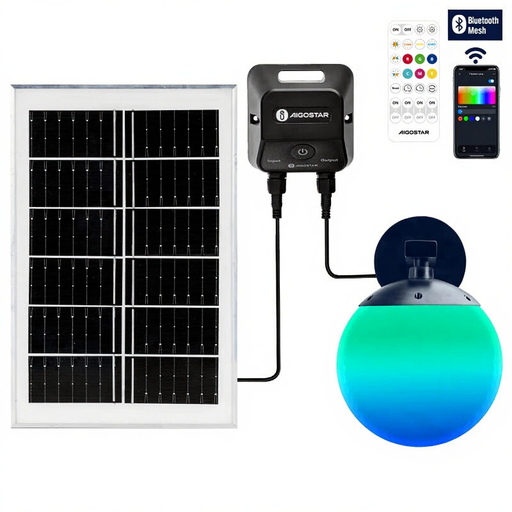
Why it suits this profile: For users who want to combine RGB lighting, warm to cool white light and Bluetooth mesh control with solar charging.
The stated 200 lumens makes it clear that this is primarily accent and atmospheric lighting rather than a powerful solar security light.
RGB plus 2700–6500 K, Bluetooth mesh for more than 200 devices and automatic activation in the dark.
We have put together a complete, up-to-date list of products that fully meet these strict selection criteria and the applicable European safety regulations.
Yes, but charging capacity may be lower because of shorter days, cloudy weather and the lower position of the sun. Position the panel in as open a location as possible and clean it regularly. A light with a motion sensor generally uses less energy than one that stays on continuously.
Service life varies depending on the battery, LED module, operating mode and weather conditions. The product details for various models state an LED lifespan of approximately 20,000 to 30,000 hours. This does not automatically mean that the entire light will last just as long. Also check the warranty and the instructions for the integrated battery.
During normal use, an outdoor solar light does not use electricity from the mains. However, you should factor in the purchase price, installation and possible battery maintenance over the longer term. Above all, choose a model that suits the desired light output and the amount of sunlight available at the installation site.
