
Vandaag of morgen in huis

Kwaliteit gegarandeerd

Welkomstaanbiedingen ontgrendelen: GRATIS bezorging | Tot 80% korting | Gratis 30 dagen JoyPlus-proefperiode
Download de app
An outdoor solar wall light with a motion sensor can illuminate an entrance, driveway, patio or garden path without an electricity cable. However, some lights can disappoint in practice. This is usually not because of the solar panel itself, but because of incorrect positioning, insufficient light output or a protection rating that is unsuitable for the location.
So do not focus only on terms such as “solar security light” or “energy-efficient outdoor lighting”. Above all, check the technical specifications and consider what you will actually use the light for.
With LED lighting, light output in lumens is more important than wattage. For example, a 20-watt light may deliver 200 lumens according to the product specification, while another solar outdoor light rated at 8.2 watts may list 1,000 lumens. So look at the number of lumens first, followed by energy consumption.
For ambient lighting on a balcony or patio, 180 to 500 lumens may be sufficient. For a driveway or façade where you want to illuminate a larger area, higher light output is more practical.
The IP rating indicates what types of exposure the housing is protected against. With an IP44 outdoor light, the first digit indicates protection against solid particles above a certain size, while the second indicates protection against splashing water. An IP44 light is therefore suitable for many sheltered outdoor locations, but not for immersion or direct water jets.
An IP65 outdoor light offers a higher level of dust protection and better protection against water jets. This makes this type more suitable for an exposed façade, but the same rule applies: the light must not be immersed. Always check the installation instructions as well.
A sensor detects movement within a specific range and angle. If you install the light too high, behind an obstacle or facing a busy road, it may respond too late or switch on unnecessarily often.
Pay attention to:
A solar light with a dusk sensor will generally only switch on when it gets dark. The motion sensor then determines when additional light is needed. This combination prevents the light from switching on unnecessarily during the day.
A colour temperature of 2700 to 3000 K produces warm white light. This often works well by a front door, patio or balcony. 4000 to 5000 K looks whiter and can be practical for a driveway or when you want to illuminate a façade brightly.
Also consider the light distribution. An adjustable light head, such as those found on certain Philips Zyren models, helps direct the light towards a path, door or section of wall. The product specification for these models lists 4000 lumens, a detection range of up to 8 metres when approached directly and 16 metres for lateral movement, plus an IP65 rating.
Solar lighting only works effectively when the panel receives sufficient sunlight during the day. A north-facing wall, deep canopy or shade from a tree can limit charging performance. The operating time may also be shorter during dark winter periods.
Some product descriptions state that the light can operate for several nights after a full charge. Treat this as a product specification under the stated conditions, rather than a guaranteed result for every garden in the Netherlands. Keep the panel free from leaves, dust and bird droppings, and clean it carefully with a soft cloth.
Check that the wall is strong enough and that the fixings are suitable for brick, concrete, wood or cladding. A wall light weighing around 1.5 kilograms requires different fixings from a compact model weighing less than 500 grams.
With an outdoor LED wall light, the light source is often integrated. This means little maintenance for the LED section, but usually also means that you cannot replace the light source yourself. Do not open the housing or internal battery unless this is permitted in the manual.
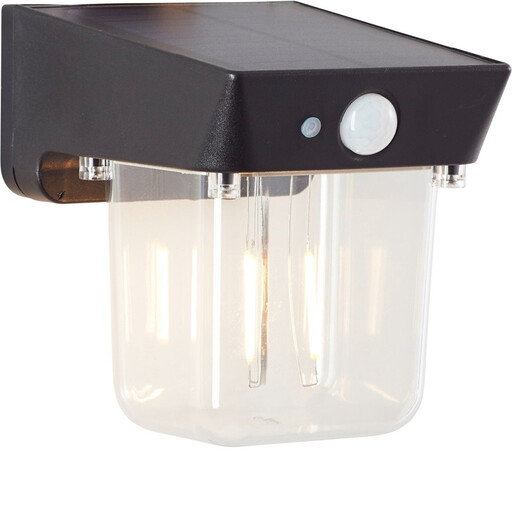
Why it suits this profile: This compact model is suitable for a front door, balcony or small patio where a wide beam is not needed. The stated light output is 180 lumens and the colour temperature is 2700 K.
The product specification lists both a motion sensor and IP44. This makes it clear that the light offers splash protection for outdoor use, rather than being suitable for immersion.
180 lumens, warm white 2700 K light, integrated battery and installation without mains wiring.

Why it suits this profile: The Fyns combines 1,000 lumens with warm white 3000 K light. This is a practical middle ground for an entrance, garage path or façade where you want both good visibility and a gentle light colour.
The light output is clearly stated, along with IP44, the two lighting modes and the motion sensor. You therefore do not have to rely solely on the term “security light”.
1,000 lumens, 3000 K, two lighting modes, integrated LED and installation without an electricity cable.
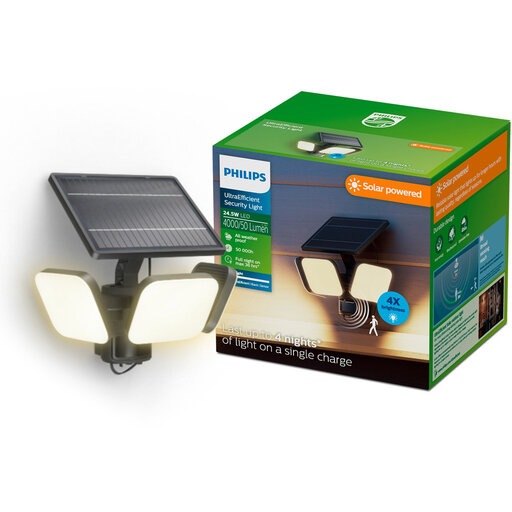
Why it suits this profile: This model is designed for larger areas such as a driveway, back garden or wide façade. According to the product specification, the light offers 4000 lumens, IP65 protection and an adjustable light head.
The stated sensor range is precise: 8 metres when approached directly and 16 metres for lateral movement. The IP65 rating is also clearly specified.
4000 lumens, IP65, 3000 K, adjustable light head and two lighting modes with dusk sensor.
We have put together a complete, up-to-date list of products that fully meet these strict selection criteria and the applicable European safety regulations.
If you live in a rented property, it is sensible to check in advance whether drilling into the façade is permitted. A freestanding outdoor light on a fence or balcony wall can be an alternative, provided the structure can support its weight.
Yes, but performance can vary. Shorter days, cloud, shade and a dirty solar panel result in less charging energy. Choose a sunny location and clean the panel regularly. A stated operating time after a full charge is a product specification, not a fixed guarantee for every weather condition.
For a small path or front door, around 180 to 500 lumens may be suitable. For a wide driveway or façade, 1,000 lumens or more is more practical when you want to illuminate a larger area. The amount required also depends on the installation height, beam angle and preferred light colour.
A solar outdoor light does not use mains electricity during normal operation. The solar panel charges the integrated battery. However, the light may run for less time or shine less brightly if the battery has not received enough charge during the day. When buying, check the battery specifications, lighting modes and charging guidance for the specific model.
