
Vandaag of morgen in huis

Kwaliteit gegarandeerd

Welkomstaanbiedingen ontgrendelen: GRATIS bezorging | Tot 80% korting | Gratis 30 dagen JoyPlus-proefperiode
Download de app
A solar outdoor wall light with motion sensor may seem straightforward to choose: install it, let it collect sunlight and enjoy automatic lighting. However, there are clear differences in brightness, sensor range, protection against rain and battery performance. As a result, a budget light may be less suitable for a dark driveway, while a powerful model could be unnecessarily bright on a balcony or by the front door.
This buying guide helps homeowners, tenants and garden enthusiasts distinguish marketing claims from specific product specifications.
The number of lumens indicates how much light a lamp emits according to its product specifications. It does not automatically tell you how large an area will be illuminated. The beam angle, mounting height and adjustability of the lamp also make a difference.
For an entrance or balcony, 300 to 500 lumens may be sufficient. For a driveway or larger patio, a model with 1,000 lumens or more may be more practical. A 4,000-lumen lamp is mainly intended for larger areas and may appear uncomfortably bright on a small façade.
IP44 outdoor lighting is protected against solid objects and splashing water. This makes IP44 suitable for many sheltered façades, balconies and entrances, but not for immersion or powerful direct water jets.
An IP65 solar lamp provides a higher level of protection against dust and water jets according to the IP rating. Even this type of lamp is not designed to be placed underwater. Therefore, as well as checking the IP label, review the installation instructions and the position of the solar panel.
A motion sensor responds to movement within a certain range. A dusk or daylight sensor determines whether it is dark enough to activate the lamp. Both functions are useful for automatic outdoor lighting, but check that they are actually included together.
Also consider the direction of the sensor. A range specified mainly for sideways movement may perform differently when someone walks directly towards the lamp.
2700K to 3000K produces warm white outdoor lighting with a softer appearance. This often suits a front door, balcony or patio. 5000K to 7000K looks cooler and brighter and may be better suited to a driveway or larger garden area, depending on the atmosphere you want to create.
Also compare the lumen figure:
An LED outdoor wall light usually has an integrated light source. Therefore, check the stated service life and bear in mind that the LED cannot be replaced by the user in many models.
Look at the stated detection distance, detection angle and lighting duration after movement is detected. A lamp with a short lighting duration conserves battery capacity, but may not stay on long enough for you to put a key in the lock.
A solar security light with an adjustable head or multiple lighting modes offers greater flexibility. Also check whether the lamp has a permanently-on setting. This mode generally uses more energy than automatic activation via a motion and dusk sensor.
A wireless outdoor light only works reliably when the solar panel receives sufficient light during the day. Do not place the lamp beneath a solid canopy or behind a wall that leaves the panel in shade for long periods. Trees, balcony edges and north-facing façades can limit charging capacity.
Clean the panel regularly with a soft cloth. In winter, shorter days and cloudy weather affect the lighting duration. A product description may state a number of nights of illumination or refer to a fully charged battery; this is a product specification under the stated conditions and not a guarantee for every season.
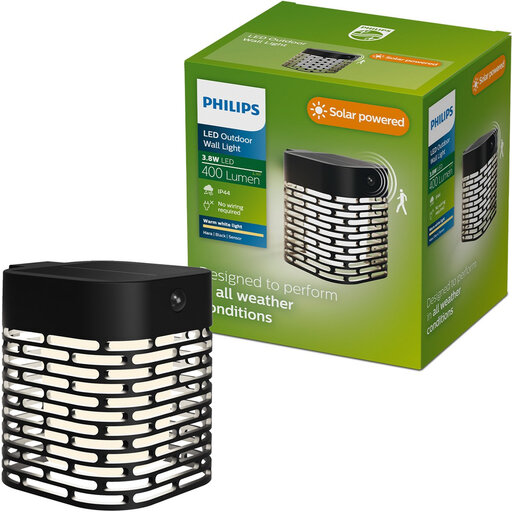
Why it suits this profile: This compact solar wall light provides 400 lumens, warm white 2700K light and two lighting modes for an entrance, balcony or small garden wall.
The product specifications state 400 lumens and IP44, so you will not mistake this lamp for powerful lighting intended for a large driveway.
Integrated LED, warm white 2700K light, two modes and installation without mains wiring.
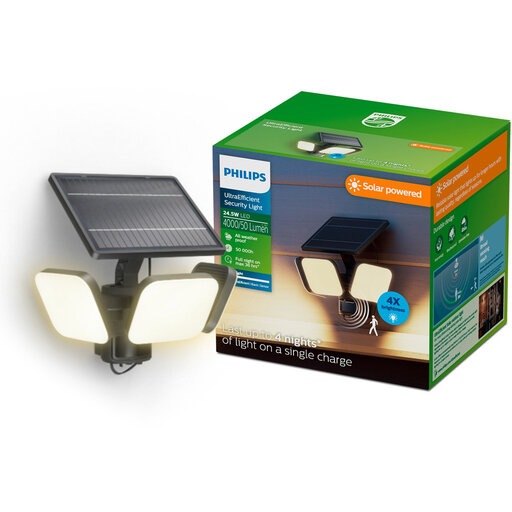
Why it suits this profile: This model is designed for larger areas such as a driveway, garage or wide façade, where greater light output and sensor range are desirable.
The product specifications state 4,000 lumens, IP65 and a detection range of 8 metres straight ahead and 16 metres to the sides. This makes the relevant figures clear.
Adjustable lamp head, two lighting modes, IP65 and, according to the product description, up to four nights of illumination when the battery is fully charged.

Why it suits this profile: With 1,000 lumens, 3000K light and a built-in motion sensor, this lamp is suitable for an entrance, side path or patio where functional lighting is needed.
The combination of 1,000 lumens, an automatic mode and IP44 makes the intended use clearer than the term “security light” alone.
1,000 lumens, warm white 3000K light, two modes and an integrated LED light source.
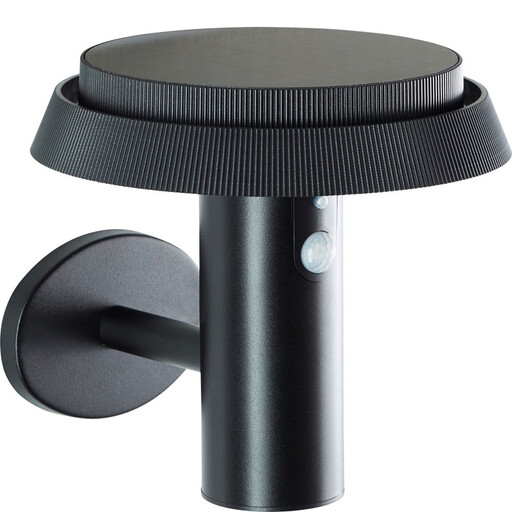
Why it suits this profile: This solar wall light combines a round design with 500 lumens, 3000K light and a motion sensor for façades, garden paths and entrances.
The stated 500 lumens and IP44 rating give a more realistic picture of its intended use than general claims about powerful lighting.
Solar power, integrated motion sensor, dimmable function and warm white 3000K light.
We have compiled a complete, up-to-date list of products that fully meet these strict selection criteria and the applicable European safety regulations.
For rented homes, a wireless outdoor light is convenient because no mains wiring is required. However, check in advance whether drilling into the façade or fence is permitted. For a temporary solution, a rechargeable wall light with USB-C may be worth considering, but this is not solar-powered outdoor lighting and requires regular charging.
The service life depends on the LED, battery, charging conditions and exposure to the weather. The specifications for various models may, for example, state an LED service life of 25,000 to 50,000 hours. This is a stated technical value for the light source and does not automatically represent the service life of the entire lamp. Keeping the solar panel clean and installing it correctly helps maintain performance.
Yes, but the lighting duration may be shorter because of shorter days, cloudy weather and less direct sunlight. Position the panel as unobstructed as possible and check that it is free from leaves and dirt. A lamp with a motion sensor generally uses less energy than a model that stays on continuously throughout the night.
While in use, the lamp draws energy from its internal battery, which is charged by the solar panel during the day. This means it does not need to be connected to the mains. A rechargeable lamp without a solar panel is different: it uses a USB charger and is therefore not a fully solar-powered outdoor wall light.
