
Vandaag of morgen in huis

Kwaliteit gegarandeerd

Welkomstaanbiedingen ontgrendelen: GRATIS bezorging | Tot 80% korting | Gratis 30 dagen JoyPlus-proefperiode
Download de app
A solar wall light with a motion sensor for outdoors may seem easy to choose: mount it, charge it in the sun and enjoy automatic light when someone walks past. In practice, however, some lights can be disappointing. A small battery, an unsuitable protection rating or a solar panel that is almost always in the shade can severely limit how useful the light is.
This buying guide compares the key specifications and helps you find the right solar outdoor light for an entrance, balcony, patio, garden or driveway.
A high lumen count only tells you the total amount of light. It does not indicate how wide the beam is, how directional the light is or how evenly a wall and path will be illuminated. 400 lumens may be enough for a front door, while a driveway requires more light.
Also consider the colour temperature:
Always check the IP rating. IP44 protects against solid particles larger than 1 mm and splashing water. This is suitable for general outdoor lighting, but do not place the light where it is constantly exposed to jets of water or heavy rain.
IP65 offers greater protection against dust and water jets. An IP65 light must not be submerged either. The installation location, seals and condition of the housing remain important.
A solar-powered wall light only works reliably when the panel receives sufficient light during the day. A north-facing wall, overhanging roof edge or dense tree can limit charging performance. “Automatically switches on at dusk” also does not mean that the light will stay on for the same length of time or at the same brightness every night. This depends on the stored energy, the weather and how often the motion sensor is triggered.
A solar light with a dusk sensor switches on when it gets dark. The motion sensor then responds to movement within its stated range. Check whether the manufacturer specifies a detection distance and detection direction. According to Philips’ product description, the Philips UltraEfficient Zyren has a stated range of 8 metres when approached directly and 16 metres when approached from the side.
Position the light so that people cross the detection area. A sensor aimed directly at a path may respond differently than expected. Also check whether it has two modes, such as automatic operation and continuous operation.
Compare lumens, not just wattage. An integrated 3.8 W LED, for example, may produce 400 lumens, while a more powerful model produces considerably more light. As a guide:
The stated value comes from the product information. The actual impression also depends on the installation height, beam angle and colour temperature.
Pay attention to the light’s weight and dimensions. A model weighing around 1.5 kg requires a sturdy wall and suitable fixings. Before installation, check that the surface can support the weight and use the supplied mounting materials where specified.
Keep the solar panel clean with a soft cloth. Do not open the housing to replace an internal battery unless the manufacturer explicitly permits this. According to the product information, the Philips models mentioned come with a statutory warranty of at least two years; additional rights may arise under Dutch law.
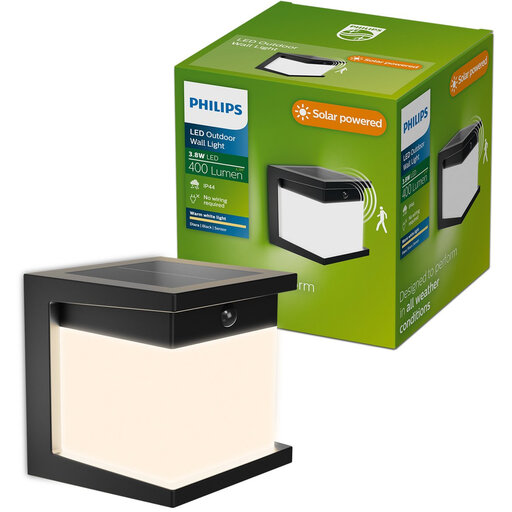
Why it suits this profile: This compact model is designed for general lighting by a garden, balcony or entrance. Its warm white colour temperature of 2700 K is ideal if you are mainly looking for practical, pleasant lighting.
The specifications state 400 lumens and IP44. This makes it clear that the model is not intended to be a powerful floodlight for a large driveway.
400 lumens, 2700 K, two light modes and an integrated motion sensor in a housing measuring 12 × 11 × 12 cm.
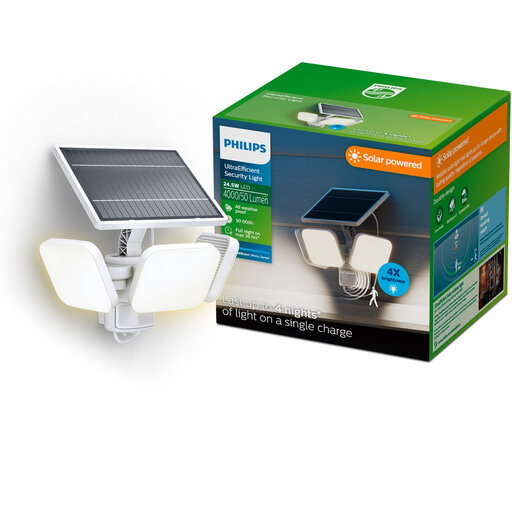
Why it suits this profile: If you want to illuminate a larger façade, driveway or entrance, you will get more from this model’s stated light output and adjustable lamp housing.
The product description states IP65, an adjustable light head and a detection range. This gives you more useful information than a general claim about weather resistance alone.
4000 lumens, IP65, two light modes and, according to Philips, a sensor range of 8 metres straight ahead and 16 metres to the side.

Why it suits this profile: This model is suitable for a front door, shed or smaller driveway where bright lighting is wanted without the bulk of a large floodlight.
The product details specify 1000 lumens and IP44. This allows you to compare the model directly with more powerful IP65 lights, rather than relying on a vague security claim.
1000 lumens, warm white light at 3000 K, two light modes and a built-in motion sensor.

Why it suits this profile: The round shape and warm white 2700 K lighting are ideal for a balcony, patio or entrance where practical orientation and attractive design come together.
The IP44 classification makes it clear that this light is splash-resistant for normal outdoor use, but is not designed to be submerged.
400 lumens, integrated LED, two modes and a motion sensor in a compact housing measuring approximately 9.5 × 17.7 × 10.9 cm.
We have put together a complete, up-to-date list of products that fully meet these strict selection criteria and the applicable European safety regulations.
A smart solar wall light such as the Aigostar Bluetooth Mesh may be worth considering when control, colour settings and connecting multiple devices are important. The product information states RGB+CCT lighting, Bluetooth Mesh control, a 4000 mAh battery and a stated light output of 200 lumens. These specifications suggest that it is more suited to ambient and smart lighting than to use as a powerful solar security light.
The operating time per night depends on sunlight, battery capacity, temperature and the selected light mode. Some product descriptions state an LED lifespan of 25,000 or 50,000 hours. This is the stated lifespan of the light source and does not guarantee that the battery will last just as long.
A solar outdoor light does not use a connection to the mains during normal operation. The solar panel charges the internal battery during the day. This means the light works without fixed wiring, although performance remains dependent on the amount of light and the charging conditions.
According to its classification, an IP44 outdoor light is suitable for protection against splashing water and normal general outdoor use. Do not place it where water can collect and never submerge the light. For an exposed façade or a location subject to more demanding weather conditions, a model with IP65 may be a more suitable choice.
