
Vandaag of morgen in huis

Kwaliteit gegarandeerd

Welkomstaanbiedingen ontgrendelen: GRATIS bezorging | Tot 80% korting | Gratis 30 dagen JoyPlus-proefperiode
Download de app
A solar wall light with a motion sensor may seem simple to choose: mount the light on the wall, let the solar panel charge during the day and enjoy automatic light in the evening. In practice, models vary considerably in light output, sensor range, protection against rain and the way the battery is charged.
For an entrance, balcony, patio, shed or driveway, the combination of light output, mounting location and IP rating is particularly important. Below, you’ll find the key points to consider, followed by several product options for different uses.
A solar outdoor light with a high lumen output does not automatically provide pleasant or effective illumination. A light producing 300 to 500 lumens is often suitable for an entrance or balcony. For a wide driveway or a dark back garden, more light may be preferable.
Also consider how the light is distributed. An adjustable light head or several light heads may be more useful than a single very bright light source that only illuminates a small part of the wall or garden. According to the product description, the Philips Zyren produces 4,000 lumens and has an adjustable head. This makes this type of solar security light particularly interesting for larger areas.
The IP code provides practical information about protection against dust and water. IP44 indicates, among other things, protection against splashing water. Such a light is suitable for general outdoor use, but should not be installed where it may be exposed to direct water jets or prolonged immersion.
An IP65 outdoor light offers greater protection against dust and water jets. However, this rating does not mean that the light can be placed underwater. So don’t just check the marketing copy; pay particular attention to the stated IP rating and the installation instructions.
A cordless outdoor light only works well if the battery can charge sufficiently. A north-facing wall, a covered area or shade from trees can limit charging time. In winter and during prolonged periods of cloudy weather, the operating time may also be reduced.
Position the panel where it will receive as much direct sunlight as possible during the day. Clean it regularly with a soft, slightly damp cloth. With a light featuring a built-in battery, you should also check whether the battery can be replaced easily. On some models, the LED light source or battery cannot be replaced by the user.
Light output is measured in lumens (lm). Use this guide as a starting point:
Colour temperature is measured in Kelvin (K). Warm white light around 2700K to 3000K appears softer and works well on a patio or by the front door. 5000K to 7000K produces cooler, whiter light, which can provide greater contrast on a driveway or around a shed. The manufacturer’s product description is the definitive source for the stated colour temperature; perceived brightness also depends on positioning and beam angle.
An outdoor light with a motion sensor should detect movement where people actually walk. Therefore, check:
According to the product information, the Philips Zyren has a stated range of 8 metres for direct approach and 16 metres for lateral movement. According to its product description, the UME light has a detection distance of 60 feet, a 180-degree angle and three lighting modes. Check the instructions for the exact settings before permanently mounting the light.
For a sheltered wall beneath an eaves, an IP44 outdoor light may be sufficient. For an exposed façade, carport or unsheltered driveway, IP65 offers greater protection against dust and water jets.
The IP rating does not tell you everything about the quality of the construction. Also consider the material, mounting bracket, seal around the sensor and the warning that the product must not be immersed.
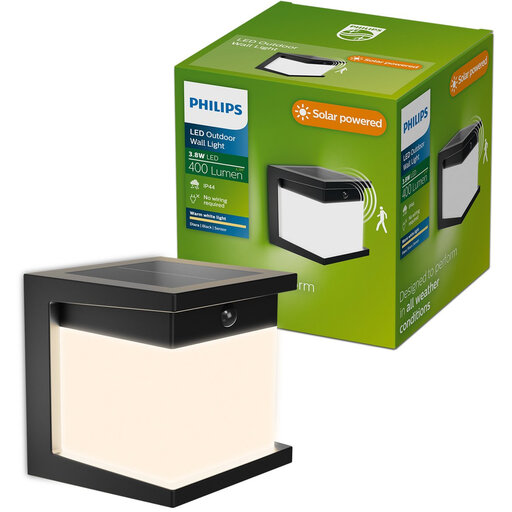
Why it suits this profile: This compact solar outdoor light produces 400 lumens, emits warm white light at 2700K and works without mains power. It’s a good choice for a front door, balcony or small patio where straightforward installation is important.
The stated 400 lumens and IP44 rating make it clear that this model is intended for basic lighting and protection against splashing water, rather than a large, completely exposed driveway.
400 lumens, 2700K, two lighting modes, integrated LED and no wiring required.
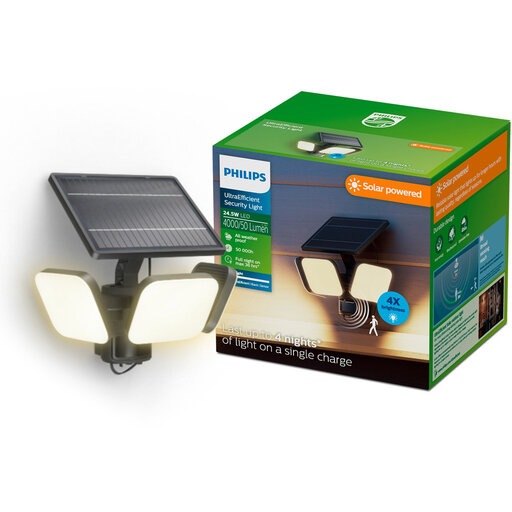
Why it suits this profile: This model is designed for larger outdoor areas where high stated light output, directional lighting and a wide sensor range are desirable.
The specifications state 4,000 lumens, IP65 and an adjustable light head. This makes the choice less dependent on general claims such as “extra bright” or “weather-resistant”.
4,000 lumens, IP65, sensor range of up to 8 metres straight ahead and 16 metres to the side, plus two lighting modes.

Why it suits this profile: The three light heads, wide lighting angle and multiple modes are practical for a large garden, garage area, patio or wide driveway.
The product information specifically mentions IP65, three lighting modes, a 180-degree angle for the sensor and 270-degree adjustability for the light heads.
302 LEDs, stated output of 3,000 lumens, IP65, three lighting modes and three adjustable light heads.

Why it suits this profile: This compact outdoor LED wall light runs on a rechargeable battery and has a magnetic mounting system. It’s ideal if you don’t want to drill holes or install wiring.
The IP44 rating makes the limits clear: splashing water is permitted, but direct water jets and immersion are not. The battery is charged via USB-C.
300 lumens, 3000K, motion sensor, magnetic mounting and USB-C charging.
We’ve put together a complete, up-to-date list of products that fully meet these strict selection criteria and the applicable European safety regulations.
Choose a sturdy, flat surface and use the supplied mounting materials. Point the sensor towards the route people use, rather than at a busy road or moving branches. Position the solar panel away from shade and, after installation, check that the light cannot come loose.
Clean the panel and sensor window with a soft cloth. Do not use harsh cleaning products. With a light featuring magnetic mounting, the surface must be flat, clean and strong enough to support its weight.
Operating time per night depends on sunlight, battery capacity, temperature, lighting mode and the number of movements detected. Manufacturers may state an LED lifespan of, for example, 25,000 or 50,000 hours. According to Philips’ own product information, such a figure applies to the light source; it does not automatically mean that the battery will last just as long.
A solar outdoor light does not use mains electricity during normal operation. The solar panel charges the built-in battery during the day. As a result, running costs are generally limited to replacing the product or battery when it no longer functions properly. During darker winter periods, the light may operate for less time or come on less frequently.
This depends on the installation location and the manufacturer’s instructions, but IP44 is intended to protect against splashing water, not direct water jets or immersion. For a completely exposed façade or driveway, a model with IP65 is generally the more logical choice, provided that all other installation and safety instructions are also followed.
