
Vandaag of morgen in huis

Kwaliteit gegarandeerd

Welkomstaanbiedingen ontgrendelen: GRATIS bezorging | Tot 80% korting | Gratis 30 dagen JoyPlus-proefperiode
Download de app
A solar-powered outdoor wall light with motion sensor can be useful by the front door, on the balcony, along the shed or beside the driveway. You do not need an electricity cable, and the light switches on automatically when movement is detected. However, some purchases can be disappointing. A light may provide very little illumination, fail to charge sufficiently during the Dutch winter or be less resistant to rain than its product name suggests.
Joybuy Product Recommendation Officer highlights the most important points to consider. This makes it easier to compare a solar outdoor light based on verifiable features rather than marketing claims alone.
The lumen count indicates how much light a lamp emits according to its product specifications. However, it does not automatically tell you how large an area will be illuminated. The light distribution, mounting height and angle of the lamp also play a part.
A compact solar wall light with 180 lumens may be sufficient by a front door, while a wide driveway may require more light and a wider beam angle. So, as well as lumens, look at the number of light heads, the beam spread and the position of the solar panel.
Describing a waterproof outdoor light as IP44 can be misleading. In practice, IP44 means protection against solid objects from 1 mm in size and against splashing water from various directions. The light is not designed to be submerged or exposed to powerful water jets.
IP44 may be suitable for a sheltered façade, balcony or entrance. Ideally, do not install the light where rainwater will run directly onto the housing or solar panel for long periods. For a more exposed spot in the garden, a model with IP65 can provide additional protection against dust and water jets, as stated for the UME light in the product specifications.
A solar security light uses an integrated battery. The solar panel needs to receive enough light during the day to charge the battery. A position beneath an overhang, next to a tall fence or on the north-facing side of a property can reduce its operating time.
Performance also varies by season in the Netherlands. Check that the panel has an unobstructed view of the sky and keep it clean. A motion sensor that is triggered frequently will also use up energy more quickly.
For an entrance or patio, many people choose warm white outdoor lighting. A colour temperature of around 2700K to 3000K generally creates a warmer look. The Philips Swyn and Philips Diara, for example, are listed as 2700K. According to the product information, the Brilliant Alvero has 3000K and 500 lumens.
For practical lighting around a garage or driveway, a higher light output may be more important than a gentle ambience. So always compare:
Brands may make additional claims about lifespan or performance. Treat these as brand or product information, not as a guaranteed result in every situation.
A wall light with sensor should suit the area where you walk. Look at the detection distance and angle. A narrow sensor may be suitable by a front door, while a wide driveway will benefit from greater coverage.
According to the product description, the UME Solar Outdoor Lights has a detection range of 60 feet, a 180-degree angle and three lighting modes. These specifications may be useful for a large garden, garage or driveway. Do not position the light directly opposite a busy road or a moving tree, to reduce unnecessary activation.
Check that the housing is suitable for outdoor use and that the mounting system fits your wall. Consider the material, weight and supplied fixings. A wireless outdoor light is only practical if you can secure it firmly.
These maintenance steps are helpful for almost any solar outdoor wall light:

Why it suits this profile: This compact model is designed for an entrance, balcony or small garden wall. According to the product information, it has 180 lumens, 2700K, an integrated battery and IP44 protection.
The specifications state both the light output and the IP rating. This makes it clear in advance that the model is intended primarily for limited, functional lighting.
2700K warm white light, motion sensor, solar panel and two stated lighting modes.
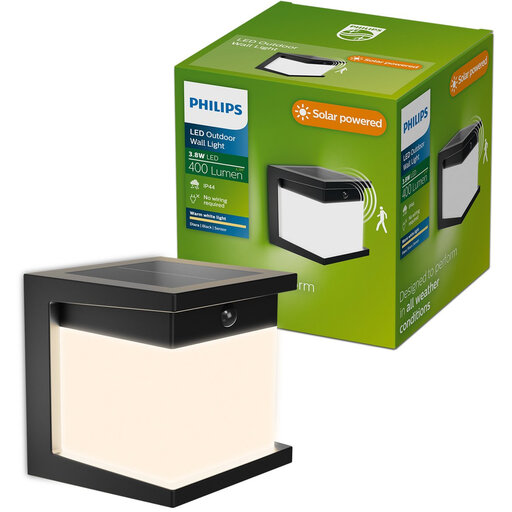
Why it suits this profile: The combination of 400 lumens, 2700K and an integrated motion and darkness sensor is well suited to an entrance or patio where ambience and visibility are both important.
The product information clearly states IP44, two modes, 400 lumens and a light-source lifespan of 25,000 hours. IP44 still means protection against splashing water, not protection against submersion.
2700K warm white light, 400 lumens, two lighting modes and a sensor for darkness and movement.

Why it suits this profile: For a large driveway, garden or garage where broad coverage and plenty of light are required. According to the product description, the model has three light heads, 3000 lumens, three modes and IP65.
The stated 180-degree detection angle and adjustable 270-degree coverage make the range clearer than the term security light alone. However, check the installation position and the availability of sufficient sunlight for charging.
302 LEDs, 3000 lumens, three lighting modes, three light heads and an IP65 rating stated in the description.
We have put together a complete, up-to-date list of products that fully meet these strict selection criteria and the applicable European safety regulations.
Yes, but charging performance may be lower because of shorter days, cloudy weather and the lower position of the sun. Install the panel where it can receive as much direct daylight as possible. Keep the surface clean and choose a light with a suitable lighting mode, so the battery does not run down unnecessarily quickly.
The operating time per night depends on the amount of sunlight, battery capacity, light intensity and the number of movements detected. The lifespan of an integrated LED module is a separate product specification. According to the product information, the Philips Diara’s light source is listed as lasting 25,000 hours. This does not guarantee the same overall lifespan for the light or battery.
During normal use, a solar-powered outdoor wall light does not draw power from the mains. The battery is charged by the solar panel during the day. A rechargeable light with a USB connection works differently: it does use electricity while charging. So, if you do not want to use a cable or charging adapter, check that the product is genuinely solar-powered.
