
Vandaag of morgen in huis

Kwaliteit gegarandeerd

Welkomstaanbiedingen ontgrendelen: GRATIS bezorging | Tot 80% korting | Gratis 30 dagen JoyPlus-proefperiode
Download de app
A shed in the backyard, a remote holiday home, or a driveway without a power outlet—securing locations without direct power access is a common challenge. Running a web of cables is often impractical and expensive. Fortunately, a solar-powered security camera offers a simple and sustainable solution.
As a Joybuy Product Recommendation Officer, I'm here to help you make an informed choice. In this article, we'll discuss what to look for when buying a solar camera and highlight several popular models suited for different scenarios.
Choosing the right camera depends on your specific needs. Here are three key points to get you started.
The camera's location determines the best connection method.
Clear video is crucial for effective security. Pay attention to the resolution, expressed in megapixels (MP) or terms like Full HD (2MP) and 4K (8MP). The higher the resolution, the sharper the image and the more detail you can see.
Good visibility at night is essential. Most cameras use infrared LEDs for black-and-white footage. Some advanced models offer colour night vision, often with the help of built-in spotlights, which can aid in identifying people or vehicles.
A security camera with a battery and solar panel is designed to be self-sufficient. The battery's capacity (expressed in mAh) and the solar panel's efficiency determine how long the camera can operate without direct sunlight. For climates with frequent overcast days, it's important that a solar-powered outdoor camera can generate enough power even on cloudy days.
Additionally, always check the IP (Ingress Protection) rating. A rating of IP65 or higher means the camera is dust-tight and resistant to rain, making it suitable for outdoor use in all seasons.
Based on specifications and features, we have selected cameras that offer solutions for common scenarios.
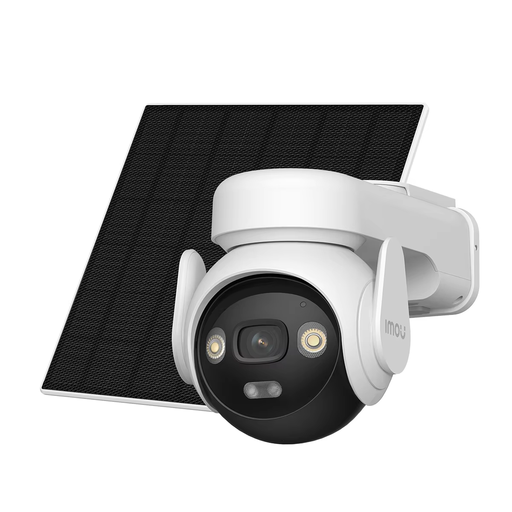
Why It Stands Out: This camera is a complete, autonomous solution for locations without power and without Wi-Fi. The combination of 4G connectivity, a large battery, and a 360° pan-and-tilt (PTZ) function makes it extremely flexible.
Key Features:
Who Is It For? Ideal for owners of large properties, remote buildings, stables, or construction sites where no fixed power or internet connection is available.
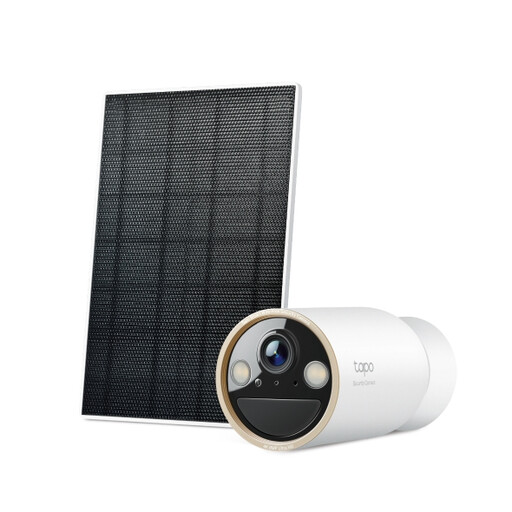
Why It Stands Out: This kit from TP-Link focuses on superior image quality. With 4K resolution and advanced colour night vision, this camera delivers exceptionally sharp and clear footage, day and night.
Key Features:
Who Is It For? Perfect for homeowners who want the absolute highest image quality for securing their garden, driveway, or entrance and have a stable Wi-Fi network.
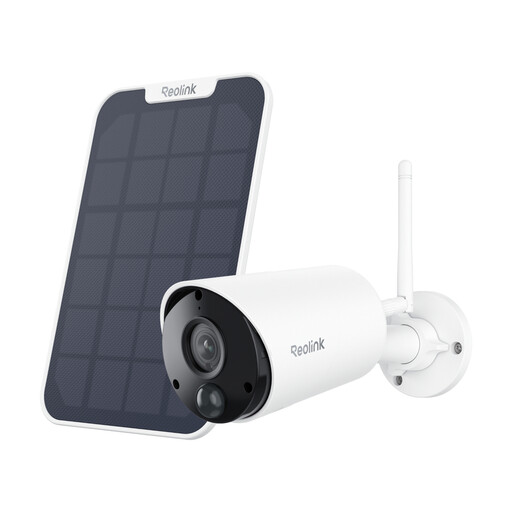
Why It Stands Out: The Reolink Argus B320 is a reliable and user-friendly all-rounder. It combines a sharp 5MP resolution with smart detection in a compact and weather-resistant design.
Key Features:
Who Is It For? An excellent choice for anyone looking for a no-nonsense off-grid outdoor camera for general home security. It's easy to install and manage via the app.
The world of solar-powered security cameras is broad and diverse. Are you looking for a model with a built-in siren, more advanced PTZ capabilities, or another specific feature?
Explore our full range for more choices that fit your situation. -> Discover All Solar Battery Powered PTZ Alarm Cameras
1. How much sunlight does a solar-powered security camera need? Generally, a few hours of direct sunlight per day are enough to keep the battery charged. Modern, efficient solar panels also generate power on cloudy days, albeit to a lesser extent. Performance depends on the battery capacity, the panel's efficiency, and how often the camera is activated.
2. Does a solar-powered outdoor camera work in the winter? Yes, these cameras are designed to operate year-round. In winter, with fewer hours of sunlight and lower temperatures, battery life may be shorter. Some models, like the IMOU camera mentioned, have features for low-temperature charging. You can extend battery life by lowering the motion detection sensitivity in the app.
3. Can I view the footage from anywhere? Yes. With both Wi-Fi and 4G cameras, you can view live and recorded footage via an app on your smartphone or tablet, wherever you are. This requires the camera to be connected to the internet (via Wi-Fi or 4G) and your phone to also have an internet connection.
