
Vandaag of morgen in huis

Kwaliteit gegarandeerd

Welkomstaanbiedingen ontgrendelen: GRATIS bezorging | Tot 80% korting | Gratis 30 dagen JoyPlus-proefperiode
Download de app
Solar-powered outdoor lighting sounds ideal: no fussing with cables, no extra costs on your energy bill, and an eco-friendly choice. Yet, the purchase often leads to frustration. A lamp that fails after the first autumn shower or lighting that barely gives off any light during the winter months are common complaints.
Before you invest in new garden lighting, it's wise to understand the most common pitfalls. This will help you avoid a bad purchase.
To ensure your purchase meets your expectations, there are a few technical specifications you shouldn't overlook. These determine the performance and lifespan of your solar-powered garden lighting.
The IP (Ingress Protection) rating indicates how well a lamp is protected against dust and moisture. This is a crucial factor for a waterproof outdoor light.
solar ground spotlights in the lawn or solar-powered string lights in a tree. These are more resistant to heavy rain and moisture.Don't be guided by photos alone; look at the numbers.
A long runtime starts with a good battery and an efficient solar panel. The battery's capacity is expressed in milliampere-hours (mAh). A higher mAh value theoretically means a longer runtime. However, this is only useful if the solar panel is of good quality and capable of sufficiently charging the battery, even on less sunny days. Models with a motion sensor are extra efficient because they only operate at full power when needed.
To help you with your choice, we have selected a number of products that suit different needs and situations.
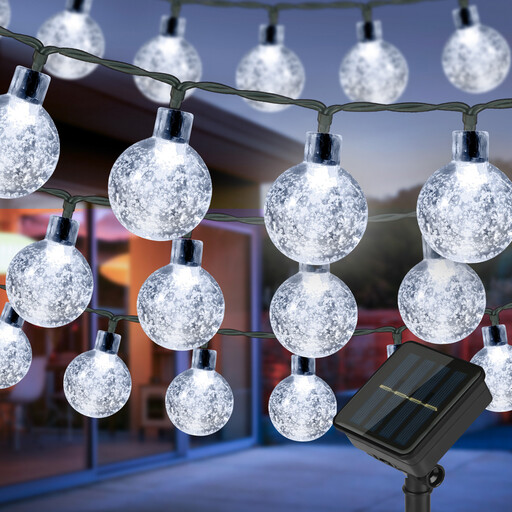
Why This Fits Their Persona: Perfect for those who want to transform a balcony, patio, or pergola into an atmospheric space. These string lights are purely decorative and, with their 60 'bubble' bulbs, instantly create a cozy ambiance for long summer evenings.
The IP65 rating ensures these string lights can withstand a heavy downpour, unlike cheaper alternatives that fail quickly. The focus is on ambiance, not bright illumination, which keeps expectations realistic.
The string is 11 meters long and features 8 different lighting modes. Installation is simple: place the panel in the sun and hang the string lights.

Why This Fits Their Persona: Ideal for anyone seeking a reliable and bright light source for a front door, driveway, or back entrance. This Philips solar light is designed for security and deters unwanted visitors.
The motion sensor prevents the battery from draining unnecessarily, ensuring the light functions reliably even in winter. The 1000-lumen output is an objective measure of brightness, not a vague promise from a mood shot.
A very powerful light beam (1000 lm) for maximum visibility. The reliable sensor and durable materials (IP44) ensure a long lifespan.
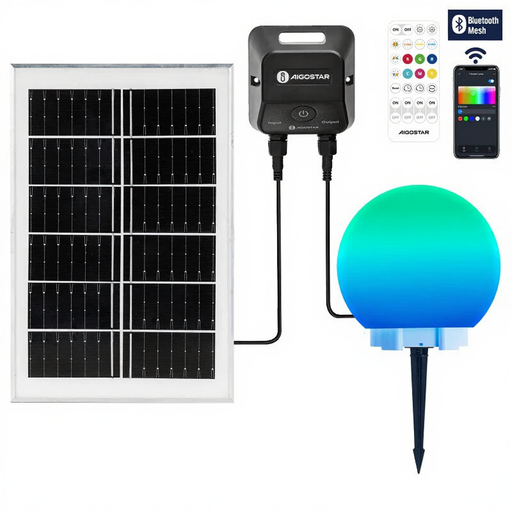
Why This Fits Their Persona: For those who want to highlight garden paths, borders, or a specific tree without the hassle of cables. This Aigostar garden light is a robust ground spotlight that you can easily stake into the ground and control remotely.
With an IP65 rating, this spotlight is designed to survive in the ground, even in wet weather. The specifications (20W, 200 lm) provide a clear picture of its performance, so you know what you're getting for your path lighting.
Smart control via Bluetooth Mesh and adjustable light colors (RGBCCT) for both functional white light and colored ambient light. According to Aigostar, you can control over 200 of these lights in a single network.
We have compiled a complete, up-to-date list of products that fully meet these strict selection criteria and safety standards.
Yes, but performance depends on the model. In winter, the days are shorter and the sun is less powerful, so the battery doesn't charge as fully. As a result, the runtime will be shorter than in the summer. For the winter months, choose a model with an efficient solar panel, a high-capacity battery (mAh), and preferably a motion sensor. This sensor ensures the light only turns on when needed, which saves energy.
That depends on your goal. For ambient lighting, such as solar-powered string lights along a fence, 50 to 200 lumens per bulb is often sufficient. For functionally lighting a garden path with solar ground spotlights, you can aim for 100 to 300 lumens per spot. For a solar wall light with a motion sensor that serves as a security light, a higher light output of 400 to 1000 lumens is recommended for good visibility.
The IP rating indicates how well a lamp is protected against external elements, specifically against solid objects (first digit) and moisture (second digit). For outdoor lighting, the second digit is especially important. IP44 means splash-proof and is suitable for sheltered locations. IP65 is jet-proof (resistant to water jets) and a more robust choice for places fully exposed to rain. For solar-powered garden lights that you place in the ground, IP65 or higher is a wise choice.
