
Vandaag of morgen in huis

Kwaliteit gegarandeerd

Welkomstaanbiedingen ontgrendelen: GRATIS bezorging | Tot 80% korting | Gratis 30 dagen JoyPlus-proefperiode
Download de app
A solar-powered outdoor light with a motion sensor can illuminate an entrance, garden path, exterior wall or driveway without needing a power cable to the outside wall. However, not every light meets the same practical requirements. A high lumen rating, for example, means little if the solar panel is mostly in the shade. Terms such as “waterproof” and “security light” are also not always used precisely.
Use this buying guide to compare the key specifications and find models suited to different settings in gardens, homes and business premises across the Netherlands.
A light with a high lumen count may seem appealing, but how long it stays lit also depends on battery capacity, charging time and the amount of direct sunlight it receives. A high light output can also be too bright for a small patio. So consider the combination of lumens, light mode, battery and detection angle.
An IP rating indicates what kind of ingress a product is protected against. IP44 means protection against solid particles larger than 1 mm and water splashes. IP65 offers greater protection against dust and water jets, but it does not mean the light can be submerged.
So check whether a waterproof solar light actually has an IP rating, and install it according to the instructions. Even an IP65 rating is no reason to mount a fitting in a puddle.
An outdoor solar wall light is less reliable if its panel faces north, is installed beneath a balcony or is shaded by trees during the day. There is also less direct sunlight in winter. Choose a spot with as much unobstructed daylight as possible, and keep the panel clear of leaves and dirt.
Brightness is measured in lumens (lm). A lower light output may be enough for a small path or decorative solar garden lighting. More light is practical for a driveway, garage or wide exterior wall.
Colour temperature is measured in kelvin (K):
Bear in mind that product descriptions may use colour terms differently. Always check the stated kelvin value.
A PIR sensor responds to movement and changes in heat. The direction someone is walking in matters as well as the distance. Someone walking straight towards the sensor may be detected at a different range from someone passing it from the side.
Check:
An LED outdoor light with a sensor is particularly useful by an entrance, garage or driveway, where the light does not need to stay on at full brightness all night.
IP44 may be suitable for a sheltered wall. For an exterior wall directly exposed to rain and splashing dirt, an IP65 outdoor light may offer better protection. Check the material, weight and fixings supplied, too.
Clean the solar panel regularly with a soft cloth. Do not open the integrated battery yourself. Product information for various models warns that mishandling a rechargeable battery can cause leaks or fire.
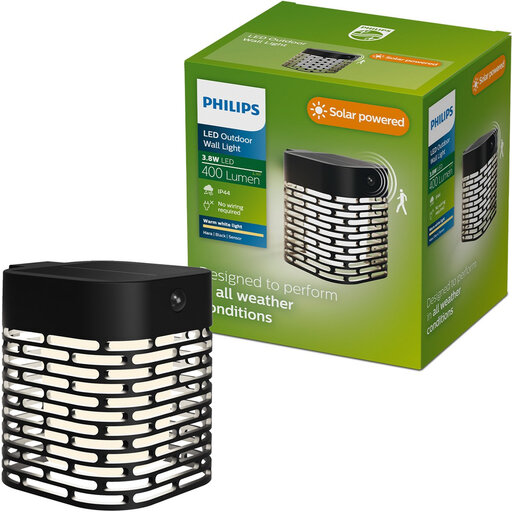
Why it suits this type of user: This compact model is suitable for an entrance, balcony or sheltered garden wall, where warm light matters more than a wide range.
The product information specifies 400 lumens, 2700 K, two light modes and IP44. This makes it easier to understand what to expect from its brightness and splash protection.
Warm light, integrated LED, two modes and installation without a mains cable.
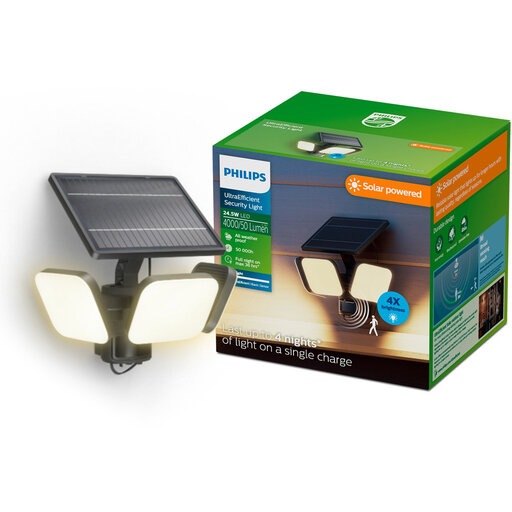
Why it suits this type of user: This model is designed for larger exterior walls, driveways and areas where a wide, powerful beam is needed.
The listed specifications include 4000 lumens, IP65, an adjustable light head and a detection range of 8 metres when approached head-on and 16 metres from the side.
IP65 rating, two light modes, dusk sensor and a choice of 3000 K or 5000 K variants.

Why it suits this type of user: This model is designed for larger areas such as a garage, large garden, patio, driveway or business premises.
The description specifies three light modes, a 180-degree detection angle, IP65 and three adjustable light heads. This gives you a clearer idea of how the light can be used than a general claim about security alone.
302 LEDs, stated light output of 3000 lumens, three light modes and plenty of adjustment options.
We’ve put together a complete, up-to-date list of products that meet these strict selection criteria and the applicable European safety regulations.
Mount the light on a firm surface and point the solar panel towards a spot that gets as much direct daylight as possible. Consider the direction people will approach from: by a driveway, approaching from the side may give you a different detection range from walking straight towards the sensor. Test the sensor after installation, before tightening the screws fully.
How long it stays lit each night depends on sunlight, the battery, light mode and temperature. Manufacturers sometimes state a number of operating hours or nights, but these are product specifications based on particular conditions. In practice, short winter days and cloudy weather can affect performance. Clean the panel regularly and check the fittings.
During normal use, a solar outdoor light gets its energy from the solar panel and integrated battery, so it does not need to be connected to the mains. However, its light output may be lower if the battery is not sufficiently charged. A model with a motion sensor can save energy by not staying on at full brightness all the time.
