
Vandaag of morgen in huis

Kwaliteit gegarandeerd

Welkomstaanbiedingen ontgrendelen: GRATIS bezorging | Tot 80% korting | Gratis 30 dagen JoyPlus-proefperiode
Download de app
A solar outdoor wall light with a motion sensor may seem easy to choose: mount the light on the wall, let the solar panel charge during the day and enjoy automatic light in the evening. In practice, some models disappoint because of poor positioning, limited splash protection or a sensor that is not suited to the situation.
For an entrance, terrace, balcony, garden path or driveway, three things are particularly important: the amount of light, how the motion sensor works and the protection it offers against British weather conditions. Below, you can read what to look out for and which models suit different situations.
Lumens indicate the total light output, but not how widely or directionally the light is distributed. A 400-lumen light may be suitable for a front door or balcony, while a wider driveway requires more light and a greater range.
Also consider the colour temperature. 2700K to 3000K produces warm white light that works well on a terrace or at an entrance. 4000K to 5000K appears whiter and may be better suited to functional lighting around a garage or driveway.
An IP44 solar light is protected against solid particles from 1 millimetre in size and splashing water. This protection rating makes it suitable for many sheltered walls, balconies and terraces. However, the light is not designed to be immersed or exposed to direct jets of water.
An IP65 solar light offers greater protection against dust and water jets. This may be relevant for an exposed wall, garage or driveway where the light is more likely to come into direct contact with rain. IP65 still does not mean that you can place the light underwater.
A solar light for the garden or terrace only works well if the panel receives enough daylight. Shade from a roof edge, tree or tall fence reduces charging capacity. Therefore, do not position the light solely based on where you want the light. Also check that the panel has a clear view of the sky for a large part of the day.
In winter, the days are shorter and sunlight is less intense. As a result, the operating time may be shorter than in summer. This is a normal characteristic of solar-powered outdoor lighting and is not a warranty issue.
Use the following guidelines as a practical comparison:
In addition to the lumen count, check whether the light head can be adjusted. This allows you to direct the beam towards a keyhole, path or door instead of letting the light shine forwards at random.
An outdoor light with a motion sensor can switch on automatically when someone enters the detection area. Look at:
A sensor does not always work the same way for a direct approach as it does for movement from left to right. A wide detection angle is useful for a narrow entrance. For a driveway, range is the most important factor.
A solar wall light usually uses an integrated rechargeable battery. Check whether the battery can be replaced and how long the manufacturer states that the product can operate. Manufacturer information about operating time and lifespan is a product specification or brand claim, not a guarantee for every location.
Wireless outdoor lighting is easy to install, but the mounting surface must be stable. With a magnetic model, the mounting plate must be securely attached and suitable for the weight of the light. Clean the solar panel regularly with a soft cloth. Dirt and leaves can reduce charging efficiency.
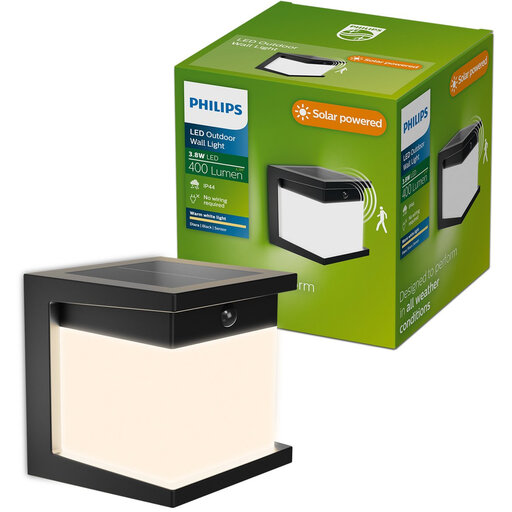
Why it suits this profile: This compact model offers a simple introduction to solar lighting for a balcony, garden path or small entrance. It works without mains electricity and has two light modes.
The specifications state 400 lumens, an integrated motion sensor and IP44. This makes it clear that the model is intended for splashing water, not direct jets of water.
400 lumens, 2700K warm white light, two modes and compact dimensions of 12 × 11 × 12 cm.

Why it suits this profile: The Fyns is suitable for an entrance or wall where more light is needed than a compact solar wall light can provide. The product information states 1,000 lumens and a dusk sensor.
The combination of a stated light output, two modes and IP44 makes the expected use clearer. However, position the light in a sufficiently sheltered location to protect it from splashing water.
1,000 lumens, 3000K warm white light, motion sensor and installation without wiring.
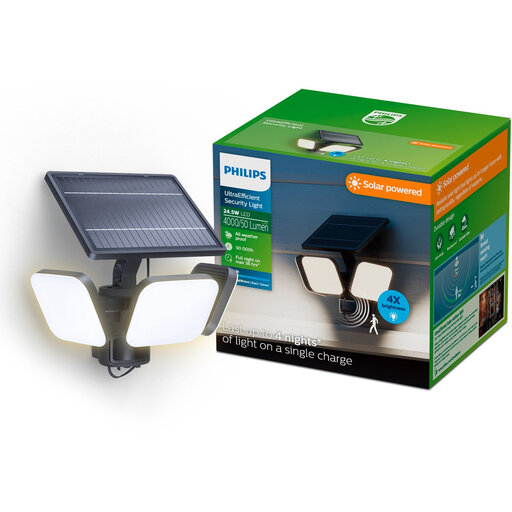
Why it suits this profile: This model is designed for a driveway, garage or wide wall where powerful solar security lighting is required. The light head is adjustable.
The stated detection range is 8 metres for a direct approach and 16 metres for sideways movement. IP65 is also specified, offering greater protection than IP44.
4,000 lumens, IP65, adjustable light head and a stated detection range for direct and sideways movement.

Why it suits this profile: The magnetic mounting and USB-C charging are useful for a rented property, balcony or location where you do not want to install a permanent solar light.
The product specifications state IP44 and a rechargeable battery. This makes it clear that regular charging is still required and that the light is not resistant to direct jets of water.
300 lumens, 3000K, motion sensor, magnetic mounting and USB-C charging.
We have put together a complete, up-to-date list of products that fully meet these strict selection criteria and the applicable European safety regulations.
A solar outdoor light does not use electricity from the mains while operating. However, a model with a USB battery may occasionally need to be charged via an adapter. With a solar wall light, the practical operating time depends on sunlight, temperature, battery capacity and how often the motion sensor is activated.
Lifespan varies depending on the battery, housing and LED module. Manufacturers may state an expected LED lifespan, but this does not automatically mean that the battery will last just as long. Therefore, also check whether the battery can be replaced and keep the solar panel clean.
Yes, but charging time and operating time may be reduced by shorter days, cloud cover and the lower position of the sun. Position the panel as openly as possible and, if the wall is dark, consider a model with a larger battery or several light modes.
Not always. IP44 may be sufficient for a sheltered balcony or covered entrance. For an exposed wall, garage or driveway, IP65 offers greater protection against dust and water jets. Also always check the installation instructions for the product you choose.
