
Vandaag of morgen in huis

Kwaliteit gegarandeerd

Welkomstaanbiedingen ontgrendelen: GRATIS bezorging | Tot 80% korting | Gratis 30 dagen JoyPlus-proefperiode
Download de app
A solar outdoor wall light with motion sensor may seem straightforward: put it up, let it charge during the day and enjoy automatic light in the evening. Yet some buyers soon find that the light output is disappointing, the battery is flat or moisture has caused damage. The product name alone does not tell you everything about how well a light will perform in a Dutch garden, on a balcony or by an entrance.
Pay particular attention to these three common pitfalls:
By checking the specifications carefully, you can find a solar wall light that suits your location and how you intend to use it.
Check whether the light only responds to movement in the dark, or whether it also has a dusk sensor. A wall light with a motion sensor will generally only switch on when it is dark and movement is detected. This prevents unnecessary lighting during the day.
Some models offer two settings:
Automatic outdoor lighting is practical for an entrance or driveway. For a patio, a constant, softer light setting may be more pleasant. Also check the detection range. According to the product description, the Philips Zyren has a range of 8 metres when approached directly and 16 metres for movement from the side. This is particularly relevant for a wide driveway or a long façade.
Lumens indicate the amount of light produced. As a guide:
So, an LED outdoor wall light with 400 lumens is not automatically less suitable; it is simply intended for a different purpose from a 4,000-lumen solar security light.
Also consider the colour temperature:
According to Philips’ own product information, the Zyren is available with 3,000 K or 5,000 K. Always check the variant, as the colour temperature affects both the atmosphere and visibility.
The IP code consists of two numbers. The first indicates protection against solid particles, while the second refers to water.
An IP44 model is suitable for general outdoor use, for example beneath a sheltered façade, on a balcony or next to a patio. Do not place the light where it will be continuously exposed to powerful water jets or where flooding may occur.
An IP65 model offers greater protection against dust and rain. Even so, do not immerse it. The installation location, the quality of the fixings and the amount of direct sunlight remain important.
One major advantage of solar-powered outdoor lighting is that you do not need to run a power cable to the wall. Choose a sturdy surface and use the mounting materials supplied. Check the following beforehand:
Clean the solar panel regularly with a soft, dry or slightly damp cloth. Do not use abrasive products. On several models, the internal battery is not designed to be opened or replaced by the user. Also check from time to time that the wall mount is still securely fixed.
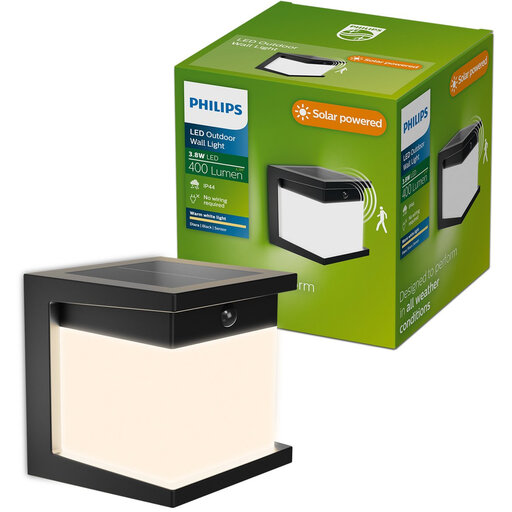
Why it suits this profile: This compact solar wall light provides 400 lumens, warm white light at 2700 K and a motion sensor for an entrance, balcony or garden path.
The specifications clearly state 400 lumens, 2700 K and IP44. Expect atmospheric basic lighting rather than a wide floodlight.
Compact dimensions of 12 × 11 × 12 cm; two light settings and installation without wiring.

Why it suits this profile: Ideal for a driveway, shed or wide façade where a powerful beam and extensive sensor range are important.
The IP65 rating is better suited to a less sheltered location than IP44, while the sensor and lighting specifications are clearly stated.
4,000 lumens; detection up to 8 metres straight ahead and 16 metres from the side; adjustable light head.
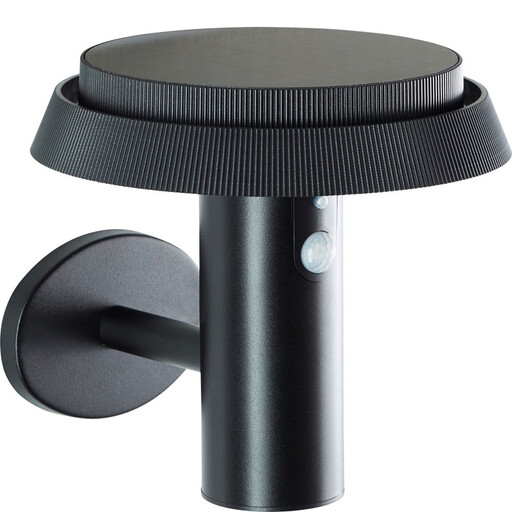
Why it suits this profile: A practical choice for anyone looking for a metal and plastic housing, 500 lumens and dimmable lighting for a patio or entrance.
The product information explicitly states IP44 for protection against splashing water. Do not therefore place the light where it will be exposed to direct water jets.
500 lumens; 3000 K warm white light; integrated motion sensor and dimming function.
We have put together a complete, up-to-date list of products that fully meet these strict selection criteria and the applicable European safety regulations.
Yes, but charging performance may be lower due to shorter days, cloudy weather and the sun being lower in the sky. Position the panel as freely as possible towards the available daylight. According to the product descriptions of some models, a fully charged battery can last for several nights, but actual running time depends on sunlight, temperature and the number of movements detected.
Various models specify an LED light source lifespan of approximately 20,000 to 50,000 hours of use. This is a product specification, not a guarantee of the lifespan of the complete light. The battery, housing and sensor may require maintenance or replacement sooner. Check the solar panel and fixings regularly.
A solar outdoor light uses solar energy during the day and does not need to be connected to the mains. This means there are no mains electricity costs during use. However, the light still depends on sufficient daylight and a properly functioning battery. Also consider the selected light setting: continuous lighting generally uses more energy than lighting that only switches on when movement is detected.
