
Vandaag of morgen in huis

Kwaliteit gegarandeerd

Welkomstaanbiedingen ontgrendelen: GRATIS bezorging | Tot 80% korting | Gratis 30 dagen JoyPlus-proefperiode
Download de app
A solar-powered outdoor wall light with a motion sensor can light up your entrance, garden, driveway or garage without a fixed electricity supply. It sounds straightforward, but not every solar outdoor wall light is right for every exterior wall. A compact light can work well by the front door, while a wide driveway needs greater light output and a wider detection range.
Look out for these three common pitfalls:
Light output is measured in lumens (lm). For a front door or patio, 180 to 500 lumens may be enough. For a driveway, garage or wider exterior wall, a more powerful solar security light may be more practical.
Colour temperature is measured in Kelvin (K):
An outdoor LED wall light with a high lumen count can be uncomfortably bright if it points directly towards windows or the road. So check whether the light can be adjusted, and where its sensor detects movement.
A wall light with a motion sensor switches on when it detects movement. The detection angle and range matter more than simply having a sensor. Position the light so that someone walks across its detection area; movement straight towards the sensor may sometimes be detected less quickly.
A dusk sensor stops the light from switching on unnecessarily during the day. Models with both an automatic mode and a constant-on mode offer more flexibility. Also check whether the light dims when no movement is detected. This can help conserve battery power, but not every model has this feature.
The first digit in an IP code refers to protection against solid objects; the second refers to water. IP44 indicates, among other things, protection against splashing water. IP65 means the housing is dust-tight and protected against water jets. Neither rating means that the light can be submerged.
A weather-resistant outdoor light should be securely mounted on a suitable surface. Before installation, check:
The products below were selected based on verifiable specifications, including lumens, IP rating, colour temperature, sensors and installation method. Claims about operating time or sensor performance come from the manufacturer’s product information and are not presented as guaranteed results for every home.

Why it suits this type of user: This compact Philips solar wall light offers 1000 lumens, warm white light at 3000 K, a motion sensor and two lighting modes. That makes it suitable for an entrance, shed or small driveway, with no wiring required.
The specifications clearly state the light output, colour temperature and IP44 rating. So expect protection against splashing water, not suitability for a location exposed to direct water jets.
1000 lm, 3000 K, integrated LED, two modes and installation without a mains connection.
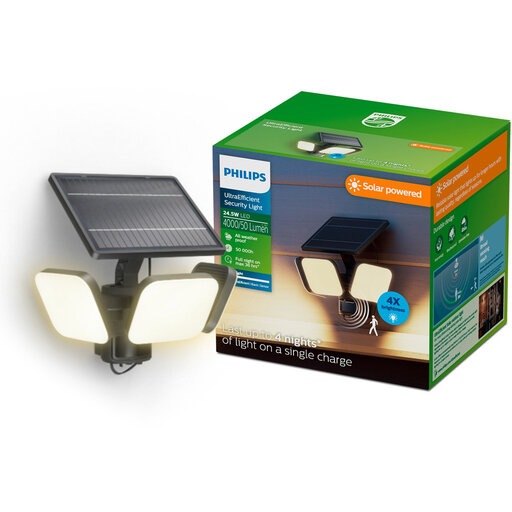
Why it suits this type of user: For a wide driveway, garage or exterior wall, the combination of 4000 lumens, IP65 and an adjustable light head is worth considering. The 3000K version gives you practical warm white light without a bluish tint.
The IP65 rating makes it more suitable than IP44 for an exposed exterior wall, provided it is installed correctly. You can adjust the light head to reduce glare and avoid wasting light.
4000 lm, IP65, motion and dusk sensors, an adjustable head and, according to the product information, a detection range of 8 metres straight ahead and 16 metres to the sides.

Why it suits this type of user: This model is designed for larger areas such as a garden, patio, garage or driveway. Its three light heads and wide light distribution are more practical when a single fixed beam doesn’t provide enough coverage.
The product information lists three modes, a 180-degree detection angle and IP65 protection. However, check that the stated 3000 lumens will provide the level of brightness you want for your property.
302 LEDs, 3000 lm according to the product description, three lighting modes, three adjustable heads and IP65 protection.
We’ve put together a complete, up-to-date list of products that meet these strict selection criteria and the applicable European safety regulations.
Whenever possible, install a solar outdoor wall light where its panel has an unobstructed view of the sky for as long as possible. A south-facing wall isn’t essential, but prolonged shade will reduce charging capacity. Keep the panel clear of leaves and grime.
Mount the light securely and test the sensor in the dark. Think about the height: if it’s too low, it may detect unwanted movement; if it’s too high, its detection range may be limited. If you rent your home, it’s a good idea to ask permission before drilling into the exterior wall.
How long the light stays on depends on sunlight, battery capacity, temperature, lighting mode and how often the sensor is activated. Manufacturers may quote a specific operating time under certain conditions. Philips says the Zyren can provide light for up to four nights when fully charged; in practice, it may last for less time during the Dutch winter.
Yes, but charging time and how long the light stays on may be reduced by shorter days, cloudy weather and the low position of the sun. Avoid installing the panel under an overhang and, where possible, choose a spot that receives direct daylight.
Lifespan varies depending on the battery, LED module, housing and frequency of use. Product information for some models, for example, gives the LED a rated life of 20,000 to 50,000 operating hours. That isn’t a guarantee of the lifespan of the complete light. Also check whether the battery can be replaced; on several models with integrated batteries, user replacement isn’t intended.
In normal use, the light gets its energy from the solar panel and built-in battery, so it doesn’t need to be connected to the mains. However, there are conditions in which it may not stay on for as long, such as prolonged shade or frequent sensor activation. That’s why choosing a good installation location matters more than simply opting for a high lumen count.
