
Vandaag of morgen in huis

Kwaliteit gegarandeerd

Welkomstaanbiedingen ontgrendelen: GRATIS bezorging | Tot 80% korting | Gratis 30 dagen JoyPlus-proefperiode
Download de app
A solar outdoor wall light with motion sensor may seem easy to choose: look for a black model, check the lumen output and mount the light on the wall. Yet problems often only become apparent after a few weeks. The light may not get enough sun, react to every cat in the garden or prove less resistant to rain than the product photo suggests.
This practical guide highlights the specifications that really make a difference in Dutch gardens, entrances, balconies and driveways.
A higher lumen output means more light, but not necessarily better light distribution. A powerful solar security light can be useful on a driveway, while 180 to 400 lumens is often enough for a door, balcony or garden path. So also consider the light colour, beam direction and area you want to illuminate.
IP44 outdoor lighting is protected against solid objects measuring 1 millimetre or more and splashing water from different directions. This is suitable for many sheltered outdoor locations, but IP44 does not mean that a light is waterproof. Do not place this type of outdoor light under a direct jet of water and never immerse it.
For a wall that receives a lot of driving rain, a higher IP rating such as IP65 may be more appropriate. Always check the official product information rather than relying solely on terms such as “weather resistant” or “suitable for all weather conditions”.
A solar outdoor light needs sufficient direct daylight during the day. Beneath an overhang, between tall fences or on a north-facing wall, the battery may not charge as effectively. In winter and during several cloudy days, the operating time may also decrease. This is not a defect, but a result of the available sunlight and use of the motion sensor.
Light output is measured in lumens (lm):
Colour temperature is measured in Kelvin (K). 2700 K and 3000 K are classed as warm white outdoor lighting. 2700 K generally looks softer and more atmospheric, while 3000 K creates a slightly brighter, more functional effect. Either can work well by a front door. If you are mainly looking for ambience, consider a lower Kelvin value.
A motion sensor switches the light on when movement is detected. Check whether the sensor settings, detection angle and detection range are specified. An overly sensitive sensor may switch on unnecessarily in response to passers-by, pets or moving branches.
A dusk sensor activates the light when it gets dark. Some solar wall lights offer several modes, such as automatic operation, permanently on or lower-intensity lighting with additional brightness when movement is detected. Multiple settings are practical, but also check how to select your preferred mode.
Check the battery type, the number of batteries and how the light is charged. An integrated lithium-ion battery cannot be replaced by the user on many models. This should be clearly stated in the product information. A cordless outdoor light with USB charging works differently from a fully solar model: neither requires permanent wiring, but only the former can be manually recharged.
When installing the light, consider:
An integrated LED light source requires little maintenance, but is often not replaceable. Clean it with a soft, dry or slightly damp cloth, following the product instructions. Avoid harsh cleaning products.
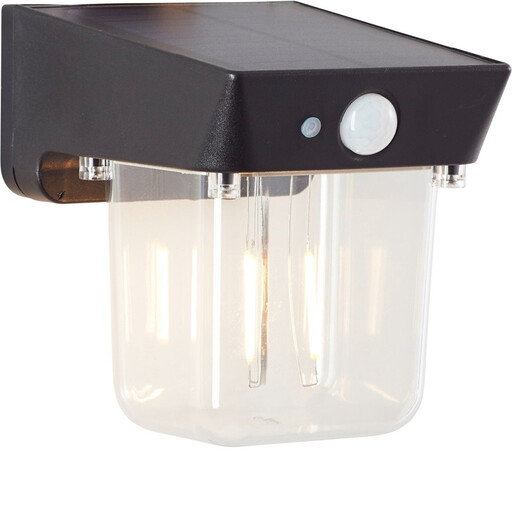
Why it suits this profile: This compact model is designed to provide basic lighting at an entrance, patio or garden path. The black finish is ideal if you are looking for a simple black outdoor light without wiring.
The product information clearly states 180 lumens, 2700 K, IP44 and an integrated battery. This makes it clear from the outset that the model is intended for targeted lighting, not broad area illumination.
Solar-powered, with motion sensor, dimmable function, 2700 K and compact dimensions of 11.5 × 10 × 11 cm.

Why it suits this profile: The Fyns is suitable if you want more light by the front door, garage or driveway and value two operating modes.
The stated 1,000 lumens makes the light output clearer than general terms such as “bright light”. IP44 provides protection against splashing water, not direct jets of water.
1,000 lm, warm 3000 K lighting, dusk and motion sensors, two modes and installation without a mains cable.

Why it suits this profile: This model is suitable for larger gardens, driveways, garages and patios where broad illumination is needed rather than just a single pool of light beside the door.
The IP65 rating is more suitable for a location with greater exposure to dust and rain than IP44. However, check that the dimensions and powerful beam are appropriate for the installation location.
302 LEDs, 3,000 lumens according to the product information, three light modes, three adjustable heads, a 180° detection angle and IP65.
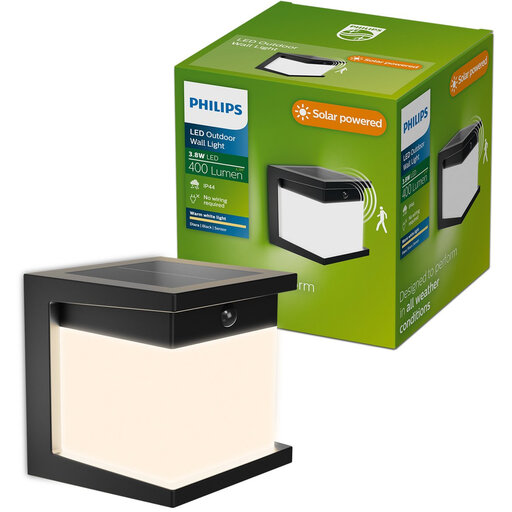
Why it suits this profile: This square black solar wall light is designed to provide warm, softer lighting on a balcony, in a garden or on a patio.
The product details specify 400 lumens, 2700 K and IP44. This makes it easier to distinguish the model from more powerful security lights designed for a different purpose.
400 lm, warm 2700 K light, two light modes, motion sensor, integrated LED and a lifespan of 25,000 hours according to the product information.
We have put together a complete, up-to-date list of products that fully meet these strict selection criteria and the applicable European safety regulations.
Yes, but the operating time may be shorter. Shorter days, a low sun and cloudy weather provide less energy for charging. Position the panel as far from shade as possible and keep it clean. Choose a light with an appropriate output and do not automatically use the most powerful setting if you mainly want to illuminate an entrance.
This varies depending on the model, charge level, temperature, amount of sunlight and number of activations. The stated burn time or LED lifespan is not the same as the battery’s operating time per night. Therefore, check the battery specifications, light modes and information about replaceability separately. With an integrated battery, replacement by the user is generally not intended.
For a sheltered entrance or wall, IP44 outdoor lighting is often a practical choice for protection against splashing water. The rating does not protect against immersion or powerful water jets. Mount the light securely, follow the installation instructions and choose a higher IP rating if the location is exposed to a lot of direct rain or splashing dirt.
