
Vandaag of morgen in huis

Kwaliteit gegarandeerd

Welkomstaanbiedingen ontgrendelen: GRATIS bezorging | Tot 80% korting | Gratis 30 dagen JoyPlus-proefperiode
Download de app
A solar-powered outdoor light with a motion sensor can illuminate an entrance, garage drive or patio without needing a cable to the mains. However, some models can disappoint in practice. The light output may be lower than expected, the sensor may not respond in the right place, or the solar panel may not get enough direct sunlight.
This buying guide helps homeowners, tenants and garden owners assess specifications more effectively. It focuses on measurable factors such as brightness, detection range, IP rating, colour temperature and installation.
A high number of LEDs doesn’t automatically mean a light will brightly illuminate a large area. Focus on the light output in lumens. For example, a compact outdoor solar wall light with 180 lumens could suit an entrance or path. For a driveway or wide exterior wall, a solar security light with a higher light output is more practical.
Also consider how long the light stays on. A light that shines very brightly for a short time uses more battery capacity than a model with a dimmed setting or a sensor mode.
An IP44 outdoor light is protected against solid objects and splashing water. This makes it suitable for a sheltered exterior wall, patio or entrance, but not for direct jets of water or immersion.
An IP65 outdoor light offers greater protection against dust and jets of water. Correct installation is still important, though. Don’t place the solar panel under a roof overhang that blocks the rain; position it somewhere it can receive enough daylight.
A motion sensor doesn’t respond equally well in every direction. Check both the distance and the angle. A light mounted on a side wall may be less effective if someone walks straight towards the sensor, while a wide detection angle can be useful along a driveway or garden path.
The stated distance is also a product specification based on certain conditions. Rain, obstacles, mounting height and a person’s movement can all affect the practical range.
Bear in mind that terms such as “ultrabright” aren’t a technical measure. Lumens, light colour and whether the light can be adjusted are more useful guides. For example, the UME light’s product information states 3,000 lumens and 7,000 K. Always check the current product specifications before buying.
An LED outdoor light with a sensor is most useful when the sensor is installed at the right height and facing the right direction. Check:
A wide spread of light is useful for a driveway. For an exterior wall or front door, a focused beam may be enough.
Solar lighting works without a permanent mains connection, but it does need enough daylight. Shade from trees, a balcony or a tall fence will reduce its ability to charge. Ideally, place the panel somewhere it will receive several hours of direct sunlight.
Also check:
Clean the panel with a soft, slightly damp cloth. Don’t use abrasive products, and don’t open the casing unless the manufacturer instructs you to.
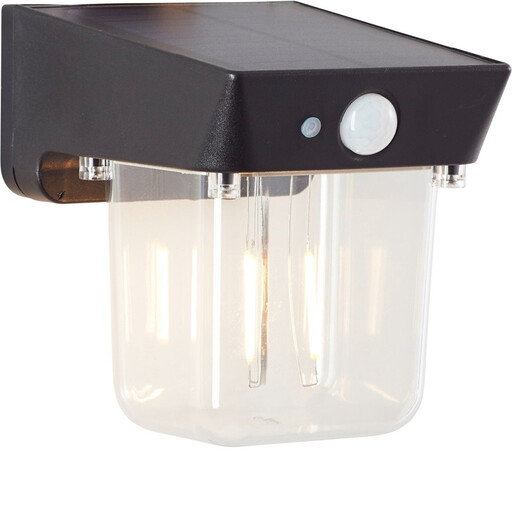
Why it suits this user: This compact wall light is suitable for a small entrance, fence or patio where you mainly need light to help you find your way.
The product specifications state 180 lumens and IP44. This makes its intended use clear: it’s not designed for a large driveway, but for a sheltered spot with modest lighting needs.
Built-in motion sensor, solar panel, dimming function and a compact height of 11.5 cm.

Why it suits this user: This model is a good fit if you’re looking for plenty of light and a wide detection range for an exterior wall, garage or larger outdoor area.
The product description gives separate distances for movement towards the sensor and across its field of view: 8 and 16 metres. It also states the IP65 rating, rather than making only a general claim about weather resistance.
According to the product information: 4,000 lumens, 3,000 K, two lighting modes, an adjustable light head and an IP65 rating.

Why it suits this user: The three adjustable light heads are designed to illuminate a wide area, such as a driveway, garage, garden or large patio.
The stated 270° light coverage and 180° sensor angle make it clear that this model is designed for a wide area, not just a front door.
According to the product information: 3,000 lumens, three lighting modes, a detection range of 60 feet and IP65 protection.
We’ve put together a complete, up-to-date list of products that meet these strict selection criteria and the applicable European safety regulations.
Yes, but charging performance may be lower because of shorter days, cloudy weather and the sun being lower in the sky. Place the panel somewhere as free from shade as possible and keep it clean. A larger battery or several lighting modes can help you make better use of the available energy.
Start by following the manufacturer’s installation instructions. Generally, the sensor should be high enough to be difficult to reach, but still aimed at the area where you expect movement. After installation, test whether it responds to people walking both directly towards the light and past it from the side.
During normal use, the light gets its energy from the solar panel and built-in battery, so it doesn’t need a permanent mains connection. However, how well it works ultimately depends on sunlight, battery capacity, the lighting mode and how often the motion sensor is activated.
