
Vandaag of morgen in huis

Kwaliteit gegarandeerd

Welkomstaanbiedingen ontgrendelen: GRATIS bezorging | Tot 80% korting | Gratis 30 dagen JoyPlus-proefperiode
Download de app
A solar outdoor light with a motion sensor can illuminate a driveway, garden path, garage or entrance without running an electricity cable to the wall. However, some buyers find that performance falls short after a few months. A light may have a high lumen output on paper, but fail to charge properly in practice, react too quickly to moving branches or be unsuitable for an exposed wall.
The main pitfalls usually come down to three things:
Don’t just look for the words “motion sensor”; check the range and angle of detection too. A LED outdoor light with a motion sensor for a narrow entrance has different requirements from a solar security light for a wide driveway.
According to the Philips product description for the Zyren, its PIR sensor detects movement up to 8 metres when approached directly and up to 16 metres when approached from the side. That difference matters if someone walks past the garage or fence from the side. Also check whether the sensor only detects movement when it’s dark or can be activated during the day too.
Lumens indicate how much light a lamp produces according to its product specifications. A higher figure doesn’t automatically mean the light will be more comfortable everywhere. Warm white light of around 2700 to 3000 K may feel more pleasant on a balcony or patio. A more neutral or cooler colour can provide greater contrast on a driveway or back path.
The Philips Zyren versions in this selection are listed at 4000 lumens and are available in 3000 K or 5000 K. According to the Philips product description, there are two lighting modes. Check which version you’re choosing before you buy, as the light colour affects both the atmosphere and visibility.
The IP code describes protection against dust and water. An IP44 outdoor light is suitable for protection against splashes, but shouldn’t be installed somewhere that’s regularly exposed to direct water jets. An IP65 outdoor light offers a higher level of protection against dust and water jets according to its rating. Even with IP65, it must not be submerged.
Also consider the mounting hardware, weight and surface. A light weighing around 1.5 kg needs a sturdy wall and suitable wall plugs. Position the solar panel where it can receive as much direct daylight as possible. An adjustable light head helps you direct the light towards the driveway, door or garden.
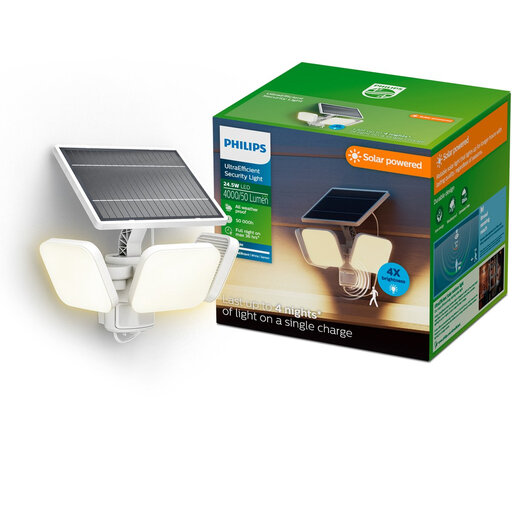
Why it suits this type of buyer: This solar-powered outdoor wall light works without a mains connection and combines a dusk sensor with a motion sensor. That makes it suitable for an entrance, shed or small driveway where easy installation matters.
The product listing mentions an adjustable light head, an IP65 rating and a detection range of 8 metres directly ahead and 16 metres to the side. Just make sure the chosen installation spot gets enough sun.
4000 lumens according to the product description, integrated LED, warm white light at 3000 K and two lighting modes.
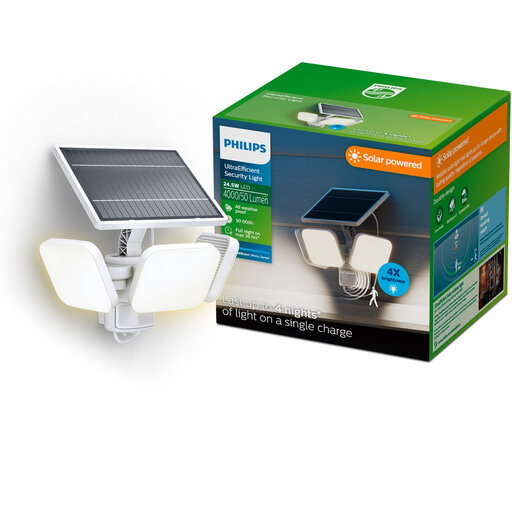
Why it suits this type of buyer: The 5000 K version is designed to provide bright lighting around a garage, back door or driveway. It’s a good option if you’re looking for a powerful solar security light without fixed wiring.
The stated IP65 protection makes it better suited to an exposed outdoor wall than IP44. The dusk sensor also means, according to the product description, that the light won’t stay on unnecessarily during the day.
4000 lumens, 5000 K, adjustable light head and a stated PIR range of up to 16 metres for movement from the side.

Why it suits this type of buyer: With three adjustable light heads and broad light coverage, this model is designed for larger areas such as a driveway, garden, patio or garage area.
According to the product listing, the light has an IP65 rating, three lighting modes and a wide sensor angle. Position the panel out of the shade to help it perform as specified.
302 LEDs, 3000 lumens according to the listing, three light heads, three modes and a stated detection angle of 180 degrees.
We’ve put together a complete, up-to-date list of products that meet these strict selection criteria and the applicable European safety regulations.
A light with a built-in battery and integrated LED needs little day-to-day maintenance, but always check the manual for information about replacing the battery. Don’t try to open or replace an internal lithium battery yourself.
Yes, but performance may be lower because of shorter days, cloudy weather and the sun’s lower position. So don’t place the panel under an overhang or behind a tall fence. A stated runtime, such as several nights on a full charge, depends on charging time, temperature and the lighting mode selected.
No. A solar outdoor light charges its built-in battery using the solar panel. It doesn’t need a mains connection. This makes installation easier, but the light still depends on receiving enough daylight. Also check whether the light needs to be charged on delivery before you test the sensor.
Not always. IP44 may be sufficient for a sheltered balcony or covered entrance, as long as the light isn’t exposed to direct rain or water jets. For an exposed wall, driveway or garden wall, IP65 water-resistant outdoor lighting offers greater protection against dust and water jets. Neither rating means the light can be placed underwater.
