
Vandaag of morgen in huis

Kwaliteit gegarandeerd

Welkomstaanbiedingen ontgrendelen: GRATIS bezorging | Tot 80% korting | Gratis 30 dagen JoyPlus-proefperiode
Download de app
A light without an electricity cable sounds simple. In practice, however, solar outdoor lighting with a motion sensor can sometimes disappoint. The light may not receive enough sunlight, the sensor may react to passing animals, or the light may not be bright enough for a driveway. Terms such as “waterproof” and “extra bright” are also not always clearly explained.
With this buying guide, you can compare models based on measurable features such as light output, detection range, IP rating, light colour and installation. This will help you find a suitable solar outdoor light for your garden, exterior wall, patio, garage or entrance.
Lumens indicate how much light a lamp emits according to its product specification. A high value is particularly useful for a driveway or large grounds, but it says nothing about how widely the beam spreads. A narrow beam can brightly illuminate a small area while leaving the rest in darkness.
Also pay attention to:
A solar floodlight with multiple heads is generally more practical for a wide driveway than a compact solar wall light.
Check the IP rating rather than relying solely on the commercial description. IP44 outdoor lighting is protected against splashing water and solid particles of a certain size. This makes IP44 suitable for general sheltered applications, such as an exterior wall, balcony or covered entrance.
According to its classification, IP65 outdoor lighting offers greater protection against dust and water jets. This is better suited to a light that is more directly exposed to rain and changing weather conditions. Neither rating means that you can place the light underwater.
A light may be technically excellent but still operate for less time when the panel is in the shade. Trees, an overhang, a north-facing wall and dirt on the panel all reduce the available charging energy.
Check in advance:
In the Netherlands, short days and cloudy weather can affect operating time. Therefore, look at the light mode and battery capacity, not just the maximum number of hours of illumination.
For ambient lighting around a patio, a lower light output may be sufficient. For outdoor lighting for gardens and driveways, a higher light output is more practical. Warm white light around 2700–3000 K creates a softer appearance. A colour temperature of around 5000–7000 K looks whiter and offers greater contrast, which may be desirable for a solar-powered security light.
Bear in mind that stated lumen values are product specifications. The actual impression also depends on the installation height, lens and light distribution.
An outdoor light with a motion sensor usually works with a PIR sensor. The stated range applies under specific conditions. The sensor often responds more effectively to movement across the detection area than to someone walking directly towards the light.
Look at:
A wide angle is useful for a driveway or side path. For a narrow entrance, a smaller range is often sufficient and can help prevent unnecessary activation.
A plastic housing can be lightweight and easy to install. Metal or aluminium may be a better fit for a permanent wall-mounted fitting, but always check the full product specification. The IP rating applies to the complete product as specified, not automatically to every connection or cable.
Also check:

Why it suits this profile: This compact solar wall light is designed for general lighting by an exterior wall, balcony or entrance. It has two light modes, a motion sensor, 400 lumens and IP44 protection.
The IP44 rating makes it clear that this light is protected against splashing water, not submersion. This helps you choose a suitable installation location.
400 lumens, 2700 K warm white light, motion sensor and installation without mains wiring.
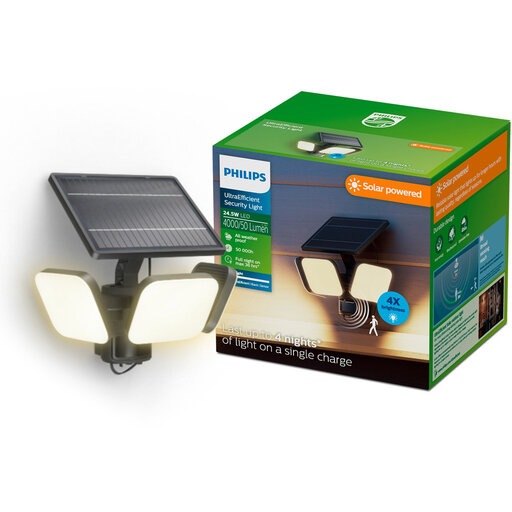
Why it suits this profile: For anyone looking to illuminate a larger area, the product specification states 4000 lumens, IP65 and a PIR range of 8 metres when approached directly and 16 metres for lateral movement.
The stated IP65 rating and separately specified detection distances provide more useful information than simply calling it a “security light”.
4000 lumens, adjustable lamp head, two light modes and a stated battery life of up to four nights according to Philips.

Why it suits this profile: The three adjustable heads and stated 270-degree lighting angle are designed for large areas such as a garage, large garden, patio or driveway.
In addition to 3000 lumens, the product specification states a detection distance of 60 feet, an angle of 180 degrees and IP65 protection. This makes it easier to match the light to a large area.
302 LEDs, three light modes, an 1800 mAh lithium-ion battery and wall-mount installation without electrical wiring.

Why it suits this profile: This cordless wall light runs on a rechargeable battery and can be attached magnetically. That is practical when you do not want to install permanent wiring.
The product information clearly states IP44 splash protection. The light is therefore not designed for submersion or direct water jets.
300 lumens, 3000 K, motion sensor, magnetic attachment and USB charging.
We have put together a complete, up-to-date list of products that fully meet these strict selection criteria and the applicable European safety regulations.
Install the light on a stable surface and position the solar panel towards a location with direct daylight as far as possible. Do not place the sensor directly opposite a busy road if you want to minimise unnecessary activation. Test the detection before permanently tightening the screws.
Clean the panel and sensor window regularly with a soft, slightly damp cloth. Do not use harsh cleaning products. After a storm or frost, check that the fitting is still secure. For models with a built-in lithium-ion battery, do not open or modify the battery yourself.
Yes, but performance can vary. Shorter days, cloudy weather and the low winter sun provide less charging energy. Choose a location with as much direct light as possible and, where available, use an energy-saving light mode. A stated operating time is not a guarantee for every weather condition.
This depends on the battery, LED, charging conditions and frequency of use. Check whether the manufacturer states a service life or warranty. With integrated LED models, the light source is generally not designed to be replaced by the user. The statutory guarantee remains applicable in accordance with the relevant consumer regulations.
During normal use, a solar light draws energy from the solar panel and stores it in the internal battery. It does not need to be connected to the mains. Models with a USB charging function may occasionally use electricity when charged from the mains. Therefore, check whether the product you choose operates entirely on solar energy or needs additional charging.
