
Vandaag of morgen in huis

Kwaliteit gegarandeerd

Welkomstaanbiedingen ontgrendelen: GRATIS bezorging | Tot 80% korting | Gratis 30 dagen JoyPlus-proefperiode
Download de app
Installing a solar-powered outdoor light without cables sounds simple. In practice, though, the light output can sometimes disappoint, the sensor may respond too slowly, or the light may not be right for the spot where you want to install it. So if you’re looking for solar outdoor lights with motion sensors, it’s worth considering more than just the lumen rating or a low price.
The main pitfalls to watch out for are:
Light colour is measured in Kelvin:
Light output is measured in lumens. A light of around 180 to 500 lumens is often suitable for an entrance, balcony or small patio. A wider driveway or larger garden area may need more light. Check the beam angle too: a wide beam illuminates a larger area, while a focused beam draws attention to a door or path.
The IP code indicates how well the casing protects against dust and water. For many outdoor lights, you’ll see:
Also check whether the light is designed for wall mounting only or can be used freestanding too. A solar wall light should be securely attached to a stable surface.
Check these three specifications:
A stated run time, such as 8 to 12 hours, depends on sunlight hours, the season, temperature, battery condition and sensor use. Treat it as a product specification under certain conditions, rather than a guarantee for every night.
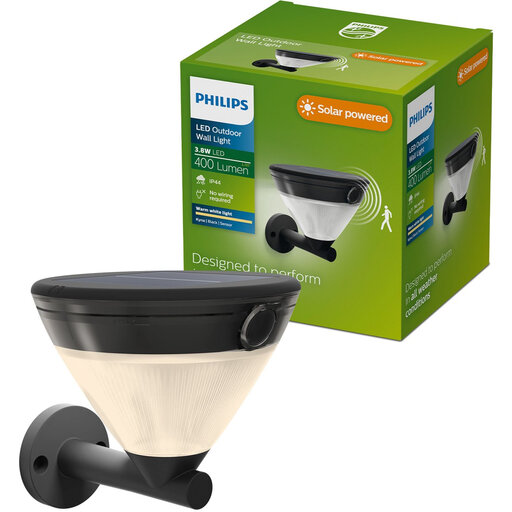
Why it suits this type of buyer: This compact solar wall light is a good fit for a balcony, small garden or entrance where easy installation and warm light matter.
The specifications clearly state 2700K, 400 lumens, two lighting modes and IP44. This makes it easier to match the light to a sheltered installation spot.
Solar-powered, with motion and dusk sensors, two modes and a stated lifespan of 25,000 operating hours according to the product information.

Why it suits this type of buyer: A practical choice if you want plenty of light by the front door, garage or back entrance without installing wiring.
The IP44 rating makes clear that this light is splashproof, but isn’t designed for immersion or direct jets of water.
1000 lumens, 3000K warm white light, motion sensor, dusk sensor and a choice of Auto or On, according to the product specifications.

Why it suits this type of buyer: The three adjustable light heads are designed for a driveway, large garden, garage or other area where broad light coverage is needed.
The product details state a detection range of 60 feet and an angle of 180°. Check beforehand that the sensor won’t cover neighbouring property or a public road.
302 LEDs, three lighting modes, three light heads, 3000 lumens and IP65 according to the product specifications. The stated colour temperature is 7000K, which is cooler than warm white.
We’ve put together a complete, up-to-date list of products that meet these strict selection criteria and the applicable European safety regulations.
Bear in mind the difference between solar garden lights and standard mains-powered lights. An outdoor solar light doesn’t need a fixed electrical connection, but its run time depends on the weather and charging capacity. If you need a light that stays on all night, a wired model may be more suitable.
Yes, but performance can vary. Shorter days, cloudy weather, low temperatures and less direct sunlight reduce the energy stored in the battery. So position the panel as openly as possible and keep it clean.
It varies depending on the battery, LED module, usage and weather conditions. Manufacturers sometimes state the lifespan of the LED, but that doesn’t necessarily tell you how long the battery will last. Check whether the battery is replaceable and what warranty applies to the product.
The light uses energy collected and stored by the solar panel during the day. It doesn’t need to be connected to the mains. Actual run time depends on the amount of sunlight, the lighting mode selected and how often the motion sensor is activated.
