
Vandaag of morgen in huis

Kwaliteit gegarandeerd

Welkomstaanbiedingen ontgrendelen: GRATIS bezorging | Tot 80% korting | Gratis 30 dagen JoyPlus-proefperiode
Download de app
A solar-powered lamp with motion detection may seem straightforward to choose. Yet many buyers fall into the same traps: a high lumen count without useful light distribution, a low IP rating in a fully exposed location, or a sensor that does not properly align with the route people take.
For a garden, patio, balcony, entrance or driveway, the decision is therefore about more than brightness alone. You should also check the detection range, mounting options, colour temperature, battery and amount of direct sunlight. As a Joybuy Product Recommendation Officer, I have summarised the key considerations below.
Lumens indicate the total light output, but not how broadly or directionally the light is distributed. A compact outdoor solar wall light with 400 lumens may be sufficient beside a front door. For a wide driveway or large garden, you may need broader coverage and multiple light heads.
Pay close attention to the colour temperature as well:
An IP rating is more specific and verifiable than general descriptions such as weather-resistant or waterproof.
Always install a lamp according to the instructions. Even an IP65 model benefits from secure mounting and a solar panel that is not shaded for extended periods by leaves, a wall or a tree.
An outdoor light with motion sensor only performs well when the sensor is positioned in line with the direction of movement. Check:
A south-facing solar panel can be advantageous in the Netherlands, but output varies according to the season, cloud cover and installation position. In winter, the operating time may therefore be shorter than in summer.
For ambient lighting around a patio, 180 to 500 lumens is often sufficient, depending on the distance and the desired light coverage. For an entrance or pathway, 400 to 1000 lumens can be practical. Larger areas require a more powerful model or multiple lights.
A solar security light that produces a short, bright burst of light uses its battery differently from a lamp that remains dimly lit throughout the evening. So do not look only at the lumen count. Also consider the lighting modes, battery capacity and expected operating time stated in the product description.
Check whether the battery is integrated and which type is used. According to the product specification, the UME Solar Outdoor Lights has a 1800 mAh lithium-ion battery. The Brilliant Alvero uses an integrated 18650 Li-ion battery. Portable Brilliant Iseo models charge via USB; they are therefore not solar outdoor lights, but they are wireless alternatives for locations with limited sunlight.
A higher battery-capacity figure does not, by itself, guarantee longer operating time. Runtime depends on brightness, sensor settings, temperature and the amount of solar energy stored during the day.
An LED solar-powered outdoor light generally does not require an electrical cable. Before installation, check:
Wipe the solar panel and sensor window regularly with a soft, slightly damp cloth. Do not use abrasive products. With a lamp featuring integrated LEDs, the light source is generally not user-replaceable.
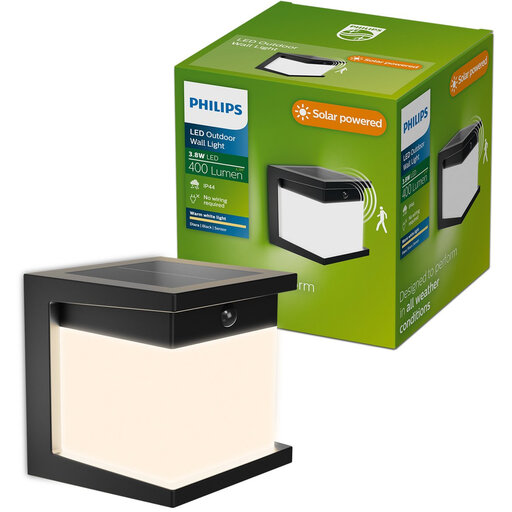
Why it fits: A compact choice for an entrance, balcony or sheltered façade where 400 lumens and warm 2700 K light are sufficient.
The specifications clearly state IP44, so you will not mistake this lamp for a model designed to withstand direct water jets.
Integrated LED, two lighting modes and a stated service life of 25,000 hours.

Why it fits: For a façade, garage or driveway where a broad, powerful beam is preferred.
The product information lists IP65, along with separate detection distances of 8 metres frontally and 16 metres laterally.
4000 lumens, 5000 K, an adjustable light head and, according to Philips, up to four nights of illumination after a full charge.

Why it fits: For a spacious garden, garage, patio or driveway where broad coverage and high light output matter.
The lamp has three light heads, a stated detection angle of 180° and an IP65 rating; positioning remains decisive for the actual coverage.
302 LEDs, 3000 lumens, three modes and a detection distance of 60 feet according to the product specification.

Why it fits: For anyone looking for a discreet wall light for the garden or patio, with warm illumination and automatic activation.
The specifications list 400 lumens and IP44, clearly defining the practical limits for a sheltered outdoor location.
Two lighting modes, a daylight sensor and an integrated motion sensor with no fixed wiring required.
Browse a current selection of outdoor lights with LED technology, battery power and motion sensors for different mounting locations and use cases.
Yes, but charging performance may be lower because of shorter days, cloud cover and the lower position of the sun. Position the panel as openly as possible and keep it clean. Choose a model with an energy-saving mode if the lamp needs to operate reliably throughout the winter.
While in use, a solar lamp does not draw electricity from the mains. There are therefore no regular electricity costs for illumination. However, you should allow for possible battery replacement over the longer term. Actual runtime varies by model, season, lighting mode and amount of sunlight.
IP44 may be suitable for a sheltered façade, balcony or patio where the lamp is mainly exposed to splashing water. For an exposed wall or driveway, IP65 is generally the more practical specification. Neither rating means that the lamp may be placed underwater.
