
Vandaag of morgen in huis

Kwaliteit gegarandeerd

Welkomstaanbiedingen ontgrendelen: GRATIS bezorging | Tot 80% korting | Gratis 30 dagen JoyPlus-proefperiode
Download de app
Solar lights are a handy way to illuminate a garden, balcony, patio, driveway or entrance without installing extra electrical cabling. However, the results can sometimes be disappointing in practice. A light may not get enough sun during the day, its motion sensor may be set incorrectly, or its low light output may not be suitable for a dark driveway.
As a Joybuy Product Recommendation Officer, I’ve filtered the key specifications of popular models. This makes it easier to see which solar outdoor lights suit your needs and which marketing claims are worth checking.
The lumen rating indicates how much light a lamp produces according to its product specifications. A solar wall light with 180 lumens is suitable for a gentle accent by the entrance, but less so if you want to illuminate a wide driveway. Also consider the light distribution, mounting height and direction of the fitting.
Always check the IP rating. IP44 means protection against solid objects larger than 1 millimetre and splashing water. A light with this rating is suitable for normal outdoor use, but shouldn’t be exposed to direct jets of water for prolonged periods or submerged.
IP65 offers greater protection against dust and water jets. However, lights with this rating still aren’t designed to be submerged. Ideally, position your solar light so rainwater can drain away, and check the fitting after a storm or frost.
A solar outdoor light with a motion sensor needs a clear line of sight. Don’t point the sensor directly at a busy road, moving branches or a warm ventilation outlet. Also check that the light receives enough direct sunlight during the day. Shade from a fence, tree or canopy can reduce charging time.
If your solar light has a dusk sensor, make sure it isn’t affected by a nearby outdoor light. Otherwise, it may switch on too late or turn off too soon.
The stated light output is a product specification. How bright the light appears also depends on the mounting height, the colour of the exterior wall and the surroundings.
IP44 may be sufficient for a sheltered veranda. For an exterior wall or open driveway, IP65 can offer greater protection against dust and water jets. Also consider the material. Aluminium, plastic, steel and ABS differ in weight, maintenance requirements and resistance to corrosion.
Claims about durability or long service life come from the manufacturer’s product information. Philips states that certain LED models have a rated lifespan of up to 25,000 or 50,000 hours. This isn’t a guarantee of actual operating life in every type of UK weather.
A built-in battery allows you to install the light without mains electricity. Actual operating time depends on sunlight hours, temperature, season and how often the motion sensor is triggered. A model with USB charging can be useful on a balcony that gets little direct sunlight.
Also consider the installation type:
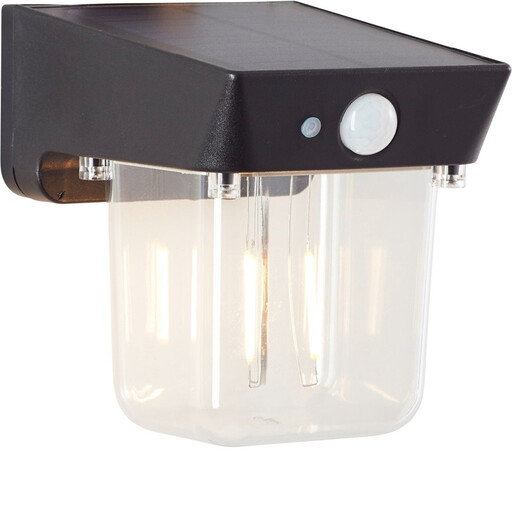
Why it suits this profile: A compact solar wall light for an entrance, balcony or small exterior wall, with no wiring required and a warmer colour temperature of 2700 K.
The product specifications state 180 lumens and IP44. This makes it clear that the model is intended mainly for localised lighting, not for a large driveway.
Built-in battery, motion sensor, solar charging and warm white light. The product information states that the housing is splashproof to IP44.

Why it suits this profile: For anyone looking to brightly illuminate a wide driveway, exterior wall or entrance, and who values an adjustable light head and a higher IP rating.
The product specifications state 4000 lumens and IP65. This makes its intended use clearer than that of a decorative light, but it still mustn’t be submerged.
PIR detection up to 8 metres when approached head-on and 16 metres when approached from the side, according to the product information, plus an adjustable light head and IP65 rating.

Why it suits this profile: A practical choice for an exterior wall, back door or shed where automatic activation and a clear level of light output are important.
The light has two lighting modes, a dusk sensor and a motion sensor. Its IP44 rating makes the limits of outdoor use clear.
1000 lumens, warm white light at 3000 K, automatic operation and installation without mains electricity, according to the product description.
For decorative solar garden lighting, you could also choose solar spike lights, solar string lights or a compact table lamp. In that case, check the charging location, operating time and whether the light is designed for ambience rather than practical illumination.
We’ve put together a complete, up-to-date list of products that meet these strict selection criteria and the applicable European safety regulations.
Their lifespan depends on the battery, LED module, housing, charging conditions and exposure to the weather. Clean the solar panel regularly with a soft cloth and check the housing for dirt or damage. Manufacturers’ stated operating hours are estimates from the product information, not a guarantee for every situation.
Yes, but performance may be lower because of shorter days, cloudy weather and the lower position of the sun. Position the panel in as open a spot as possible, facing direct sunlight. A model with USB charging can be useful if the battery doesn’t get enough charge during winter.
A solar light doesn’t use mains electricity during normal operation. The solar panel charges its built-in battery. Models with an additional USB charging function may use electricity when you recharge the battery manually. Actual operating time still depends on sunlight, battery capacity and sensor settings.
