
Vandaag of morgen in huis

Kwaliteit gegarandeerd

Welkomstaanbiedingen ontgrendelen: GRATIS bezorging | Tot 80% korting | Gratis 30 dagen JoyPlus-proefperiode
Download de app
Solar outdoor lighting is useful for a driveway, entrance, balcony or garden where you do not want to install cabling. A built-in solar panel charges the battery during the day, after which the light switches on at dusk or when movement is detected. However, not every solar outdoor light performs equally well in every situation. A shady façade, a low IP rating or a battery that is too small can lead to disappointment in practice.
The following points will help you compare models based on verifiable specifications, rather than relying solely on marketing copy.
A solar outdoor light needs daylight to charge its battery. Direct sunlight generally provides better charging conditions than a spot beneath a canopy, tree or balcony. Also consider the direction of the panel. A light that hangs mostly in the shade during the day may provide less light or run for less time in the evening.
For models with a separate panel, check the cable length and mounting position. This allows you to place the light on a dark façade while positioning the panel in a sunnier part of the garden.
A water-resistant outdoor light with IP44 is protected against solid objects larger than 1 millimetre and splashing water from various directions. This makes IP44 suitable for many sheltered outdoor locations, but not for immersion or powerful direct water jets.
For a façade exposed to heavy rain, IP65 may be more practical. This classification offers greater protection against dust and water jets. Even then, the light must not be immersed. Install the solar panel and housing in accordance with the manufacturer’s safety instructions.
Lumens indicate the total luminous flux, but they do not tell you everything about how the light is distributed. A 400-lumen light may be suitable for an entrance, while a powerful solar security light with 4,000 lumens is intended to brightly illuminate a larger area.
You should therefore also consider:
For example, a solar string light with many LEDs is intended as atmospheric garden lighting, not as functional lighting for a dark driveway.
For atmosphere, warm white tones of 2700K to 3000K are usually pleasant. Philips models such as the Diara and Hara use 2700K, while the Fyns and certain Zyren versions offer 3000K. A higher colour temperature, such as 5000K, appears whiter and more direct.
As a general guide:
This classification is practical, but the actual impression also depends on the mounting height and beam angle.
A solar outdoor light with a motion sensor only switches on fully or partially when movement is detected. This can conserve the battery and is useful near a front door, shed or driveway. A dusk or daylight sensor determines when the light becomes active automatically.
Pay attention to the difference between:
According to Philips’ product specifications, the Zyren has a PIR detection range of 8 metres when approaching the sensor directly and 16 metres when approaching from the side. Treat this as a product specification, not a guarantee for every installation location.
The performance of solar-powered LED outdoor lighting depends on sunlight, temperature, shade and the condition of the panel. Clean the panel regularly with a soft, slightly damp cloth and check that leaves or dirt are not covering the surface.
A product description may state a particular run time, but according to the manufacturer or seller, this depends on the conditions. For example, the VIVREAL string lights are stated to have a charging time of 6 to 8 hours and a run time of 8 to 14 hours under suitable conditions. Output may be lower during a dark winter period.
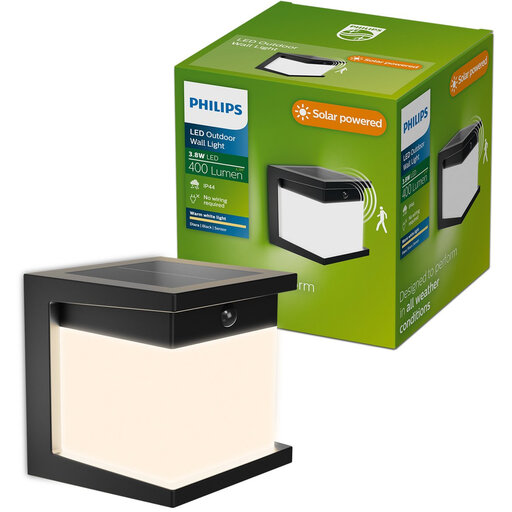
Why it suits this profile: This compact solar wall light is designed for a balcony, garden or entrance where basic lighting without cabling is required.
The product specifications state 400 lumens, 2700K, a motion sensor and IP44. This makes it clear that the model is intended mainly for general outdoor lighting, rather than heavy-duty security.
Two lighting modes, integrated LED and a compact size of approximately 12 x 11 x 12 cm.

Why it suits this profile: A homeowner looking for a neat façade or entrance light with automatic operation gets more light output here than with compact atmospheric models.
The light output of 1,000 lumens, the 3000K light colour and IP44 classification are clearly stated. This means the light is not mistakenly judged as a small decorative light point.
Motion sensor, dusk sensor, two lighting modes and installation without a mains cable.

Why it suits this profile: For a driveway, large garden or entrance where a wide beam and a higher level of protection matter more than soft atmospheric lighting.
This model specifies 4,000 lumens, IP65 and an adjustable light head. The stated sensor range is 8 metres when approached directly and 16 metres when approached from the side. According to Philips, a fully charged battery can provide lighting for up to four nights; conditions remain decisive.
IP65, 3000K warm white light, two lighting modes and an adjustable light head for focused illumination.
We have put together a complete, up-to-date list of products that fully meet these strict selection criteria and the applicable European safety regulations.
A solar string light often has a separate switch on the panel. According to the product information, the power button on the VIVREAL set must be pressed before charging. Always check the manual before installing the light outdoors for the first time.
Yes, but charging output may be lower due to shorter days, cloudy weather and the lower position of the sun. Position the panel as openly as possible and keep it clean. A light with a motion sensor may be more practical during this period than a model that stays on continuously throughout the evening.
The operating time per night depends on the battery, amount of sunlight, light intensity and selected mode. Manufacturers may state an LED lifespan or run time per charge, but these are product specifications under certain conditions. The battery is a wear part and may hold less charge over time.
During normal use, the light gets its energy from the solar panel and built-in battery. It does not need to be connected to the mains. However, batteries, replacement parts or maintenance costs may become relevant later. Therefore, do not compare only the purchase price; also consider battery access, warranty and IP classification.
