
Vandaag of morgen in huis

Kwaliteit gegarandeerd

Welkomstaanbiedingen ontgrendelen: GRATIS bezorging | Tot 80% korting | Gratis 30 dagen JoyPlus-proefperiode
Download de app
Lighting a garden, balcony, driveway or exterior wall without cables sounds simple. In practice, however, things do not always go to plan. A light may run for less time after a few cloudy days, a motion sensor may react incorrectly, or a product may turn out to be less resistant to rain than its product title suggests.
This buying guide to solar outdoor lighting explains which specifications really matter. We also compare several models for different situations, from subtle solar garden lighting to powerful motion-sensor lighting.
A high number of LEDs does not automatically mean that a light will illuminate a large area brightly. Also look at the luminous flux in lumens, the light distribution and the beam angle. A compact solar garden light with 10 lumens is suitable for marking a path or border, but not for fully lighting a driveway.
IP65 outdoor lighting is better protected against dust and water jets than a light with IP44. However, IP65 does not mean that you can submerge the light. IP44 is mainly suitable for splashing water and a sheltered location. Install a solar wall light according to the fitting instructions and avoid direct water jets unless the manufacturer explicitly permits them.
Solar outdoor lighting works by storing energy during the day. A panel in the shade of a fence, tree or canopy will charge less efficiently. In the Netherlands, operating time may also decrease in winter because of shorter days and cloudy weather. Check that the chosen location receives several hours of daylight.
For ambient lighting, warmer colour temperatures of around 2700K to 3000K are generally pleasant. Philips Hara and Philips Diara, for example, provide 2700K warm white light. For paths, borders and driveways, 3000K can offer a practical balance between atmosphere and visibility.
Higher light output is useful for functional lighting. The UME 302 LED light states 3000 lumens and has three adjustable light heads. This makes this type of solar outdoor light suitable for an exterior wall, garage or larger area. The Philips Fyns states 1000 lumens and has a motion sensor.
A solar outdoor light with a motion sensor comes on, or shines more brightly, when movement is detected. This can help conserve stored energy and is useful by an entrance, garage or driveway. Check the stated range and detection angle. The UME light states a range of 60 feet, equivalent to approximately 18 metres, with an angle of 180 degrees. Brilliant Magua models state a detection angle of 120 degrees.
A sensor is less practical when the light points directly at a busy road, moving branches or a driveway with a lot of traffic. Position the light to suit the route you want to illuminate.
For long-term outdoor use, the IP rating, housing and fixing method are important. Models with IP65, such as the UME 302 LED and UME solar pathway lighting, offer protection against dust and water jets according to the product specifications. Models with IP44 are suitable for general outdoor conditions, but require a more sheltered installation location.
Also check the installation type:
Clean the panel regularly with a soft, damp cloth. Dirt, leaves and bird droppings can reduce light output.
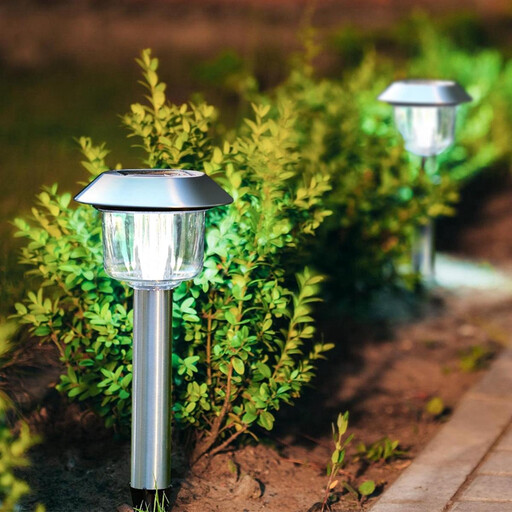
Why it suits this profile: A simple solar garden light for anyone who wants to illuminate a border, patio or small garden area without complicated installation.
The product specifications state a compact size of 36.6 cm and solar power. Expect decorative lighting rather than broad illumination for a driveway.
Stainless steel and plastic components, solar power and one light supplied per pack.

Why it suits this profile: A good choice for an entrance or exterior wall where a recognised brand, motion sensor and higher light output are desirable.
The light output of 1000 lumens and the IP44 rating are stated. Install the light outdoors, but not where it will be exposed to direct water jets.
3000K warm white light, two lighting modes, integrated motion sensor and a battery that is built in according to the product information.

Why it suits this profile: Designed for anyone looking to add motion-activated lighting to a larger garden, garage, patio or driveway.
The product specifications state 3000 lumens, IP65 and a detection angle of 180 degrees. This makes the key performance indicators clearer than simply looking at the number of LEDs.
Three light heads, three modes, 1800mAh lithium-ion battery and wall or flat-surface mounting.
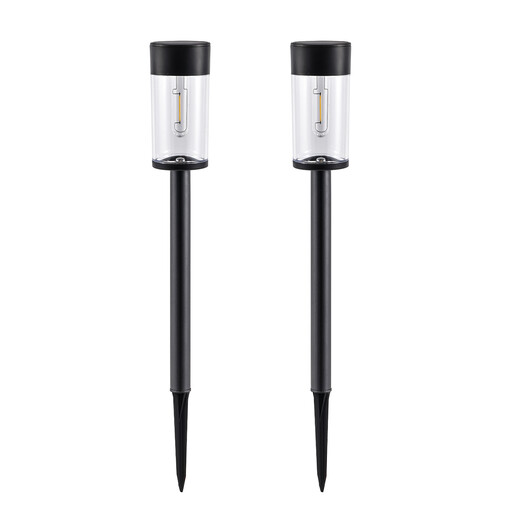
Why it suits this profile: Ideal for garden paths, borders, lawn edges and the side of a driveway where even, gentle light is needed.
The light output of 10 lumens per light makes it clear that this is accent lighting for paths, not a security light for a large area.
Two lights per set, 3000K light, IP65 rating and automatic switching on and off via the light sensor.
We have put together a complete, up-to-date list of products that fully meet these strict selection criteria and the applicable European safety regulations.
Correct positioning makes a big difference when it comes to solar garden lighting:
Actual operating time depends on hours of sunlight, temperature, battery capacity, lighting mode and usage. Any stated operating time is therefore a product specification under certain conditions, not a guarantee for every Dutch garden.
Yes, but operating time may be shorter. There are fewer hours of daylight in winter and the sun is lower in the sky. Position the panel as openly as possible and keep it clean. For an entrance where lighting is needed every evening, a motion-sensor model may be more practical than continuous lighting.
This varies according to the model, battery and weather conditions. Check the stated LED lifespan, battery type, warranty and IP rating. An integrated LED cannot be replaced on every model. Check the product information in advance and keep your purchase details in case you need to make a warranty claim.
During normal use, a solar light does not draw power from the mains. The solar panel charges the built-in battery during the day. However, there may be maintenance costs or costs for replacing parts in the longer term. Light output remains dependent on the amount of sunlight available.
