
Vandaag of morgen in huis

Kwaliteit gegarandeerd

Welkomstaanbiedingen ontgrendelen: GRATIS bezorging | Tot 80% korting | Gratis 30 dagen JoyPlus-proefperiode
Download de app
Installing a solar-powered outdoor light sounds simple: place the panel in the sun, tighten the screws and you’re done. In practice, some models disappoint because the panel receives too little light, the motion sensor is positioned incorrectly or the protection rating is not suitable for the location. Use these checks to make a more informed choice between a solar wall light, solar garden lighting, exterior wall lighting or a powerful solar security light.
A large number of LEDs or a high lumen rating may sound appealing, but it does not tell you how widely or evenly the light is distributed. A garden light for ambience needs less light than a lamp above a driveway. So check the following:
Also pay attention to wording used in product marketing. A brand’s claim about longer battery life or higher efficiency is not a universal guarantee. According to a brand’s own research, certain performance levels may apply under specific conditions. So focus particularly on the stated battery, lighting modes, charging time and installation requirements.
IP44 outdoor lighting is protected against solid particles larger than 1 mm and splashing water from various directions. This makes IP44 suitable for many sheltered façades, balconies and patios, but not automatically for locations exposed to direct jets of water or prolonged heavy rain.
IP65 outdoor lighting offers greater protection against dust and water jets. This is better suited to an open driveway, garden wall or powerful outdoor light exposed more heavily to the elements. IP65 does not mean that you can submerge the light. Also, always check that the mounting and cable entry have been installed correctly.
View our range of waterproof outdoor lighting if you specifically want to filter by protection rating.
A solar outdoor light needs enough direct sunlight during the day. Do not place the panel beneath a canopy, close to a tall fence or behind dense foliage. In winter and on cloudy days, the operating time may be shorter. A light with a larger battery will not stay on indefinitely if the panel cannot charge sufficiently.
Before buying, check:
For decorative outdoor lighting or a patio light, 180 to 400 lumens may be sufficient. For an entrance, garage or driveway, a higher light output is generally more suitable. Warm white light around 2700 K complements a cosy garden or façade. 3000 K has a slightly brighter appearance. A product listing may describe the colour temperature differently, so check the Kelvin figure.
Outdoor lighting with a motion sensor only switches on when movement is detected. Pay attention to the stated detection distance and viewing angle, but bear in mind that mounting height, temperature and obstacles can affect real-world performance. A wide detection area is useful for a driveway, while a shorter range can help limit unwanted activation at a front door.
Battery capacity is usually stated in mAh. A higher capacity may provide more reserve power, but actual operating time also depends on brightness, lighting mode and hours of sunlight. Clean the panel and sensor window regularly with a soft, slightly damp cloth. Do not replace or dismantle an integrated lithium battery yourself if the manufacturer does not permit this.

Why it suits this profile: This solar wall light is suitable for an entrance, balcony or sheltered patio wall where you want to get started without wiring. The two lighting modes and motion sensor keep operation straightforward.
The product description states IP44, so you will not mistakenly use the light as submersible or fully sealed lighting.
400 lumens per light, warm white light at 2700 K, a motion sensor and two lighting modes.
Why it suits this profile: A suitable choice for anyone who values a clean look, automatic operation and clear product specifications for exterior wall or balcony lighting.
The product information explicitly states IP44 and direct sunlight as a requirement. This helps prevent incorrect use in a completely exposed location.
400 lumens, 2700 K, two lighting modes, an integrated motion and dusk sensor, plus a statutory warranty of at least two years.

Why it suits this profile: This solar security light is designed to provide broad illumination for a driveway, garage, garden or large patio where detection range and light coverage matter more than a subtle design.
The specifications state IP65, three lighting modes, three adjustable heads and a detection distance of 60 feet with an angle of 180 degrees. However, check that the installation allows this range to be achieved.
302 LEDs, a stated light output of 3000 lumens, three light heads and an 1800mAh lithium-ion battery.
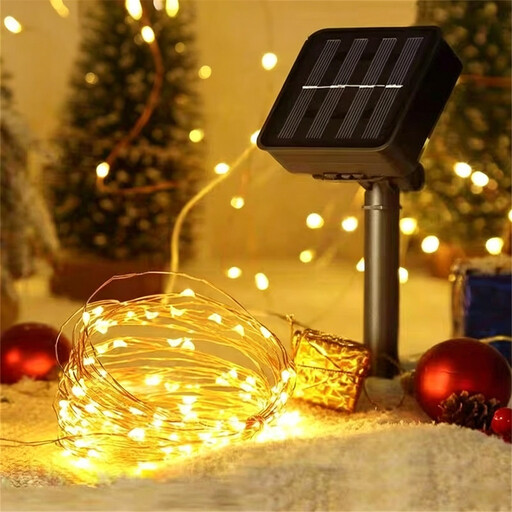
Why it suits this profile: A practical model for anyone who wants to add decorative lighting to a balcony, pergola, patio or border without a permanent connection.
The information states a charging time of 6–8 hours and an operating time of 8–14 hours, depending on the conditions. This gives a more realistic picture than promising a fixed number of hours overnight.
Two 49 ft light strings, each with 75 warm white LEDs, eight lighting modes and a memory function.
We have put together a complete, up-to-date list of products that fully meet these strict selection criteria and the applicable European safety regulations.
Its lifespan depends on the battery type, charging conditions, exposure to the weather and operating mode. Check whether the LED is integrated and whether the battery can be replaced. Keep the panel clean and position it away from shade. Manufacturers may state a particular lifespan, but actual performance varies by season and location.
Yes, but operating time may be shorter because of shorter days, the lower position of the sun and cloudy weather. Position the panel so that it receives as much direct light as possible during the day. Choose a motion sensor or lower lighting mode if you want to use the stored energy more efficiently.
During normal use, a solar light does not use electricity from the mains. However, there are purchase costs and, over time, possible costs for a battery or replacement light. Its overall value therefore depends on how long it is used, maintenance and where you install the lighting.
