
Vandaag of morgen in huis

Kwaliteit gegarandeerd

Welkomstaanbiedingen ontgrendelen: GRATIS bezorging | Tot 80% korting | Gratis 30 dagen JoyPlus-proefperiode
Download de app
Solar outdoor lighting is ideal if you want to illuminate a garden, balcony, façade or driveway without running cables to the mains. Installing an outdoor solar light seems straightforward, but not every light suits every spot. Limited sunlight, too low an IP rating or unclear claims about runtime can easily lead to a disappointing purchase.
A high lumen figure sounds appealing, but it doesn’t tell the whole story about usable light. Also check the light distribution, the number of modes and the runtime. A powerful light with a motion sensor can shine brightly for short bursts, while a solar garden light for ambience gives softer light for hours.
Also pay attention to colour temperature:
A product description may call the colour “warm white” while the stated Kelvin value is much cooler. Always check both.
An IP44 light is splash-resistant and suitable for many sheltered outdoor spots. That does not mean the light is waterproof or can withstand a direct jet of water. So don’t mount an IP44 solar wall light where rainwater falls directly onto it continuously.
An IP65 light offers protection against dust and water jets from various directions. This still doesn’t mean you can submerge the light. Placement and installation remain important, especially during prolonged rain or frost.
A solar light with a motion sensor only charges well if the panel gets enough daylight. A spot under a solid canopy, next to a tall fence or beneath trees might work in summer, but far less well in the darker months of the year.
Before you buy, check:
For ambience, anything from a few dozen to a few hundred lumens is often enough. For a driveway, garage or dark passageway you may want more light. A solar garden light with a motion sensor prevents the lamp running at full power all night.
Look at the available modes too. Some models offer a gentle background glow with a brighter level on motion. Others only switch on when movement is detected. Detection angle and range matter: a wide-angle sensor is useful at an entrance, while a shorter range can be better for a balcony.
Battery capacity is usually given in mAh. A higher capacity can store more energy, but real-world runtime also depends on sunlight, temperature, light mode and battery condition. Claims such as 8 to 14 hours of use should be read as stated product values under certain conditions, not a guaranteed nightly duration.
A solar light with a separate panel can be more flexible because you can mount the panel in a sunnier spot. With an integrated panel, the light and charging surface are tied to the same location.
ABS plastic is lightweight and widely used for solar outdoor lighting. Metal can create a different look, but check the finish and fixings. Make sure screws and mounting points suit the surface, such as brick, wood or concrete.
For a solar wall light the wall should be solid. A solar garden light on a ground spike needs firm, level ground. A solar lantern with a handle is easier to move, but is usually meant for atmospheric lighting rather than illuminating a whole path.
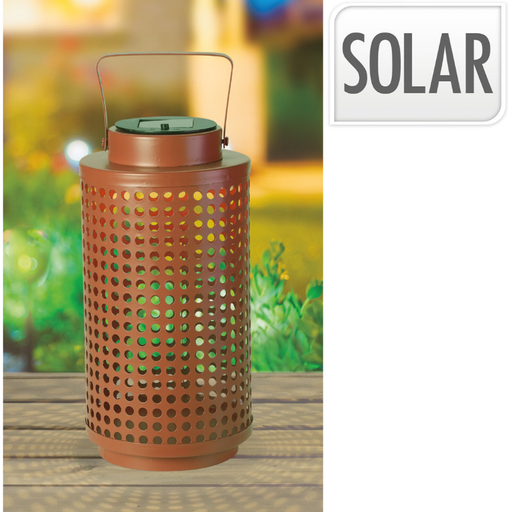
Why it suits this profile: This compact solar lantern is ideal for a patio, balcony or garden table where you mainly want soft ambient lighting.
The stated runtime is 6 hours after a full charge. That sets expectations more clearly than a generic ‘overnight use’ claim.
Metal housing, 14 cm diameter and 28 cm height; easy to place with no extra tools.

Why it suits this profile: A smart choice for an entrance, façade or patio where automatic, functional lighting is desired.
The specifications state 1000 lumens, 3000K, a motion sensor and IP44. That lets you compare light function, colour and placement in advance.
Two light modes, 1000 lumens and a stated lifetime of 25,000 hours for the integrated LED light source.

Why it suits this profile: Designed for those who want to light a driveway, garage, large garden or back garden with a wide beam and motion detection.
The product description lists IP65, three light modes and a sensor range of 60 feet with a 180-degree angle. Do check the actual lighting mode you need before installation.
302 LEDs, a stated light output of 3000 lumens, three adjustable heads and wide coverage according to the product specifications.
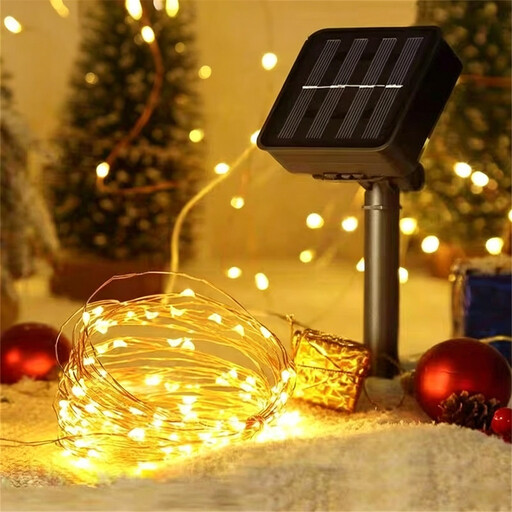
Why it suits this profile: Perfect for anyone who loves a warm string of lights for a balcony, pergola, tree, fence or party décor.
The set specifies two 49-foot strings, a charging time of 6 to 8 hours and eight lighting modes. Keep the solar panel clear and place it in direct light.
75 warm white LEDs per string, eight modes with memory function and a flexible copper wire for decorative installation.
We’ve compiled a complete, up-to-date list of products that fully meet these strict selection criteria and current European safety regulations.
Choose a spot where the panel gets as little shade as possible. Mount wall lights securely and make sure the beam doesn’t shine directly into people’s eyes as they pass. For a light on a ground spike, a stable base is important.
Clean the solar panel regularly with a soft, slightly damp cloth. Also check the sensor, fixings and housing. Don’t use an IP44 light in a location where it could end up under water. If the battery or LED light source is integrated, don’t open or modify it if the manufacturer advises against it.
Yes, the panel can still generate energy in diffuse daylight, but usually less than in direct sunlight. As a result, the light may run for a shorter time or be less bright. Position the panel as freely as possible and keep it clean.
That varies by model, battery, materials and exposure to the elements. The stated lifetime of an LED light source is not the same as the lifetime of the complete light. Check the warranty, battery details and IP rating.
An outdoor solar light does not draw power from the mains during normal use. It does need to store enough solar energy during the day. Actual performance depends on season, placement, temperature and the selected lighting mode.
