
Vandaag of morgen in huis

Kwaliteit gegarandeerd

Welkomstaanbiedingen ontgrendelen: GRATIS bezorging | Tot 80% korting | Gratis 30 dagen JoyPlus-proefperiode
Download de app
A light that only switches on when someone walks past sounds simple. Yet the wrong solar outdoor lighting with a motion sensor can disappoint in practice. The panel may not receive enough sunlight, the sensor may only respond once you have passed by, or the light may be less suitable for a wall exposed to heavy rain.
For a garden path, driveway, entrance, patio or balcony, three things are particularly important: the right brightness, sufficient protection against the weather and a sensor suited to the installation location. Below, you’ll find what to look out for and which models suit different situations.
A high lumen figure means that a light can produce plenty of light, but it does not automatically mean that your entire garden will be well lit. Light distribution, the angle of the lamp and the number of light heads also make a difference.
A compact solar wall light with 300 to 500 lumens can be practical by a door or balcony. For a wide driveway or a large back garden, a solar floodlight with several light heads is a more logical choice. Also check whether the light is warm or cool. 2700K to 3000K generally creates a warmer look, while 5000K to 7000K appears whiter and provides stronger contrast.
The IP code consists of two digits. The first digit indicates protection against solid particles, while the second refers to water.
No IP rating means that you should submerge the light. Also consider the installation location: a canopy, tree or tall fence can leave the solar panel in the shade for much of the day.
A sensor does not work equally well in every direction. The stated detection distance is a product specification measured under certain conditions, not a guarantee that every movement will be detected at exactly the same distance.
So check:
An outdoor light with a motion sensor should also be firmly secured. An unstable installation changes the sensor’s viewing direction and can affect its performance.
Lumens indicate the total amount of light. Use the figure as an initial point of comparison, but also look at the light heads and the stated beam angle. A lamp with three adjustable heads can distribute light across a larger area than a single light source with a similar lumen count.
For ambience on a patio or balcony, warm white light is often the better choice. For a driveway, garage or shed, bright white light may be more practical. Choosing 3000K, 5000K or another colour temperature is mainly a matter of application and personal preference; it is not an indication of quality.
A wireless outdoor light depends on the energy stored during the day. The actual operating time depends on factors including sunlight, season, temperature, shade, battery capacity and how often the sensor is activated.
Position the panel:
According to Philips’ own information, the Zyren can provide up to four nights of illumination when the battery is fully charged. This is a statement from the brand based on its specified conditions and is not a fixed operating time for every Dutch garden.
ABS and PC plastic are often used for lightweight, wireless fittings. Metal or aluminium can offer a different appearance and construction, but the weight and installation method then become especially important.
Before buying, check:
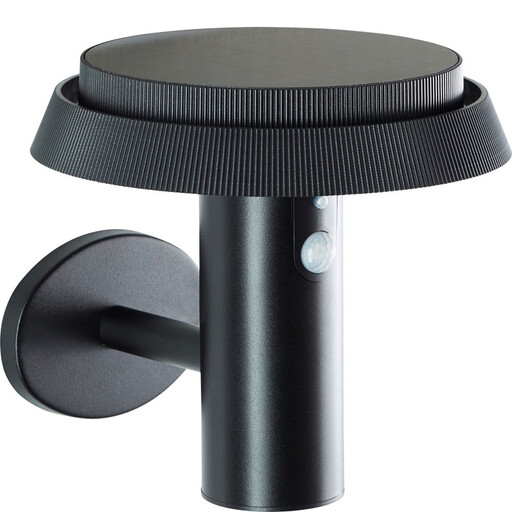
Why it suits this profile: The combination of 500 lumens, 3000K and an integrated motion sensor is well suited to an entrance, patio or smaller garden. The light requires no fixed wiring and has a compact wall-mounted design.
The product information states IP44 and warns that the light is splash-resistant, but not suitable for submersion or direct water jets. This makes its usage limitations clear.
500 lumens, 3000K, motion sensor, two operating modes and installation without mains power.
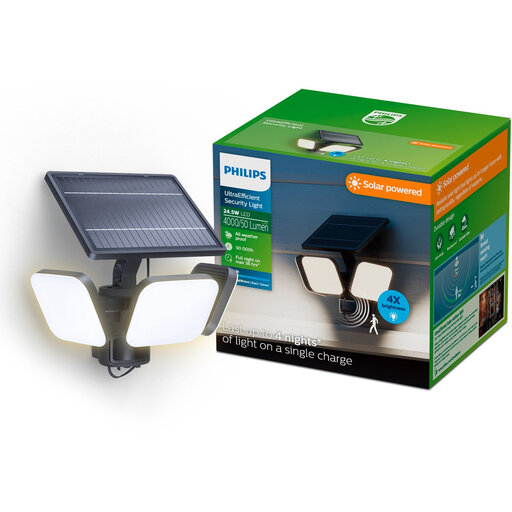
Why it suits this profile: This model is designed to provide broad, powerful lighting around a driveway, garage or large wall. The stated brightness is 4000 lumens and, according to the product information, the sensor has a range of 8 metres when approached directly and 16 metres when approached from the side.
The combination of a stated detection range, adjustable light head and IP65 rating makes it easier to compare the product based on concrete specifications rather than marketing terms alone.
4000 lumens, IP65, adjustable light head, two lighting modes and wide PIR detection according to the product description.

Why it suits this profile: The three light heads and stated 270-degree angle are designed to provide broad lighting for a driveway, grounds, garage or spacious garden, for example.
The specifications state a 180-degree sensor angle, a detection distance of 60 feet, three modes and IP65. When installing it, be sure to check the converted distance and the amount of available sunlight.
302 LEDs, stated 3000 lumens, three adjustable heads, three lighting modes and an 1800 mAh lithium-ion battery.
We’ve put together a complete, up-to-date list of products that fully meet these strict selection criteria and the applicable European safety regulations.
Install the light on a stable surface and test the sensor before tightening the screws fully. Don’t automatically point the panel in the same direction as the light beam; the best position for charging may differ from the best direction for illumination.
Clean the solar panel and sensor window several times a year with a soft, slightly damp cloth, unless the instructions specify another method. Do not use abrasive products. Also check after storms or frost that the housing and fittings are still intact.
This varies depending on the battery, charge level, season and number of activations. Product information sometimes states an LED lifespan, but this is not the same as the total lifespan of the light. With many models, the integrated LED or battery cannot be replaced by the user.
Yes, but shorter days, cloudy weather, the low position of the sun, and snow or dirt on the panel can reduce the available charging energy. Choose a location with as much direct light as possible and keep the panel clear of leaves and dirt.
A light that runs entirely on solar power and an internal battery does not need to be connected to the mains. However, check the product information: some wireless models can also be, or are exclusively, charged via USB.
