
Vandaag of morgen in huis

Kwaliteit gegarandeerd

Welkomstaanbiedingen ontgrendelen: GRATIS bezorging | Tot 80% korting | Gratis 30 dagen JoyPlus-proefperiode
Download de app
A solar-powered lamp with a motion sensor seems easy to choose. Yet many purchases disappoint. The lamp may produce less light than expected, switch on unnecessarily during the day or barely charge because it has been installed in an unsuitable location. Checking the product specifications carefully helps you avoid these problems.
This buying guide helps homeowners, tenants and garden enthusiasts compare solar outdoor lighting with a motion sensor for the driveway, exterior wall, shed, garden, balcony or entrance.
A high number of LEDs does not automatically mean that a lamp will brightly illuminate a large area. Pay particular attention to the luminous flux in lumens, the light spread and the colour temperature. A decorative garden lamp often has a limited light output, while a solar floodlight is designed to illuminate a driveway or back garden more powerfully.
Also check whether the stated brightness applies to one lamp, a set or a temporary boost mode.
An outdoor lamp with a sensor is only practical if the sensor can detect movement reliably. A narrow passage, a wall directly opposite the sensor or lots of passing traffic can cause unwanted activation. Therefore, check the detection range and detection angle.
For example, the UME Solar Outdoor Lights specifies a range of 60 feet, equivalent to approximately 18 metres, and an angle of 180 degrees. According to the product description, this model has three adjustable light heads with a total coverage of 270 degrees. The actual experience will, of course, depend on the installation height, direction of movement and any obstacles.
An IP44 outdoor lamp is protected against solid particles from 1 millimetre in size and splashing water. This is suitable for many sheltered exterior walls, balconies and patios, but not for immersion or powerful direct jets of water.
An IP65 outdoor lamp provides a higher level of protection against dust and water jets. IP65 does not mean that the lamp can be placed underwater either. Consider the location carefully: IP44 may be sufficient under a canopy, while an exposed exterior wall or shed wall requires greater protection.
For atmospheric solar garden lighting, a few hundred lumens are often sufficient. For an entrance, garage or driveway, a higher light output is more appropriate.
The colour temperature determines the overall look. Around 2700–3000 K produces warm white light. Around 5000 K, the light appears cooler and brighter. The UME lamp lists 7000 K in its product details, so check carefully whether this colour temperature suits your preference.
Solar lighting depends on daylight. Position the panel in as much direct sunlight as possible, and not beneath a balcony edge, tree or roof overhang. In winter and during prolonged periods of cloudy weather, the operating time may be shorter.
A lamp with several light modes gives you greater control. A continuously dim setting generally uses less energy than a bright setting triggered by every movement. Also pay attention to the stated battery capacity. According to its product specifications, the UME has a 1800 mAh lithium-ion battery. The Philips Zyren states in its product information that it can operate for up to four nights when fully charged. These are product specifications and do not guarantee the same operating time in every garden.
A wireless outdoor lamp is an attractive option for rented properties or locations where you do not want to run a cable. Check whether mounting hardware is included and whether the surface is suitable for installation. A heavy lamp requires a stable wall and suitable wall plugs.
Clean the solar panel and sensor window regularly with a soft, damp cloth. Do not open or modify the built-in battery yourself. With a lamp featuring an integrated LED, the light source is generally not designed to be replaced by the user.
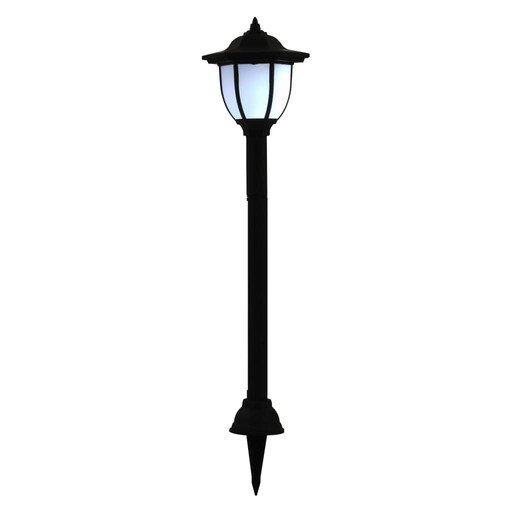
Why it suits this profile: This set contains three lamps and is designed for decorative lighting along a path, patio or garden border. The low light output is ideal for anyone looking for an affordable starting point.
The specifications clearly state three LEDs rated at 0.06 watts per lamp and an IP44 rating. This makes it clear in advance that it is not a powerful solar security light.
Set of three; automatic activation in the dark; mounting components included.

Why it suits this profile: This model is designed for larger outdoor spaces where high light output and a wide detection range are important, such as a driveway, garage or spacious garden.
The product information specifies 4000 lumens, IP65 and a PIR detection range of 8 metres for direct approach and 16 metres for lateral movement. The adjustable light head helps direct the light where it is needed.
IP65 rating; 4000 lumens; two light modes and dusk sensor according to the product description.

Why it suits this profile: The three light heads and wide spread are practical for large grounds, sheds, pool areas or a wide driveway where a single narrow beam is not enough.
The product specifications state not only the number of LEDs, but also 3000 lumens, three light modes, IP65, a detection angle of 180 degrees and adjustable heads.
302 LEDs; 3000 lumens; three light modes; IP65; wall mounting without cabling.
We have compiled a complete, up-to-date list of products that fully meet these strict selection criteria and the applicable European safety regulations.
Yes, but charging capacity may be lower because of shorter days, cloudy weather and the sun being lower in the sky. Position the panel where it will receive as much direct daylight as possible. Where possible, choose a lamp with several light modes so that you can limit energy consumption.
Its lifespan depends on the battery, LED module, exposure to the weather and maintenance. Manufacturers may state an expected lifespan for the light source, but this is not the same as a guarantee for the complete lamp. Also check the statutory guarantee and the seller’s terms and conditions. Keep the panel clean and inspect the mounting regularly.
A solar-powered outdoor lamp does not use electricity from the mains during normal operation. The battery is charged through the solar panel during the day. However, the amount of light and operating time depend on the amount of stored solar energy and the selected light mode.
