
Vandaag of morgen in huis

Kwaliteit gegarandeerd

Welkomstaanbiedingen ontgrendelen: GRATIS bezorging | Tot 80% korting | Gratis 30 dagen JoyPlus-proefperiode
Download de app
A light without a power cable sounds simple: mount it, let it charge and enjoy automatic lighting whenever someone walks past. In practice, however, solar outdoor lighting with a motion sensor can sometimes disappoint. The light may receive too little sunlight, the sensor may react to every cat or the brightness may be insufficient for a driveway.
With the right specifications, you can avoid a disappointing purchase. In this guide, you’ll find practical considerations for a solar outdoor wall light, solar security light or other wireless outdoor lighting for your garden, balcony, patio, garage and entrance.
A high number of LEDs does not automatically indicate how much light the lamp actually produces. Pay particular attention to the luminous flux in lumens. A lamp producing 180 or 400 lumens is generally suitable for guidance lighting or ambience. For a wide driveway or garage, a higher light output makes more sense.
Also consider the colour temperature. 2700K to 3000K generally gives a warmer appearance. Around 4000K to 5000K, the light looks more neutral or whiter. Product listings may describe light colours differently, so always check the technical specifications.
An IP44 outdoor light is protected against splashing water and solid objects of a certain size. This makes the rating suitable for many sheltered façades, balconies and entrances, but not for direct jets of water or submersion.
IP65 outdoor lighting offers a higher level of protection against dust and water jets. However, an IP65 lamp must not be placed underwater either. Also check whether the installation location collects rainwater and whether the housing remains properly sealed.
A solar outdoor light will not work at its best when the panel remains in the shade for long periods. A north-facing wall, a position beneath a canopy or shade from trees can extend charging times. In winter, the days are shorter and the light output is often lower.
Choose a location with as much direct daylight as possible. Clean the panel occasionally with a soft, damp cloth. With a lamp featuring a motion sensor, it is also important that plants, fencing or drainpipes do not obstruct the detection field.
Lumens indicate how much visible light the lamp emits according to the product information. For a garden path, a soft solar garden light is often sufficient. For a driveway, shed or garage, you could consider a solar floodlight or solar security light with a higher luminous flux.
For an outdoor light with a motion sensor, check:
A wide detection range is not always practical on a small balcony. There, a broad sensor may react more frequently to passers-by or pets.
The IP code consists of two numbers. The first indicates protection against solid particles, while the second refers to water.
The IP classification is therefore a technical indication, not a guarantee that every installation location is suitable. Always install a waterproof outdoor light according to the manufacturer’s instructions.
A solar lamp stores energy during the day in a built-in battery. The actual operating time depends on sunlight, the season, temperature, the selected mode and how often the motion sensor is activated. A claim about several nights of operation or a specific number of lighting hours should therefore be understood as a stated product value under particular conditions.
Pay attention to the battery capacity when it is provided. The UME lamp, for example, lists a 1800mAh lithium-ion battery. According to its own product information, Philips states that the Zyren range can operate for up to four nights when the battery is fully charged. This is a claim from Philips’ product information, not a universal result for every garden or winter’s day.
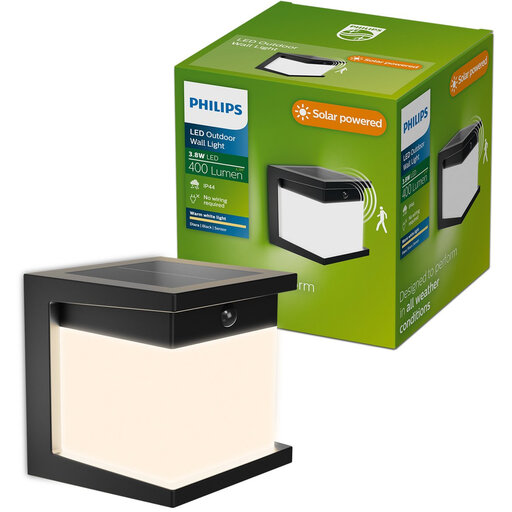
Why it’s a good fit: A compact option for a balcony, garden path or entrance when you’re mainly looking for automatic guidance lighting without wiring.
The product information states 400 lumens and IP44. This makes its intended use clearer: general outdoor lighting rather than a powerful floodlight.
2700K warm white light, two lighting modes, a built-in motion sensor and dimensions of approximately 12 × 11 × 12 cm.

Why it’s a good fit: Suitable for a façade, patio or balcony where warm light and simple operation matter more than illuminating a large area.
The IP44 classification clearly indicates the limits of its use. Install this lamp in a sheltered position and do not expect the performance of an IP65 outdoor light.
400 lumens per light point, 2700K warm white light, two modes and installation without connection to the mains.

Why it’s a good fit: Designed for larger areas such as a driveway, garage, garden or patio where broad, powerful lighting is needed.
The listing states 3000 lumens, IP65 and a detection angle of 180°. You can compare these values directly with your intended use.
302 LEDs, three lighting modes, three adjustable heads and a stated detection distance of 60 feet, equivalent to approximately 18 metres.
Mount the lamp securely on a stable surface and use the supplied mounting materials. Position the solar panel where it will receive the most daylight. Place the motion sensor so that people walk towards the detection area; some sensors respond less effectively when someone approaches them head-on.
After installation, test the different modes and walking routes. Also check after several rainy days that no water has entered the housing. A solar lamp does not incur electricity costs when operating via its battery, but the battery may lose capacity over time and need replacing if this is possible according to the manufacturer.
Browse a current selection of solar-powered outdoor lighting and compare product details such as light output, IP classification and motion sensors.
Yes, but performance may be lower because of shorter days, less direct sunlight and cloudy weather. Position the panel as unobstructed as possible and keep it clean. Choose a mode that does not continuously use full power if the lamp is primarily intended for guidance lighting.
During normal use, the lamp does not draw electricity from the mains. However, you may incur costs for the purchase, mounting and any replacement of the rechargeable battery. Actual operating time varies according to the season, location and operating mode.
No. For a sheltered façade or balcony, IP44 may be sufficient provided the lamp is not exposed to direct water jets. For an open driveway, garden or location exposed to more rain, IP65 may be the more practical choice. Always check the installation instructions and the product’s precise IP classification.
